

















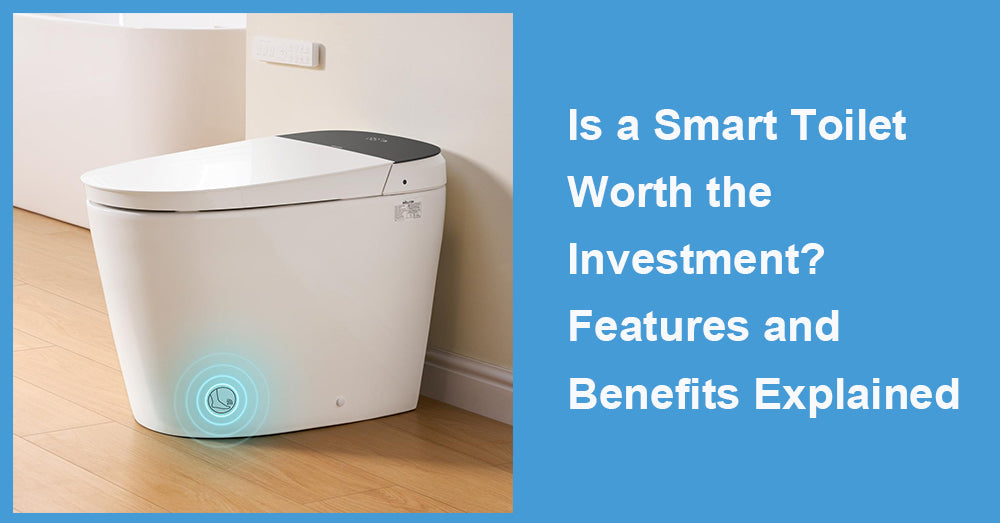
In the trend of bathroom upgrades in recent years, smart toilet have gradually evolved from "novel technology products" to long-term home investments that are carefully evaluated.
Industry data shows that the adoption rate of innovative toilet systems in renovation projects continues to rise, and the driving force behind this change is not only technological advancement itself, but also practical needs related to hygiene, comfort, and long-term efficiency.
So, is the smart toilet worth investing in?
To answer this question, it is necessary to break it down into three levels: functional value, user experience, and long-term returns.
1. The value of smart toilets is not just about "adding a few more functions."
When many people first look at a smart toilet, they are drawn to the extensive list of features: warm-water flushing, seat heating, automatic flushing, deodorization system, night light, drying, etc.
But industry feedback shows that what truly affects long-term satisfaction is not the number of features, but whether these features address the core pain points in traditional toileting experiences.
The most crucial change lies in upgrading cleaning methods.
Warm-water rinsing is gentler and more thorough than dry wiping, particularly in high-frequency use cases.
Long-term users have generally reported a significant reduction in skin irritation and a continuous improvement in overall comfort.
2. The accumulation of comfortable experiences often exceeds expectations
The heating of the seat ring may seem simple in terms of parameters, but it strongly influences the experience during cold seasons.
Industry data shows that this feature consistently ranks among the highest in user satisfaction.
At the same time, the ergonomic design of smart toilets is constantly being optimized.
The standard seat height is concentrated in the 15–16 inch range, which is more in line with natural sitting posture and makes the sitting process more effortless.
For long-term users, this subtle improvement in comfort will continue to be amplified day after day.
3. Systematic improvement of the hygiene environment
In addition to personal experience, smart toilets also improve overall hygiene.
Automatic flushing reduces contact frequency.
The self-cleaning function of the nozzle reduces the risk of cross-contamination.
Some models are also equipped with air purification and deodorization modules, which significantly reduce residual odor time in enclosed bathrooms.
Industry tests have shown that in high-frequency use environments, reducing manual operation can significantly reduce the likelihood of bacteria remaining at contact points.
This is also an important reason why smart toilets are gradually being introduced into high-standard sanitary spaces.
4. Installation and size: realistic factors that must be evaluated before investment
Compared to traditional toilets, smart toilets are slightly larger.
The length of shared integrated smart toilets is typically 26 to 29 inches, while the length of ordinary toilets is usually 24 to 26 inches.
The 2–3 inch difference may directly affect the comfort of passage in compact bathrooms.
Therefore, accurately measuring the space before investment is a key step to avoid inconvenience later.
Meanwhile, smart toilets require power support, and whether the power location and waterproof conditions are reasonable will directly affect installation costs and long-term safety.
5. Long-term cost perspective, more important than initial price
The core reason why many people hesitate about smart toilets is that the initial purchase cost is higher than that of traditional products.
However, from an industry usage data perspective, comparing only the purchase price is insufficient to evaluate its actual investment value.
The warm-water flushing function generally reduces toilet paper use.
The efficient flushing system is more stable in controlling water volume.
At the same time, reducing discomfort caused by cleaning stimuli indirectly lowers related care costs.
Of course, electronic modules imply potential maintenance expenses, which is also an essential reason for choosing mature processes and reliable manufacturing systems.
6. Who is most likely to feel "worth", and who may not feel it clearly
Significant differences are evident in the usage feedback.
High-frequency use of the main bath space significantly increases satisfaction with smart toilets.
In a shared environment with multiple people, the convenience and hygiene advantages are more easily amplified.
In guest baths with lower usage frequency, the improvement in experience is relatively limited.
In other words, the usage scenario determines the strength of the return on investment.
7. Is it better to have more functions? not necessarily
Industry experience has repeatedly proven that stability is far more critical than the number of features.
What truly determines the long-term expertise is whether the water temperature is stable, the nozzle is reliable, and the system is easy to maintain, rather than complex mode switching.
Overly complex control systems can become a maintenance burden over time.
Mature designs often emphasize the reliability of core functions rather than stacking configurations.
8. The "invisible value" of smart toilets
In addition to direct functional benefits, smart toilets also affect spatial quality and users' psychological perceptions of use.
A stronger sense of cleanliness, reduced odor, and more effortless operation together create a more comfortable daily environment.
In industry research, the most common evaluation given by many users after replacement is not "strong sense of technology", but "can't go back".

9. Conclusion: Whether it is worth it depends on whether it matches your lifestyle
A smart toilet is not a must-have upgrade for everyone.
But in suitable spaces and use cases, it can be a highly profitable long-term investment.
When you value the cleaning experience, comfort, and daily convenience, and the space and installation conditions allow, the value brought by smart toilets usually far exceeds the initial price tag.
The real question is never whether it is expensive, but whether it brings continuous improvement to your lifestyle.
When the answer is yes, this investment often becomes one of the least regretful choices.















Leave a comment
This site is protected by hCaptcha and the hCaptcha Privacy Policy and Terms of Service apply.