
















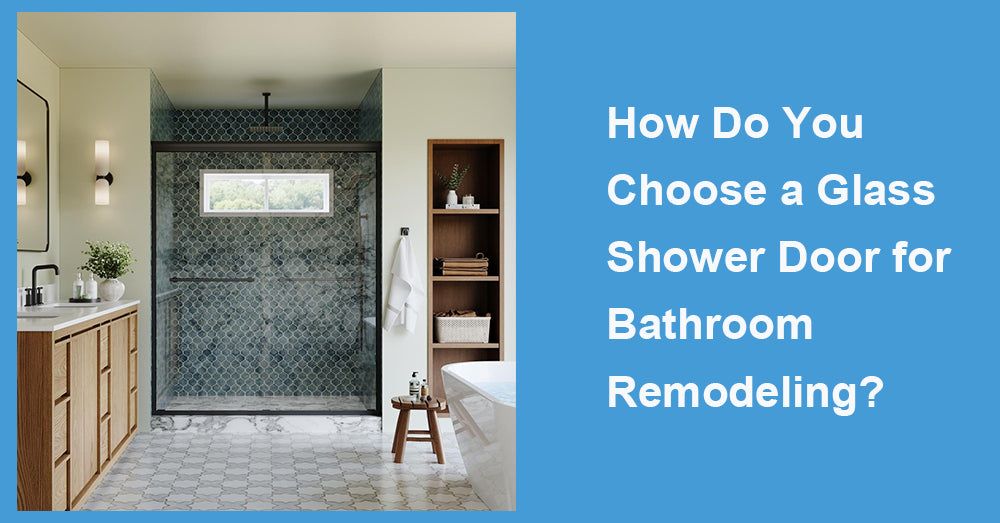
Against the backdrop of the continued rise in the residential renovation market, bathroom upgrades have become one of the most popular renovation projects. According to industry trends, over 80% of homeowners prioritize optimizing shower spaces during renovations, and glass shower door has become a key element in enhancing spatial quality and property value. From traditional shower curtains to modern glass partitions, this decision is gradually evolving into a comprehensive evaluation of design, materials, budget, and construction.
So, when renovating a bathroom, how should consumers choose a suitable glass shower door? The experience of the building materials and home decoration industry shows that the answer is far more than just 'good-looking'.

1. From "Appearance" to "Performance": The Core Classification of Glass Shower Doors
At present, the mainstream glass shower doors in the market are mainly divided into three categories: framed, unframed, and semi-frameless.
1. Frameless glass shower door: the mainstream choice in the high-end market
The frameless design relies on thicker tempered glass (usually 3/8 inch to 1/2 inch) to support its own weight, and is fixed with simple hardware to present a minimalist visual effect. This type of design can significantly enhance the space's transparency, making small bathrooms feel more spacious. In modern minimalist-style and high-end residences, frameless shower doors have become the "standard".
2. Framed glass shower door: a representative of pragmatism
The framed shower door uses a metal frame to support thinner glass (about 3/16 to 1/4 inch), providing structural stability, cost-effectiveness, and stronger sealing to prevent water splashing effectively. For bathrooms with a limited budget or high household usage frequency, these products remain competitive.
3. Semi-frameless design: a compromise solution
In recent years, semi-frameless products have gradually become popular, achieving a balance between visual appeal and cost by reducing borders while retaining some structural support, becoming a growth point in the mid-range market.
2. Four key dimensions: the true logic of consumer decision-making
1. Matching space with design style
Designers generally believe that glass shower doors are primarily "visual tools".
Frameless design can weaken boundaries and make tiles and space the visual focus; Framed design is more suitable for traditional or industrial styles and can enhance the sense of structure.
Research shows that in bathrooms smaller than 80 square feet, frameless design increases space satisfaction by approximately 25%. Therefore, small-sized units or apartment renovations are more inclined to choose frameless products.
2. Budget and Long-term Value
Price differences are among the most realistic considerations for consumers.
Framed shower door: Low price, easy installation
Frameless shower doors: higher cost, usually requiring customization and professional installation
But industry experts point out that frameless products increase the resale value of houses and are seen as an "investment-oriented upgrade".
3. Sealing and waterproof performance
From a functional perspective, the framed structure still has advantages.
Its track-and-sealing-strip design can effectively prevent water overflow, making it especially suitable for open or large shower spaces.
In contrast, although frameless doors also have waterproof capabilities, they require higher installation accuracy. Once the construction is not in place, water seepage problems may occur.
4. Cleaning and maintenance costs
Maintenance difficulty is becoming a growing concern for more and more consumers.
Frameless glass: simple structure, easier to clean, less likely to accumulate dirt and grime
Framed structure: The track and metal frame are prone to water accumulation, which may breed mold or corrosion in the long term
However, the industry also recommends that, regardless of the type, choosing tempered glass with a waterproof coating can significantly reduce cleaning frequency.
3. Safety and Installation: Neglected but Critical Factors
In building regulations, shower doors must use tempered safety glass. Even if this type of glass breaks, it will shatter into blunt-angled particles, reducing the risk of injury.
In addition, the installation quality directly determines the user experience:
Frameless doors are heavier and require higher load-bearing capacity and hardware components for the walls
Installation errors may cause the door to sag or close loosely
Professional installation is almost a must-have option
Industry insiders emphasize that "shower doors are not DIY projects," especially for high-end frameless products.
4. Market Trend: Moving from Functionality to 'Lifestyle.'
In recent years, bathroom renovations have shown a clear trend:
1. "Frameless" acceleration
Frameless shower doors are rapidly replacing traditional products and becoming a mainstream trend due to their modern feel and space-enlargement effect.
2. The demand for customization is on the rise
Consumers tend to customize glass doors based on bathroom size, flow, and style, including irregular designs, curved structures, etc.
3. Intelligent and material upgrades
Waterproof coatings, stain-resistant glass, and more durable hardware are becoming new standards.
5. Industry advice: How to make the best choice?
Based on the experience of the home decoration industry, consumers should follow the following decision-making path when choosing glass shower doors:
Step 1: Clarify the usage scenario
The main bathroom prioritizes experience and design, while the secondary bathroom emphasizes practicality and budget.
Step 2: Evaluate the spatial dimensions
Priority is given to small spaces without frames, while large spaces can be flexibly selected.
Step 3: Balance budget and long-term value
If considering real estate appreciation, frameless has more advantages.
Step 4: Choose a professional installation service
Avoid affecting the service life due to construction issues.
Conclusion
The glass shower door may seem like just a bathroom component, but in the residential renovation industry, it has become an important node that integrates design, engineering, and consumer decision-making. From framed to unframed, from standardization to customization, this segmented market reflects the industry-wide trend of upgrading.
For consumers, the truly rational choice is not 'which one is best', but 'which one is most suitable'. Finding a balance between budget, space, and lifestyle is the key to a successful bathroom renovation.













Leave a comment
This site is protected by hCaptcha and the hCaptcha Privacy Policy and Terms of Service apply.