


















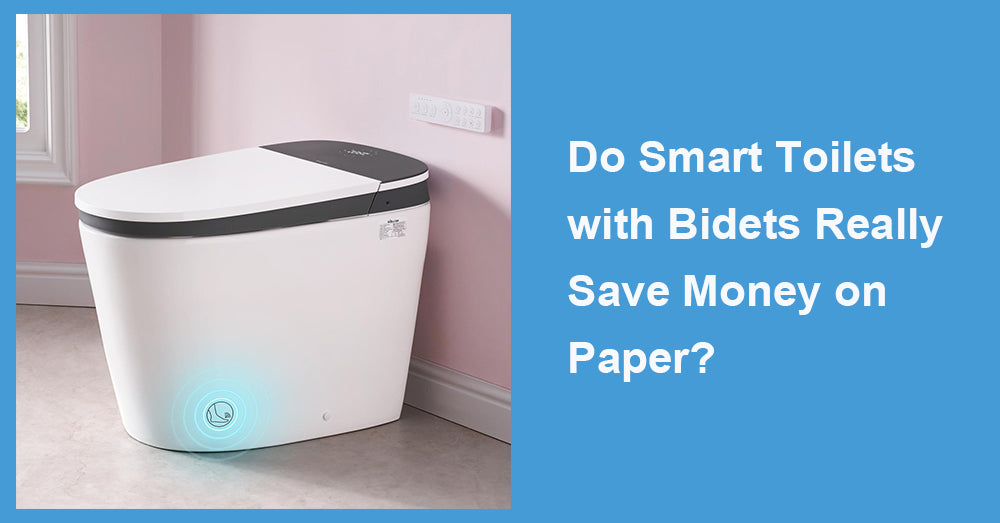
The paper-savings claim around smart toilet with bidet has become almost as common as the feature lists on LED mirrors: “efficient, modern, and it pays for itself.” The truth is more specific. Bidets can noticeably cut toilet paper use, but whether they save money depends on three practical variables: how much paper your household actually burns through, what you pay per roll, and how much your bidet adds in water and electricity.
1. What the “Paper Savings” Claim Is Based On
1. A bidet doesn’t eliminate the need for toilet paper for most people; it reduces it. The typical pattern is: wash with water, then pat dry with a smaller amount of paper.
2. Household paper usage varies wildly. One commonly cited benchmark from a major tissue brand is about 85 rolls per person per year (based on standard roll assumptions).
3. Price is not stable. Consumer Reports has documented shrinkflation patterns (fewer sheets per roll while prices rise), which makes “same household habits” cost more over time.
2. A Straightforward Savings Model (With Realistic Inputs)
To avoid fuzzy math, the cleanest way to estimate savings is to start with annual roll usage and roll cost.
1. Baseline paper spend:
1. If one person uses 85 rolls/year and a household pays $0.70 to $1.10 per roll (common big-box pricing ranges and promo swings), that’s roughly $60 to $94 per person per year in toilet paper.
2. A household of four at that usage can land around 340 rolls/year, or roughly $240-$375 per year, depending on roll price.
2. Reduction with bidet:
3. There isn’t one universal number, but many real-world claims cluster around 50% to 75% less toilet paper after adopting bidet washing (still using some paper for drying). Because the exact percentage depends on personal routine, it’s best to treat this as a range rather than a guarantee.
4. Annual paper savings (range):
1. If a person spends $60 to $94/year and reduces usage by 50%, savings are $30 to $47/year.
2. If the reduction is 75%, savings rise to $45-$70/year.
3. For a household of four, that’s roughly $120 to $280/year in paper savings, depending on paper price and how aggressively paper use drops.
3. The Hidden Offsets: Water and Electricity Costs
Paper savings are only half the equation. Smart toilet bidets add operating costs.
1. Water cost:
2. The water used by a bidet washing is usually small per use, but it is not zero. A commonly referenced estimate is roughly one-eighth of a gallon per use for bidet washing (actual devices and settings vary).
3. To translate gallons into dollars, EPA WaterSense publishes an estimate of average combined water + wastewater rates around $16.83 per 1,000 gallons for residential service (a national-average style benchmark).
1. At 0.125 gallons/use, even 10 uses/day is 1.25 gallons/day, about 456 gallons/year.
2. At $16.83 per 1,000 gallons, that’s roughly $7.70/year in water + wastewater costs.
3. In other words, water cost is usually a rounding error compared to paper spend.
4. Electricity cost (where smart toilets differ from simple bidet attachments):
5. Heated seats, warm-air dryers, instant water heaters, auto-deodorizers, and night lights can add ongoing electricity draw. Some manufacturers publish life cycle assessments showing that, in certain cases, the use phase can be dominated by electricity consumption and replacements over long time horizons.
6. The practical takeaway: a basic non-heated bidet seat typically costs less to run than a full-feature smart toilet with heat and drying, especially when used frequently.

4. So Do They Actually Save Money?
Yes, often they do on toilet paper alone, but “often” isn’t “always.”
1. Best-case scenario for savings:
1. Multi-person household.
2. Higher toilet paper costs or heavy paper usage.
3. Bidet use replaces most wiping (paper dries out mostly).
4. Modest use of power-hungry features (or using an efficient bidet seat rather than a full smart toilet).
2. When savings are smaller (or slow):
1. Single-person household with light paper use.
2. Buying very cheap paper consistently.
3. Heavy reliance on warm-air drying, heated water, and heated seats that run frequently.
4. If the unit requires expensive filters or maintenance parts on a short schedule (varies by model).
3. A realistic payback lens:
4. If a household saves $120 to $280 per year in paper and spends $8 to $30 per year on extra water/electricity (the range depends heavily on how “smart” the toilet is used), net savings might be around $90 to $270/year.
5. That means a $300–$600 bidet seat can pay back faster than a $1,500–$4,000 smart toilet, which may be purchased more for comfort and features than pure payback.
5. Market Signals: Why the Paper Math Is Getting More Interesting
Two trends push the economics in favor of bidets over time.
1. Paper pricing pressure:
2. Consumer Reports has highlighted higher prices and reduced sheet counts in popular products, which effectively raises the cost per use even when the pack price looks familiar.
3. Upstream cost signals:
4. Tissue and sanitary paper products have tracked cost shifts at the producer level, as shown in published producer price indexes for sanitary tissue products. This doesn’t tell you the retail price directly, but it supports the reality that input costs move, and retail prices follow.
6. A Practical Buyer Checklist (If the Goal Is Savings)
If the user story is “save on paper,” not “build a luxury bathroom,” a few choices matter more than brand hype.
1. Drying method matters:
1. If you’re fine with a quick pat-dry, you’ll likely use less paper and less electricity.
2. If you want warm-air drying every time, paper drops further, but electricity use rises.
2. Feature discipline matters:
3. Heated seats and heated water can be great, but don’t pretend they’re free. If you use them constantly, savings from paper can be partially offset.
4. Maintenance costs matter:
5. Filters, deodorizer cartridges, and specialty parts vary. A “cheap per year” device on paper can become expensive if consumables are frequent.
7. Bottom Line
1. Paper savings are real for many households, because a bidet changes the routine from “wipe until clean” to “wash, then dry.”
2. Water cost is typically small compared to paper savings, especially when you use EPA WaterSense rate benchmarks to double-check the math.
3. Electricity and consumables decide whether a smart toilet is a financial win or primarily a comfort upgrade. If your goal is ROI, a well-chosen bidet seat often delivers a faster payback than a feature-heavy smart toilet.














Leave a comment
This site is protected by hCaptcha and the hCaptcha Privacy Policy and Terms of Service apply.