






















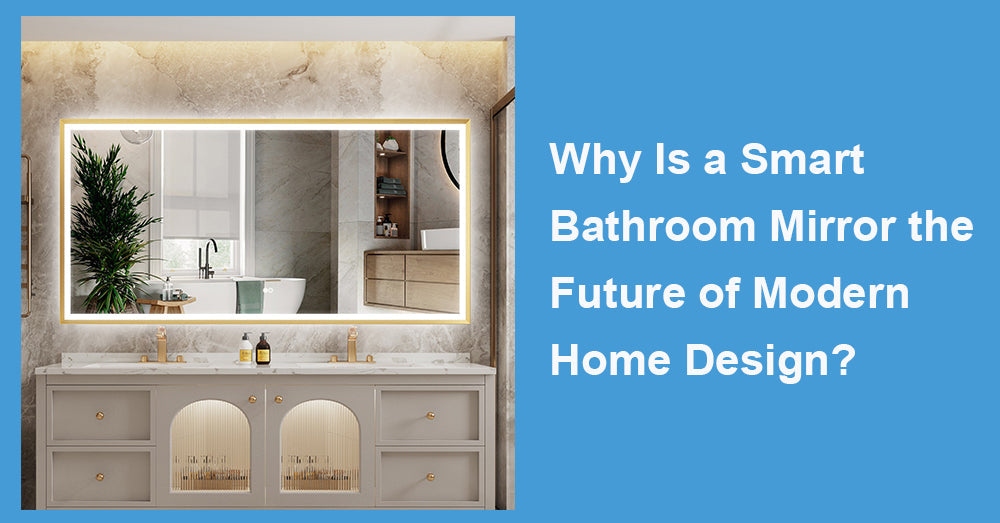
The smart bathroom mirror is quickly becoming more than a stylish upgrade. It now sits at the center of several major shifts in home design: better lighting, wellness-focused bathrooms, energy efficiency, compact storage, and connected daily routines. As bathroom renovation spending remains strong and homeowners look for practical features that improve everyday comfort, the mirror is becoming one of the most valuable places to add technology without taking up extra floor space. Harvard’s Joint Center for Housing Studies reported that home improvement and repair spending is expected to remain above $600 billion through 2025, showing that homeowners are still investing heavily in better living spaces.
Bathroom Design Is Moving Toward Wellness
Bathrooms are no longer treated as purely functional rooms. They are becoming personal care zones where lighting, storage, comfort, and mood all matter. The 2025 Houzz Bathroom Trends Study found that 25% of homeowners use their primary bathroom for rest, while 24% use it for beauty and pampering routines. More than one-third of renovated bathrooms (36%) now include wellness-oriented features, with upgraded lighting leading that category at 30%.
A smart bathroom mirror fits well with this trend because it supports grooming, skincare, shaving, makeup, and nighttime routines in a single fixture. Adjustable color temperature, dimming, anti-fog performance, and memory settings make the bathroom feel more personal. A mirror that can shift from warm 3000K lighting for a relaxing evening bath to bright 6000K lighting for morning grooming is no longer just decorative. It becomes part of the user’s routine.
LED Lighting Makes the Mirror More Efficient
Lighting is one of the strongest reasons smart mirrors are gaining attention. Built-in LED lighting can reduce the need for separate vanity lights, wall sconces, or extra fixtures above the mirror. The Department of Energy states that residential LED products, especially ENERGY STAR-rated options, use at least 75% less energy and last up to 25 times longer than incandescent lighting.
The shift toward LED is already widespread. The Energy Information Administration reported that 90% of households used LED bulbs in 2024, and 37% used LED bulbs for all indoor lighting. For bathroom mirrors, this matters because LED strips can be integrated into slim mirror frames, front-lit panels, backlit edges, or medicine cabinet doors without bulky fixtures. A 24-inch W x 36-inch H mirror can work well above a single vanity, while larger 60-inch W to 72-inch W mirrors can support double vanities with even lighting across both sink areas.
Smart Mirrors Solve Real Bathroom Problems
The strongest smart home products are not the ones with the most complicated features. They are the ones that solve repeated daily problems. In the bathroom, steam, uneven lighting, limited outlets, and poor visibility are common issues. A smart mirror can address these problems through anti-fog heating pads, touch controls, dimming, built-in clocks, USB ports, magnifying mirrors, and motion sensing.
Anti-fog technology is especially useful after hot showers. Instead of wiping the glass and leaving streaks, the user can activate a defogging zone to keep the reflection clear. This is valuable in smaller bathrooms where ventilation may be limited. In a 30-inch W x 36-inch H medicine cabinet, for example, a centrally located anti-fog area can make the mirror more functional without increasing the cabinet footprint.
Connected Home Adoption Supports the Category
Smart bathroom mirrors are also benefiting from broader smart home adoption. Parks Associates reported that about 13 million new internet households entered the smart home market since 2020, expanding the base of households that own a smart home device to 54 million. The same report noted that buyers are moving beyond early adopters and becoming more practical, value-focused users.
That shift is important for bathroom product design. Buyers do not necessarily need a mirror overloaded with complex apps or unnecessary screens. They want features that feel simple: tap to change light color, hold to dim, press once for defogging, or restore the last brightness setting automatically. The future of smart bathroom design will favor intuitive technology that improves the room without making it harder to use.
Space-Saving Design Gives Smart Mirrors an Advantage
A bathroom mirror is already necessary, so adding technology to it is an efficient use of space. This is why LED medicine cabinets and mirrored storage cabinets are becoming more attractive. They combine reflection, lighting, hidden storage, and, sometimes, power access in a single wall-mounted fixture.
For smaller bathrooms, a 20- to 30-inch-wide smart mirror or medicine cabinet can make the space feel cleaner by reducing countertop clutter. For larger primary bathrooms, a 48-inch to 72-inch wide LED mirror can create a hotel-style look while improving task lighting. In both cases, the mirror does not compete with the vanity, shower, or toilet for floor space. It upgrades the room vertically, which is one of the most practical strategies in modern bathroom planning.

Better Lighting Supports Better Grooming
Poor bathroom lighting can distort skin tone, create shadows, and make grooming less accurate. Smart mirrors improve this by placing light closer to face level. Front-lit designs help reduce shadows under the eyes and chin, while backlit designs add a softer wall glow, making the room feel more open.
For product selection, high color rendering is important. A CRI of 90 or higher is a strong selling point because it helps colors appear more natural. Dimmable brightness from 10% to 100% also gives users more control. Bright light is helpful for shaving and makeup, while lower brightness is more comfortable for late-night use. This makes the smart mirror both a task-lighting product and an ambient-lighting product.
Installation Flexibility Will Influence Buying Decisions
As the category grows, installation flexibility will become more important. Buyers often compare plug-in and hardwired options, especially for remodels where electrical planning is already part of the project. A plug-in model may be easier for some updates, while hardwiring can create a cleaner built-in look. For medicine cabinets, surface- and recessed-mount options also matter, as wall depth, stud placement, and existing plumbing can affect installation.
Professional installation remains relevant. Houzz found that 84% of homeowners hire professionals for bathroom renovation projects, indicating that electrical, plumbing, cabinetry, and finish work are often handled by trained tradespeople. For smart mirrors, clear wiring instructions, mounting hardware, safety certifications, and practical dimensions are all part of the purchase decision.
The Future Is Practical, Not Gimmicky
The future of modern home design is not about adding technology everywhere. It is about putting technology where it makes daily life easier. A smart bathroom mirror works because it improves a product people already use every day. It can improve lighting, reduce fog, save wall space, support grooming, and create a cleaner visual style.
As renovation investment, wellness design, LED adoption, and smart home ownership continue to grow, the smart bathroom mirror is positioned to become a standard feature rather than a luxury extra. The best designs will be simple to operate, energy-efficient, moisture-resistant, and sized for real bathrooms, from compact 24-inch vanities to large 72-inch double-sink layouts. In that direction, the smart mirror is not just following the future of bathroom design; it is shaping it. It is helping define it.







































Leave a comment
This site is protected by hCaptcha and the hCaptcha Privacy Policy and Terms of Service apply.