






















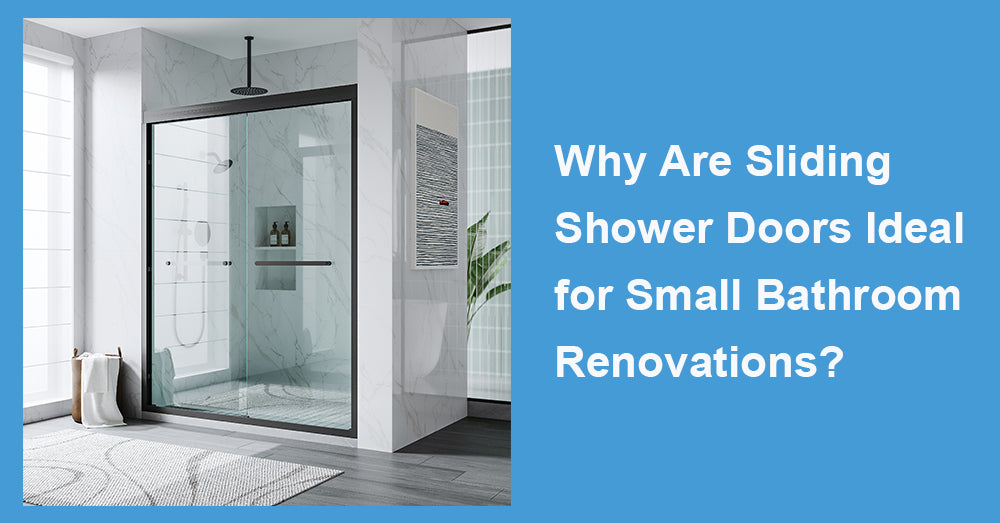
In the current era, where space efficiency is a core issue in bathroom renovations, designers and homeowners increasingly see sliding shower doors as an ideal choice for small bathrooms. Compared with traditional outward-opening or folding shower doors, sliding doors better align with the practical needs of compact spaces in terms of structural logic, flow planning, and visual presentation. From an industry perspective, its popularity is not an aesthetic preference, but a rational result of the combined effects of functionality and spatial conditions.
1. The core contradiction of renovating a small bathroom: insufficient space but greater demand
The typical area of a small bathroom is usually concentrated in the 30-50 square feet range, but its functionality is no less than that of a large bathroom. The distance between the shower area, toilet, and washbasin is often compressed to the limit, and any excess opening radius will directly affect safety and comfort.
Industry research has shown that the opening method of the door in a limited-area bathroom is one of the key factors affecting the efficiency of available space. External shower doors typically require at least 20-24 inches of swing space, which is often difficult to achieve in small bathrooms and can easily conflict with the flow of washbasins or toilets.
2. The essential advantage of the sliding structure: zero opening radius
The most significant structural advantage of sliding shower doors is that they do not occupy additional front and rear opening space. The door slides left and right along a fixed track, almost without changing the original plane layout.
In actual renovation cases, when the shower opening width is 48-60 inches, the sliding door can fully cover the entrance without encroaching on any external space. This is particularly important for small bathrooms with already tight channel widths and significantly reduces the likelihood of having to adjust the position of other bathroom equipment during renovation.
3. Make the flow smoother rather than more crowded
The bathroom user experience largely depends on whether the flow is natural. In a small space, if the door opening direction is not reasonable, it is easy to cause "fighting with each other during use".
The sliding shower door is essentially parallel to the wall or fixed glass panel when closed, creating a clear but not abrupt boundary between the shower area and the dry area. In daily use, whether entering or exiting the shower area, or using the washbasin or toilet at the same time, the flow is smoother.
Industry research shows that feedback on "usability" after the renovation of small bathrooms indicates that satisfaction with the sliding-door solution is significantly higher than with the external-door-opening solution.
4. Visual magnification effect: the "spatial illusion" brought by the glass
In small bathrooms, visual perception is often as crucial as actual size. Sliding shower doors typically use large areas of transparent or low-iron glass, reducing the need for solid borders and door leaf separation.
When the width of the shower area is between 36 and 48 inches, the visual extension formed by a continuous piece of glass can effectively weaken the sense of oppression in the space. In contrast, multiple folding doors or door-opening structures with heavy borders are easier to cut space and make the bathroom visually appear smaller.
5. A more "friendly" installation logic for renovation conditions
From a construction perspective, sliding shower doors have greater tolerance for spatial constraints. It usually only requires top or top+bottom track support, with relatively concentrated load-bearing requirements for the side walls.
In the renovation of old bathrooms, standard shower opening sizes are mainly 48 or 60 inches. The finished product level of the sliding door system is high within this size range, with sufficient adjustment margins, which can reduce the cost and construction risk associated with non-standard customization.
6. Balance between safety and stability
In a small bathroom, safety cannot be ignored either. External doors are more prone to accidental collisions or rebounds in wet, slippery environments, whereas the track always controls the sliding door's movement.
The mainstream sliding door system usually adopts a double-roller or multi-roller structure, combined with tempered glass, to maintain smooth operation while ensuring the door body's weight. Industry test data show that a well-designed sliding door system exhibits more balanced structural stability and track-life performance over the long term.
7. Cleaning and maintenance: not more complicated than imagined
Many people's concerns about sliding doors are focused on track cleaning. But from the perspective of product design, this issue has been significantly improved in recent years.
Modern sliding shower doors commonly use simplified track structures to reduce dead corners caused by water accumulation. Some systems also support quick disassembly or no-disassembly designs, which facilitate daily cleaning. For small bathrooms, this "simplified structure" design is actually easier to maintain than multiple door hinges.
8. High style adaptability, easier to integrate into modern design
In terms of style, the sliding shower door offers greater adaptability. Whether minimalist, modern, industrial, or transitional, sliding doors can be paired with different profile colors and glass treatments.
In small bathrooms, the goal of design is often not to "pile up elements" but to create a space that looks unified, clean, and orderly. The low visual presence of sliding doors perfectly aligns with this design logic.

9. Conclusion: Why has it become the preferred solution for renovating small bathrooms
From the perspective of comprehensive space efficiency, reasonable flow line, visual effect, and construction controllability, sliding shower doors are not a "good-looking" choice, but a structural optimization made for the practical conditions of small bathrooms.
When the bathroom area is limited, renovation budget, and construction complexity need to be strictly controlled, the value of sliding shower doors goes far beyond saving a few inches of space; it significantly improves the user experience and space quality without changing the overall layout. This is precisely the fundamental reason why it continues to be favored in the renovation of small bathrooms.









































Leave a comment
This site is protected by hCaptcha and the hCaptcha Privacy Policy and Terms of Service apply.