






















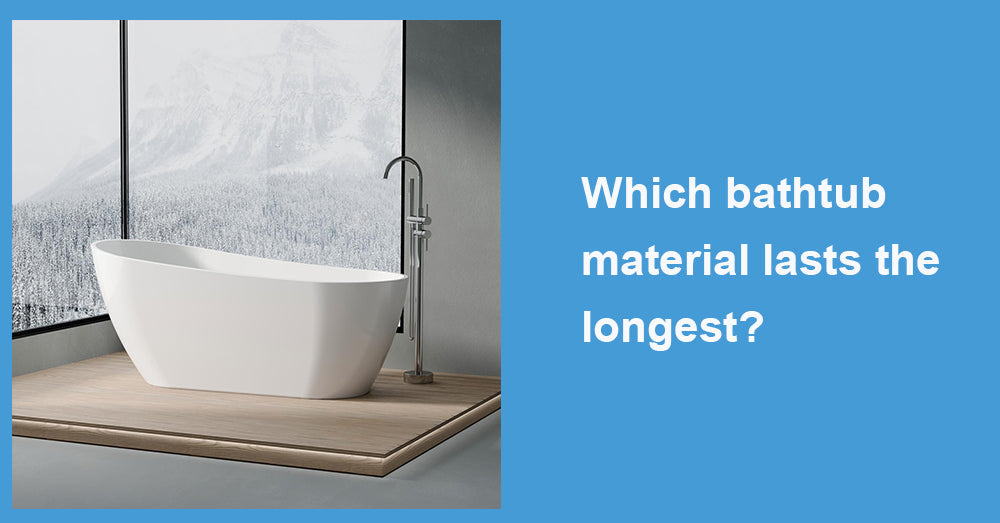
In a bathroom renovation, the bathtub is often a large item that is "installed but no longer needs to be moved": it is difficult to disassemble, can affect waterproofing, and can affect the entire body. So, "which material is the most durable" is not just a matter of selection, but more like a long-term asset allocation. Industry surveys and engineering maintenance data generally show that three factors usually determine the actual lifespan of a bathtub: the structural strength of the material body, the wear and chemical resistance of the surface layer, and whether the installation support is in place. Even if the appearance is similar, different materials may have completely different states in 10 or 20 years.
1. First, let's conclude: whose "upper limit of lifespan" is the highest?
If we only look at the "theoretical useful life" and structural stability, the recognized first tier is usually cast-iron enamel bathtubs. Many building maintenance and home decoration statistics estimate the service life of cast iron bathtubs at 25-50 years. In many cases of old house renovation, the cast iron body is still intact, and what really needs to be addressed is the local collapse points in the surface glaze layer or hardware aging. The second tier is more commonly composed of quartz composite/artificial stone (usually more stable for over 20 years), followed by high-quality acrylic (often with a 10-20 year span), and steel enamel (usually 15-20 years but more dependent on surface integrity).
It should be emphasized here that the so-called "longest" does not mean "most suitable for everyone". The durability of materials is also significantly affected by load-bearing conditions, insulation requirements, and maintenance habits.
2. Cast iron enamel: the most stable structure and the highest upper limit of service life
The core advantages of cast iron bathtubs are "thickness, weight, and high density". Standard household models range in length from 60 to 72 inches and often weigh up to 300 pounds. High self-weight brings two results:
Strong deformation resistance: Long-term load-bearing, cold and hot impact, and edge stress are not easy to cause deformation of the barrel body;
Strong stability: It is unlikely to encounter problems such as "softening when stepped on" or "sinking at the bottom".
Its shortcomings are also very practical: higher requirements for floor load-bearing, handling, and installation. Once complex objects shatter the glaze layer, the cost of later repair is higher. In other words, the durability of cast iron belongs to the category of "able to withstand time, but afraid of extreme point damage".
3. Quartz composite/artificial stone: wear-resistant, homogeneous surface, long-term more "dignified."
Quartz composite and artificial stone bathtubs are usually thick, with a touch closer to "stone," and their surfaces are often made of homogeneous materials rather than a thin coating. Many engineering end-of-life assessments consider these materials as "high-end longevity options" because:
Surface scratches are less likely to form "peeling boundaries", making the overall appearance more durable.
The structure has high rigidity, and long dimensions (such as 67 inches or 71 inches) are less likely to generate stress cracks due to insufficient support.
The drawback is that the weight is still not light, and transportation and installation costs are higher; at the same time, there are stricter requirements for the levelness and force distribution at the grassroots level. Its durability is more like "long-term stability, slow aging", especially suitable for projects that pursue texture and long-term preservation.
4. Acrylic: the most widely used, but with the most significant difference in lifespan (key to consider "reinforcement and support")
The standard length of acrylic bathtubs is also between 60 and 72 inches, with the advantages of being lightweight, offering high design flexibility, and providing better insulation. The problem is that acrylic is not necessarily durable after purchase, and its lifespan is greatly affected by differences in craftsmanship. Common watershed points in industry maintenance experience include:
The thickness of the barrel and the fiberglass reinforcement layer: thin walls and insufficient reinforcement make it more likely that the bottom will become soft after a few years.
Bottom support structure: Whether there is continuous bottom support and whether the force points are uniform often determine whether it can cross the 10-year mark stably.
Daily cleaning method: Long-term use of vigorous grinding for cleaning will accelerate surface gloss loss and the formation of fine lines.
Therefore, acrylic is better understood as "durable, but with the right specifications and structure". When balancing budget and experience, high-quality acrylic is a very realistic choice.
5. Steel enamel: the structure is good, but the lifespan is highly dependent on the surface integrity
The idea of steel enamel is "a thin steel plate forming + an enamel surface". It is often more rigid and more structurally stable than acrylic, but the key to durability is that the glaze cannot be broken. Once the glaze is chipped, it is more prone to rusting and spreading, and maintenance costs will rapidly increase. In many cases, it is not "used soon", but "once injured, it is difficult to age gracefully".
6. It's not just the material that truly determines how long a bathtub can last
Even if the material with the most extended lifespan is chosen, installation and use can shorten it. Common key points on the engineering side include:
Grassroots level error: Long bathtubs (>60 inches) are more sensitive to level, and long-term uneven stress can easily induce stress cracks.
Quality of drainage and overflow components: Water leakage is not a material issue, but it is the most fatal.
Cleaning chemicals: Strong acids, strong alkalis, and grinding powders can accelerate surface aging.
Risk of "point impact": Especially on enamel surfaces, dropping complex objects may cause irreversible damage.

7. Conclusion: if you only want to choose "most durable", the answer is usually cast iron
Conclusion: If you only want to choose "most durable", the answer is usually cast iron; But a better question is "What kind of long-term stability do I need?"
Title: Which bathtub material lasts the longest?
Starting from the upper limit of lifespan and structural stability, cast iron enamel bathtubs are usually the most "durable" option; If you pursue long-term texture and wear resistance, quartz composite/artificial stone is very worth considering; To strike a balance between budget, comfort, and accessibility, high-quality and reinforced acrylic is often the most practical choice.
A truly durable bathtub is not just about "selecting the right materials", but also about "selecting the right structure, installing it correctly, and maintaining it properly". As long as these three things do not fall apart, your bathtub is likely to last longer than the next renovation cycle.








































Leave a comment
This site is protected by hCaptcha and the hCaptcha Privacy Policy and Terms of Service apply.