






















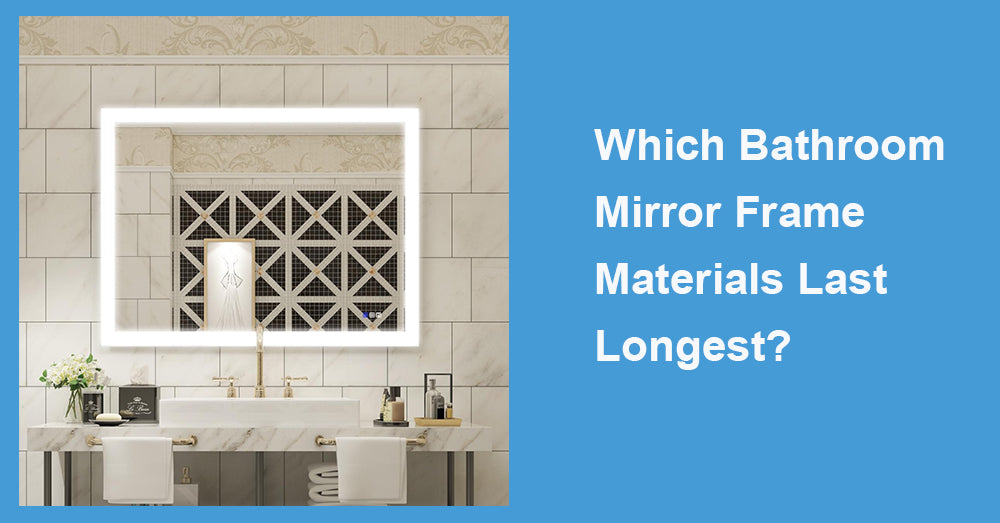
A bathroom mirror frame lives in a tough microclimate. Steam spikes humidity, splashes add standing water at corners, and common cleaners bring chemicals into contact with finishes. Over time, most “failures” are not dramatic breaks. They show up as pitting, rust bleed, bubbling paint, peeling foil, swollen joints, or a dull, patchy finish. If you want a frame that still looks sharp after years of daily use, the winning materials are the ones that resist corrosion, tolerate moisture cycling, and keep their finish intact with normal cleaning habits.
Below is a practical durability ranking, plus the “why” behind each material, so you can buy based on performance, not marketing.
1. What “Longest-Lasting” Means in a Bathroom
A frame can be structurally fine yet visually ruined. In bathrooms, durability usually comes down to three issues:
1. Corrosion and pitting on metal, especially where water or cleaner residue sits in crevices.
2. Finish breakdown, such as blistering, peeling, or discoloration from moisture and cleaning chemicals.
3. Moisture movement in wood-based frames, which can cause swelling, joint gaps, or warping when humidity changes.
Wood science summarizes an important truth: wood gains and loses moisture as relative humidity changes, and coatings slow that movement but do not stop it. (Source: USDA Forest Products Laboratory, Wood Handbook, moisture relations chapter.) That one principle explains why “wood look” frames range from excellent to disappointing depending on construction quality.
2. Stainless Steel: Top-Tier Durability When the Grade Is Right
Stainless steel is often the longest-lasting frame material because it forms a protective passive layer that slows corrosion. The key detail is the grade.
· 316 stainless is generally more resistant to pitting and crevice corrosion than 304 stainless, largely because 316 contains molybdenum, commonly around 2%–3%. (Source: stainless grade composition summaries from materials references commonly used in manufacturing and fixture specifications.) That extra resistance matters in bathrooms with heavy daily steam, frequent cleaning, or coastal air.
How stainless fails: It usually does not “rust evenly.” Instead, it can pit in tiny points where salts or cleaner residue sit. Avoid abrasive pads and harsh chemicals that can damage the passive layer. Choose smooth profiles with fewer water-trapping ledges.
Best for: long-term ownership, high-humidity bathrooms, and modern or minimalist designs.
3. Anodized Aluminum: Lightweight, Stable, and Highly Corrosion-Resistant
Aluminum naturally forms an oxide layer, and anodizing strengthens and stabilizes that surface. Anodizing is widely used to improve corrosion resistance and wear resistance. (Source: anodizing corrosion-resistance studies in surface engineering literature.)
In mirror frames, anodized aluminum performs well because it does not rust, it does not swell, and it stays dimensionally stable. It is also lighter than steel, which reduces stress on mounting hardware for large mirrors.
How anodized aluminum fails: Lower-quality anodizing can scratch or show edge wear, and some finishes can discolor with aggressive cleaning. Use gentle cleaners and soft cloths.
Best for: humid bathrooms, large mirrors, and slim frame profiles where weight matters.
4. Powder-Coated Metal: Durable if the Prep and Coating System Are Real
Powder-coated frames can last a long time, but the durability depends on surface prep and coating thickness. Powder-coating performance is often discussed alongside salt spray testing. ASTM B117 is the standard practice for operating salt spray apparatus. (Source: ASTM B117 standard references used across coating industries.) While salt spray results do not translate perfectly into “years in a bathroom,” they are useful for comparing coating systems.
Some industry guides describe salt spray durations from tens of hours for basic coatings to hundreds or even 1,000+ hours for more robust protective systems. (Source: coating test method explainers and manufacturing QA references that summarize typical salt spray benchmarks.)
How powder coat fails: Chipping at corners or edges exposes base metal. On steel, that can trigger rust beneath the coating. Aluminum under powder coat is generally more forgiving.
Best for: a wide range of styles and colors, with good value when the manufacturer provides real performance data.
5. Brass and Bronze: Long Service Life, With a Patina Trade-Off
Brass and bronze are copper alloys, so they do not rust like steel. Instead, they tend to age by darkening or developing patina. In bathrooms, that can be a durability advantage: the metal remains stable even as the appearance evolves.
The trade-off: Some people love a “living finish,” while others read patina as wear. If you want a stable look, choose sealed, lacquered, or well-plated finishes and clean gently to avoid stripping protective layers.
Best for: classic, transitional, or luxury bathrooms where warmth and long-term stability matter.
6. Solid Wood: Can Last for Years, but Only With the Right Build and Finish
Solid wood frames can be durable, but wood responds to humidity cycles. The Wood Handbook notes coatings can slow moisture changes but cannot prevent them. (Source: USDA Forest Products Laboratory, Wood Handbook.) That means durability depends on construction quality:
· Fully sealed surfaces, including edges and joints
· Stable joinery that tolerates movement
· Finishes designed for humid environments
How wood fails: swelling at joints, finish cracking, and edge lifting where moisture enters. Poor ventilation accelerates these issues.
Best for: well-ventilated bathrooms, owners who wipe splashes quickly, and frames made with sealed construction, not decorative “raw wood” finishes.
7. MDF and Veneered Composites: Most Common Weak Link Near Moisture
Many budget frames use MDF under paint, foil, or veneer. MDF is flat and easy to machine, but it is vulnerable when moisture reaches unsealed edges. Research on MDF swelling shows deformation behavior under water exposure at the material level. (Source: MDF swelling studies in building materials literature.)
How MDF fails: edge swelling, bubbling finishes, corner damage, and joint separation—often starting where a towel frequently brushes the frame or where splashes collect.
Best for: powder rooms or low-splash areas, especially if the frame is well-sealed and ventilation is strong.
8. Practical Durability Ranking
If long life in real bathroom conditions is the priority, a practical ranking looks like this:
Top tier (best longevity):
· 316 stainless steel
· High-quality anodized aluminum
· Well-finished brass or bronze
Strong performers (good longevity with quality control):
· 304 stainless steel
· Powder-coated aluminum or steel with verified coating performance
Conditional (can last, but depends heavily on build and ventilation):
· Solid wood with full sealing and good joinery
Higher risk in humid, splash-prone bathrooms:
· MDF or composite frames, especially with unsealed edges or thin decorative films

Conclusion
The longest-lasting bathroom mirror frame materials are the ones that resist corrosion and handle moisture cycling without changing shape: 316 stainless steel, anodized aluminum, and quality brass or bronze. Powder-coated metal can also last very well when the coating system is proven and edges are protected. Solid wood can be excellent with proper sealing and ventilation, while MDF-based frames are the most likely to show early swelling or finish damage near splashes. Choose the material based on how your bathroom actually behaves—steam level, cleaning habits, and ventilation—and your frame will look good far longer than trend-based choices.







































Leave a comment
This site is protected by hCaptcha and the hCaptcha Privacy Policy and Terms of Service apply.