






















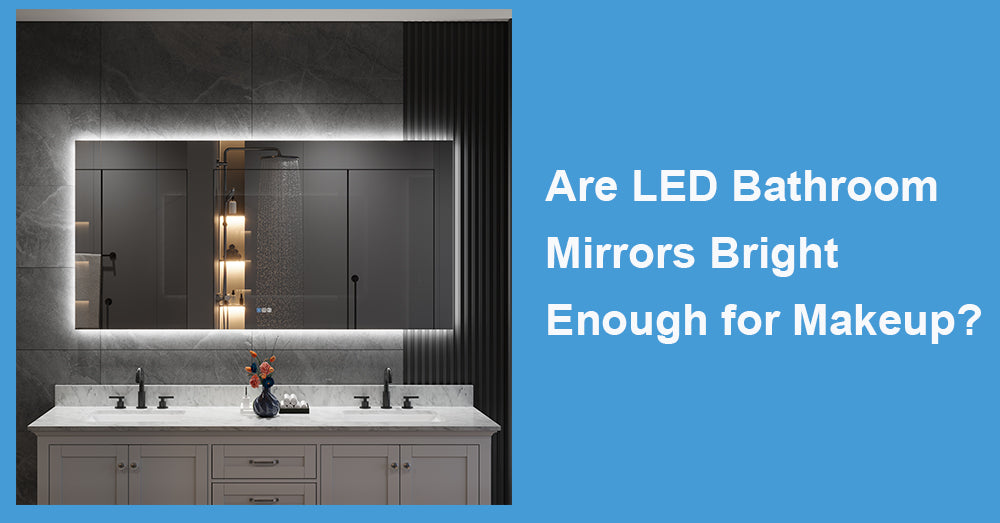
A good LED bathroom mirror can be bright enough for makeup, but only when it delivers the right kind of light to your face. Many mirrors look bright because they glow, yet still leave shadows under the eyes or make foundation look “right” in the bathroom and wrong in daylight. The difference is not hype or price alone. It comes down to measurable factors: how much light reaches your face, how evenly it is distributed, and how accurately it renders color.
What “Bright Enough” Means for Makeup
Makeup lighting is task lighting. The goal is clear, comfortable illumination at face level, not just a bright room. Lighting guidance commonly discusses bathroom illumination in a broad range that can reach roughly 20–50 foot-candles, depending on tasks and design choices. For makeup, you typically want lighting that feels closer to the higher end of “comfortable and even,” while avoiding glare and harsh hotspots.
Brightness alone is not the full answer. Two mirrors with similar “brightness” claims can perform very differently. A mirror that pushes light forward and wraps the face evenly will feel more usable than a mirror that creates a dramatic halo but sends most light onto the wall.
Why Some LED Mirrors Feel Dim Even When They Look Bright
1) Backlit-only designs
Backlit mirrors shine behind the glass and create a glow on the wall. This looks premium and adds ambiance, but a significant portion of the light is not directed toward your face. If you rely on the mirror as your main makeup light, backlit-only designs can feel insufficient.
2) Narrow LED placement or weak diffusion
Some mirrors use a thin strip of LEDs or minimal diffusion. You see a bright outline, but face illumination stays uneven. That unevenness is what causes shadows under the nose and chin and makes blending harder.
3) The mirror is trying to replace all vanity lighting
If the ceiling fixture is weak and there are no sconces, the mirror becomes the only true task light. Many LED mirrors are designed to complement a lighting plan, not replace it completely.
The Specs That Matter Most for Makeup
A) Light direction and distribution
For makeup, you want meaningful forward-facing illumination. Product listings may use terms like “front-lit,” “edge-lit,” or “backlit.” What matters is whether the mirror provides even light across the face from a normal standing distance.
A quick visual clue: if the mirror’s light mainly appears as a halo on the wall, it is likely doing more ambience than task lighting. If the light visibly fills the area in front of the mirror and reduces facial shadows, it is more makeup-friendly.
B) CRI (Color Rendering Index) — aim for 90+
Color accuracy is critical for shade matching. Many lighting guides recommend CRI 90 or higher for makeup so skin tone and cosmetics appear more natural and consistent across environments. If a mirror does not publish CRI, consider that a caution sign for makeup use.
If you want to go one level deeper, look for information about strong red rendering (often called R9). Some lighting education sources explain that two products can have similar CRI, yet differ in red rendering, which affects how healthy and natural skin looks.
C) Color temperature (CCT) — neutral white is usually easiest
Color temperature affects how warm or cool your makeup appears. Many makeup-lighting recommendations cluster around neutral white, often roughly 3000K–4000K. Warm light can make makeup look more golden; cool light can make it look more pale or gray. Neither is “wrong,” but extremes can distort judgment.
The most practical feature is tunable white (adjustable CCT). It lets you check your makeup under a warmer evening look and a more neutral daytime look without changing fixtures.
D) Dimming and diffusion — comfort matters
Dimming helps you adapt to time of day and natural light. Diffusion helps avoid harsh hotspots that exaggerate texture and create glare. For makeup, “bright and soft” beats “bright and sharp.”
A Simple At-Home Test: Is Your LED Mirror Enough?
You can evaluate a mirror quickly without special equipment.
1) Shadow test
Stand at your normal distance. Look for dark shadows under the eyes, nose, and chin. If shadows are strong, your light is either too overhead, too directional, or not evenly distributed. That usually means you need better face-level lighting (often sconces), not just more brightness.
2) Color test
Apply a small amount of foundation or concealer, then check it in three conditions:
· Under the mirror lighting
· Near a window in daylight
· Under another indoor light (for example, a bedroom lamp)
If the shade looks dramatically different, your mirror likely has weak color rendering, an extreme color temperature, or both.
3) Comfort test
If you squint, see glare, or feel “washed out,” the light may be intense but poorly diffused. Makeup application becomes harder when the lighting is uncomfortable.
Optional tip: If you have a smartphone, you can use a basic lux meter app to compare setups consistently (treat it as relative guidance, not lab precision). What you want is a noticeable improvement in face-level brightness and uniformity when the mirror is on.
When an LED Mirror Alone Is Usually Enough
An LED mirror can be sufficient for makeup when:
· It provides forward, face-level illumination (not only a wall halo)
· It publishes CRI 90+ (and preferably strong red rendering information)
· It offers dimming and, ideally, tunable white
· The bathroom has decent ambient light so the mirror is not doing all the work
In this situation, a quality LED mirror can be a reliable daily makeup station, especially for routine looks.
When You Should Add Sconces or a Vanity Light
Add lighting if:
· The mirror is mainly backlit and your face still looks dim
· You see strong facial shadows while grooming
· Your bathroom has dark finishes that absorb light
· Two people use the vanity at the same time and lighting becomes uneven
Sconces at about face height are effective because they reduce shadows and illuminate both sides of the face evenly. Even if you keep the LED mirror for style and convenience, sconces often provide the “makeup-grade” improvement that people notice immediately.
Efficiency Is a Bonus (Not the Main Reason)
LED lighting is also efficient, and reputable efficiency programs note that LEDs can deliver similar light output with far less energy than older incandescent technologies. Efficiency is not what makes a mirror good for makeup, but it is a practical benefit for a product used daily.

Bottom Line
Yes, LED bathroom mirrors can be bright enough for makeup. The mirrors that succeed are the ones that deliver even, forward-facing light, publish CRI 90+ for accurate color, offer a neutral white range (ideally adjustable), and include dimming with good diffusion. If your mirror is mainly backlit or your bathroom lighting is weak, add sconces or a dedicated vanity light to eliminate shadows and make color decisions more reliable.







































Leave a comment
This site is protected by hCaptcha and the hCaptcha Privacy Policy and Terms of Service apply.