






















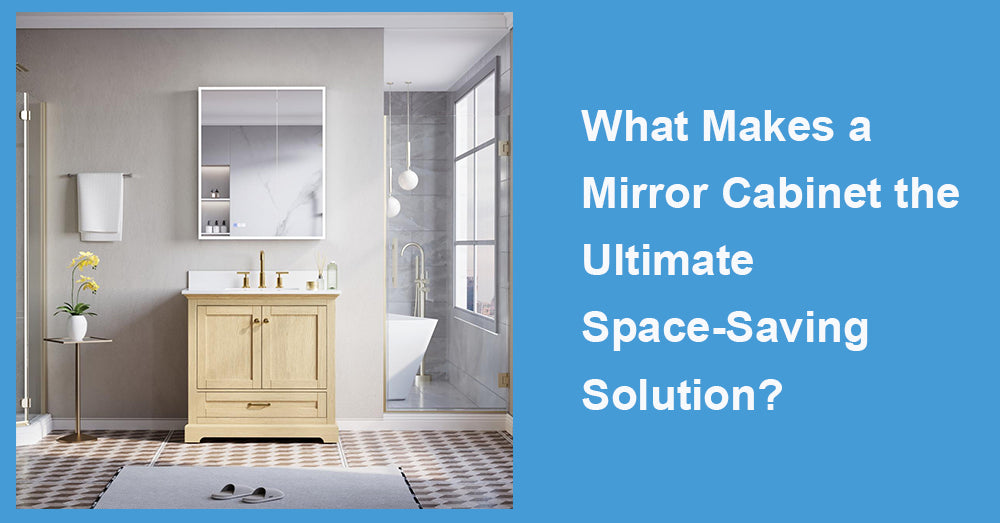
The modern mirror cabinet is having a quiet moment in bathroom design, and it is not driven by novelty. It is driven by math: homes are expensive, bathrooms rarely get bigger, and daily routines keep adding more products to the store. In 2024, the median price of new single-family homes sold was $420,300, and the median size was 2,210 square feet, based on Survey of Construction data (source: U.S. Census Bureau). When every room must earn its footprint, a fixture that combines reflection and storage without adding floor bulk becomes an easy upgrade to justify.
1. It Uses the One Surface Bathrooms Always Have: The Wall
Most bathrooms have limited “free” real estate. Floors are interrupted by toilets, vanities, and doors. Countertops get crowded fast. Walls, however, provide a vertical zone that can be converted into storage without altering the room's footprint. A mirror cabinet takes advantage of that zone by placing shelves directly behind the mirror, keeping essentials within arm’s reach while staying visually quiet.
This design approach also aligns with current bath planning priorities. The NKBA’s 2025 Bath Trends Report highlights “ample, elegant storage within arm’s reach” as a key direction in bath spaces (source: NKBA). A mirror cabinet delivers exactly that, while still doing the primary job a mirror must do.
2. It Reduces Counter Clutter, Which Immediately “Adds Space.”
Space-saving is not only about square footage. It is also about what the eye reads. A vanity top filled with bottles, toothbrush holders, and grooming tools makes the room feel smaller, even if the layout never changed. A mirror cabinet removes dozens of small items from view and stores them at a natural reach height.
That need is showing up in renovation behavior. In the 2024 Houzz Bathroom Trends Study, “old bathroom lacked sufficient storage” was one of the triggers for bathroom renovations, ranking 12% in 2024. When storage is missing, homeowners often compensate by leaving items out. A mirror cabinet solves the root cause rather than managing the symptom.
3. It Fits How Bathrooms Are Actually Sized Today
Even when people renovate, bathrooms often stay modest in size. Houzz reports that 79% of renovating homeowners do not change the size of the bathroom, and more than half (55%) of renovated bathrooms end up under 100 square feet (source: Houzz). In spaces like that, a separate tower cabinet or extra shelving can feel intrusive, while a mirror cabinet adds storage without tightening walkways.
This is why mirror cabinets perform well in both a 5-foot-wide guest bath and a larger primary suite. A 24-inch or 30-inch mirror cabinet can make a small vanity wall functional, while a 36-inch, 48-inch, or wider model can support shared storage and reduce morning bottlenecks. The key is that the storage is built into an element that the wall already needs.
4. It Consolidates Multiple Functions Into One Product
Space-saving is also about reducing the number of separate items required to complete a routine. A basic flat mirror may still need side shelving, countertop organizers, and sometimes additional lighting to be truly usable. Many mirror cabinets now combine storage with lighting and convenience features, such as integrated LEDs, dimming, color temperature changes, and anti-fog options.
This “one product replaces three” effect is especially useful in tighter layouts where extra wall sconces may be difficult to install, or where the vanity countertop must stay clear for accessibility. The cabinet does not just store items; it organizes the entire grooming workflow into a single vertical zone.
5. It Supports the Shift Toward Function-First Remodeling
Mirror cabinets fit that “daily payoff” logic. They improve organization, cut countertop mess, and reduce the time spent hunting for small items. For many households, that is the kind of improvement that feels bigger than a decorative refresh.

6. It Scales With Homes That Have More Bathrooms
Homes are also being built with more full bathrooms, which increases the need for compact, repeatable storage solutions across multiple rooms. NAHB, citing Survey of Construction data, reports that 64.7% of new single-family homes started in 2023 had two full bathrooms, and 23.8% had three full bathrooms (source: NAHB). More bathrooms mean more sink zones, more daily products, and more opportunities for clutter to show up.
A mirror cabinet serves as a standardized storage solution that can be used in a primary bath, a secondary bath, and even a powder room, without forcing each space to add bulky furniture. That is why builders and designers increasingly treat it as a practical default rather than an optional upgrade.
7. It Offers Two Installation Paths for Different Constraints
Mirror cabinets also win because they adapt to different construction realities. Recessed models sit partially inside the wall cavity, reducing depth and creating a more built-in look. Surface-mount models are easier to install and work well when studs, plumbing vents, or wiring limit recessing.
From a space-saving perspective, both can be effective. The best choice depends on what the wall can accommodate and how tight the bathroom circulation is. In a narrow bath where the door swing and walkway are tight, a shallower profile can make a difference. In a remodel where speed and simplicity are priorities, surface-mount can deliver storage benefits immediately.
8. Why It Keeps Rising as the “Smart” Storage Upgrade
The mirror cabinet’s popularity is not a trend based on decoration. It is a response to how people live: more products, busy mornings, limited counter space, and bathrooms that rarely expand. With new-home pricing pressure and renovation budgets climbing, buyers are looking for upgrades that return value every single day.
A mirror cabinet earns the “ultimate space-saving solution” label because it makes the bathroom feel larger without asking for more square footage. It uses the wall, hides clutter, improves usability, and often upgrades lighting in the same move. In a room where inches matter and visual calm matters even more, that combination is hard to beat.









































Leave a comment
This site is protected by hCaptcha and the hCaptcha Privacy Policy and Terms of Service apply.