






















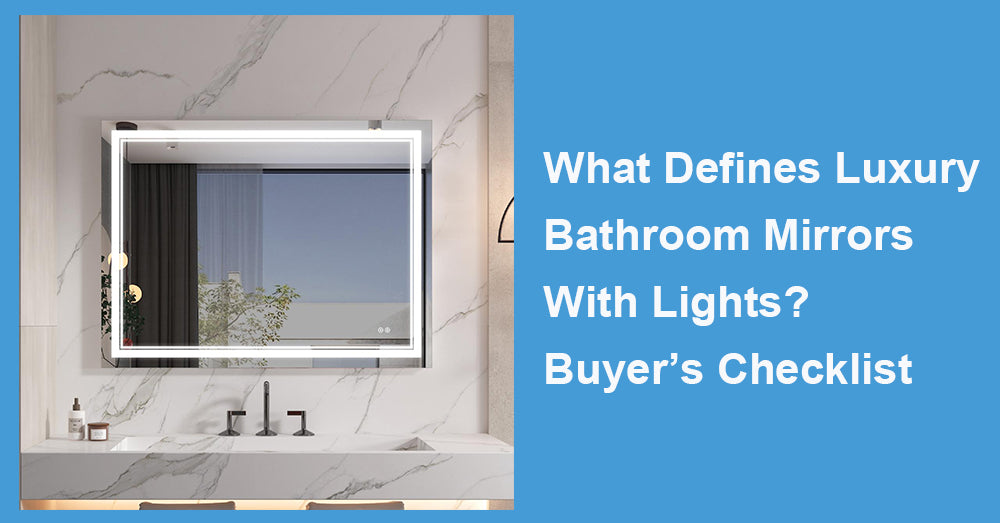
Luxury bathroom mirrors with lights are no longer just a “high-end hotel” detail. They’ve moved into mainstream remodels, driven by homeowners who want better grooming light, a cleaner wall look, and extra features that feel like a daily upgrade. Houzz’s 2024 Bathroom Trends Study found that LED lighting is the most popular upgraded mirror feature (21%), followed closely by anti-fog systems.
That demand has also raised the bar. Buyers are asking a simple question: What actually makes a lighted mirror “luxury,” and what is just marketing? In today’s market, “luxury” comes down to four things: better lighting, better build quality, better safety certifications, and a better user experience.
Below is a practical, plain-English checklist in the style many designers and contractors use when specifying premium mirrors.
1) The light is the product, not the accessory
A true luxury lighted mirror is designed to solve a real bathroom problem: shadows on the face. That’s why lighting position matters more than flashy features.
The NKBA’s planning guidance recommends vanity task lighting that’s beside the mirror and at eye level, which helps reduce harsh shadows and glare. A well-lit mirror aims to deliver the same “even face light” effect, either through front lighting, side lighting, or a hybrid front + back system.
Buyer checks
· Even illumination: Your face should look evenly lit, not bright in the middle and dark on the sides.
· Dimming: Bright for shaving and makeup, softer for night use.
· Color options: Adjustable color temperature (warm/neutral/cool) is common in better models, because “one color” does not fit every bathroom.
2) “Luxury” means clean light quality, not just brightness
Many listings emphasize lumens, but luxury is also about how the light renders skin tones and how comfortable it feels. A mirror can be bright and still look harsh or flat.
Buyer checks
· High color accuracy (CRI): Higher CRI usually looks more natural for skin and makeup.
· No visible hot spots: You shouldn’t see dots or stripes of LEDs through the glass.
· No flicker: Flicker can cause eye fatigue and look cheap on video calls.
(If a product page doesn’t state basics like CRI, driver type, or light output, treat that as a quality red flag.)
3) Moisture safety is non-negotiable: look for damp-location suitability
Bathrooms are humid environments. A luxury mirror is built and labeled for it.
The language you want to see is that the mirror (as a luminaire/fixture) is suitable for damp locations (or, when appropriate, wet locations). Damp locations are generally areas subject to moisture and condensation rather than direct water spray.
Buyer checks
· Damp-location rating: Good for typical vanity zones with humidity and condensation.
· Wet-location rating: Consider this if the mirror is truly exposed to direct spray (less common for vanity mirrors, more relevant near showers). UL 1598 is the key luminaire standard often discussed in wet-location testing contexts.
· Ignore vague claims like “waterproof” unless the listing shows real labeling and documentation.
4) Certification matters: UL / ETL / CSA and the NRTL concept
Luxury isn’t only how it looks—it’s whether it’s been independently evaluated for safety.
OSHA explains that Nationally Recognized Testing Laboratories (NRTLs) are organizations recognized to test and certify products to appropriate safety standards, and that they use their certification marks.
Buyer checks
· Look for an NRTL mark (e.g., UL, ETL, CSA).
· Confirm the listing applies to the entire product, not just a component such as a “UL-listed driver.”

5) Anti-fog: a “nice-to-have” that’s becoming expected
Anti-fog is now one of the top-requested upgrades. Houzz lists anti-fog right behind LED lighting as popular for upgraded mirrors.
Buyer checks
· Fog clears where you need it: Some mirrors only heat a small center patch.
· Timer or auto shutoff: Better models help manage energy use.
· Separate control: It’s useful when you want light but don’t need heat.
6) Controls that feel premium, not annoying
Luxury is often about daily interaction. The mirror should be easy to use with wet hands and dim lighting.
NKBA accessibility-oriented guidance also discusses operable parts and reachable control ranges in the broader bathroom context. You don’t need to build an ADA restroom at home, but the concept is sound: controls should be reachable and simple.
Buyer checks
· Touch controls that respond reliably.
· Memory settings (so it returns to your preferred brightness/color)
· Night mode (very low light)
· Optional: motion sensor, but only if it works consistently (cheap sensors can be frustrating)
7) Mirror construction: the “boring” details that separate premium from disposable
A luxury mirror usually costs more because it’s built to remain flat, clear, and corrosion-resistant.
Buyer checks
· Glass clarity: Distortion-free reflection, especially at the edges.
· Edge finishing: Clean, consistent, and well-sealed.
· Corrosion resistance: Bathrooms are hard on mirror backing. Better products specify protective backing and better sealing.
Also, check the warranty. A more extended warranty doesn’t guarantee quality, but luxury brands typically stand behind their electronics and mirrors longer.
8) Installation fit: hardwired vs plug-in, and serviceability
Many “luxury” mirrors are hardwired for a clean look. That can be excellent—if planned correctly.
Buyer checks
· Power plan: Hardwired or plug-in? Does your wall location support it?
· Driver access: If a component fails, can it be serviced without replacing the entire mirror?
· Mounting system: A solid bracket and clear instructions reduce installation risk.
9) Size, placement, and accessibility: don’t mount it like a piece of art
A lighted mirror can be beautiful and still be wrong for the user.
If the project is commercial (or otherwise ADA-covered), mirror height rules may apply. The U.S. Access Board notes that mirrors above lavatories/countertops may comply if the bottom of the reflecting surface is 40 inches or less above the finished floor; mirrors not above a lavatory/countertop must be 35 inches or less.
Even at home, the lesson is practical: mount the mirror so real users can see themselves comfortably—standing and, if relevant, seated.
Buyer’s Checklist
Before you buy, confirm:
· Even light on the face (not just a bright halo)
· Dimming + a usable color temperature range
· Damp-location suitability for bathroom humidity
· A recognized safety certification mark (NRTL concept)
· Anti-fog with sensible controls (ideally separate from lighting)
· Quality glass, sealed backing, and a genuine warranty
· Clear installation method and serviceability plan
· Correct mounting height for your users (and ADA if required)
· Luxury isn’t one feature. It’s when the mirror gives you flattering, reliable light every day, survives bathroom humidity for years, and is built and certified like a real electrical product—not a gamble with LEDs glued to glass.







































Leave a comment
This site is protected by hCaptcha and the hCaptcha Privacy Policy and Terms of Service apply.