






















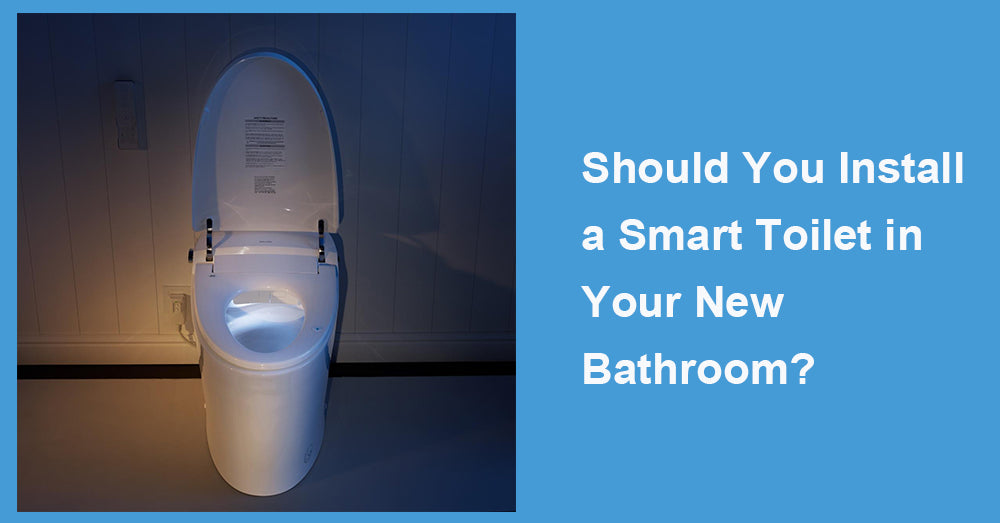
In recent years, with the rapid popularity of smart homes in the market, smart toilets (Smart Toilet/Bidet Toilet) that were once considered "exclusive to Asia" are gradually entering more and more households. From California to New York, from high-end residences to ordinary home bathrooms, smart toilets are no longer just luxury items, but are seen as an essential upgrade option to enhance quality of life, health, and home value.
When building or renovating a bathroom, is it worth installing a smart toilet? Industry experts believe that the answer is shifting from 'optional' to 'worthy of serious consideration'.

1. The growth trend of smart toilets in the market
In the past decade, smart toilets have undergone a significant transformation in the market from "niche imported products" to "mainstream high-end bathroom choices". Although the overall penetration rate is still lower than that of Japan and South Korea, its growth rate and market acceptance are in a rapid upward stage, becoming one of the most promising sub-categories in the North American bathroom industry.
The market size continues to expand, and the growth curve steadily rises
According to industry analysis from multiple North American bathroom and home research institutions, the intelligent toilet and smart toilet seat market has maintained a medium to high growth rate over the past few years. Especially after the epidemic, consumers' emphasis on personal hygiene, home health, and contactless experience has significantly increased, driving the demand for innovative bathroom products.
Significant changes in consumer cognition
In the early days, consumers' perception of smart toilets mostly remained at the level of "complex," "expensive," and "unnecessary. But in recent years, this concept has rapidly changed.
On the one hand, cross-cultural influence has significantly increased. A large number of consumers who have lived in Japan, South Korea, or Europe have become accustomed to the convenience and hygiene experience brought by smart toilets and actively seek similar products when they return. On the other hand, social media, home renovation programs, and designer recommendations are also continuously lowering consumers' cognitive barriers.
Channel changes accelerate the speed of popularization
The sales channel structure of smart toilets has also undergone significant changes.
In the past, this category was mainly concentrated in high-end bathroom exhibition halls or professional channels, with a limited audience. Nowadays, large home retailers, e-commerce platforms, and independent brand websites have become essential growth engines.
The rise of online channels has enabled consumers to compare features, prices, and reviews more intuitively, and has also created a broader market space for mid to high-end and entry-level products.
Dual wheel drive of the new residential construction and renovation market
From the demand side, new residential construction and bathroom renovation projects are the two core driving forces for the growth of smart toilets.
In new residential construction, developers and designers often use smart bathrooms as a differentiator to attract young families and high-income homebuyers. In the renovation market, especially in high-end bathroom renovation projects, smart toilets have become a popular upgrade option alongside temperature-controlled showers and LED bathroom mirrors.
The aging trend has further amplified this demand. For the elderly and those with limited mobility, the advantages of smart toilets in terms of comfort, safety, and convenience are particularly evident.
2. Where is the "intelligence" of smart toilets?
Compared with traditional toilets, smart toilets are not just about "a few more buttons", but a complete upgrade to the toilet experience.
Healthier and more hygienic
Smart toilets are commonly equipped with a warm water cleaning function, which can effectively reduce dependence on toilet paper and is particularly friendly to hemorrhoids, postoperative recovery, women, and the elderly. Some models also have antibacterial nozzles and automatic self-cleaning systems, significantly reducing the risk of bacterial growth.
A more comfortable user experience
In the cold winter, the seat heating and warm air drying functions significantly improve comfort; Soft lighting at night to avoid glaring illumination; Automatic flushing and sensing lid opening achieve true "contactless use".
More in line with the trend of modern smart homes
Many smart toilets support remote control operation and can even be linked with smart home systems, becoming an essential part of bathroom intelligence.
3. The advantages of installing smart toilets in new bathrooms
If it is a new bathroom renovation or overall renovation, the industry generally believes that this is the best time to install smart toilets.
• More user-friendly installation
New bathrooms can usually reserve power sockets and suitable drainage positions in advance to avoid later renovation costs.
• Design a more holistic approach
The appearance of the intelligent toilet is more modern, with simple lines that can be highly integrated with minimalist, light luxury, or hotel-style bathroom styles.
• Enhance the long-term value of houses
In some regions, smart bathrooms have become a bonus for high-end residential properties. Real estate agents point out that houses equipped with smart toilets are more attractive for display and rental.
4. The most concerning issues for consumers
Is electricity safe to use?
Mainstream smart toilets comply with UL or cUPC safety standards in the United States and have a leakage protection design. As long as they are installed according to specifications, they are highly safe.
Is maintenance complicated?
The maintenance of modern smart toilets is not complicated, and most daily cleaning is similar to that of ordinary toilets, with longer maintenance cycles for the filter and nozzle.
Do I have to buy an all-in-one model?
Not always. For budget-conscious or older home renovation users, smart toilet seats are also a very popular alternative on the market.
5. Industry perspective: Smart toilets are becoming the 'new standard'
Analysts in the bathroom industry point out that the popularization path of smart toilets is similar to that of dishwashers and intelligent constant temperature shower systems in the past:
From 'unnecessary', to 'used but can't go back', and then to becoming a standard configuration for mid to high-end residential properties
With technological maturity, widening price ranges, and improved consumer awareness, the penetration rate of smart toilets is expected to continue to rise over the next 3-5 years.
Conclusion: Is it worth installing? The answer depends on 'lifestyle.'
If you are building a brand-new bathroom and seeking higher comfort, hygiene, and long-term value, installing a smart toilet is undoubtedly a worthwhile choice. It is not only a bathroom product, but also represents a more modern and humane way of life.
Today, as the wave of smart homes deepens, the bathroom is becoming the next space to be redefined.







































Leave a comment
This site is protected by hCaptcha and the hCaptcha Privacy Policy and Terms of Service apply.