






















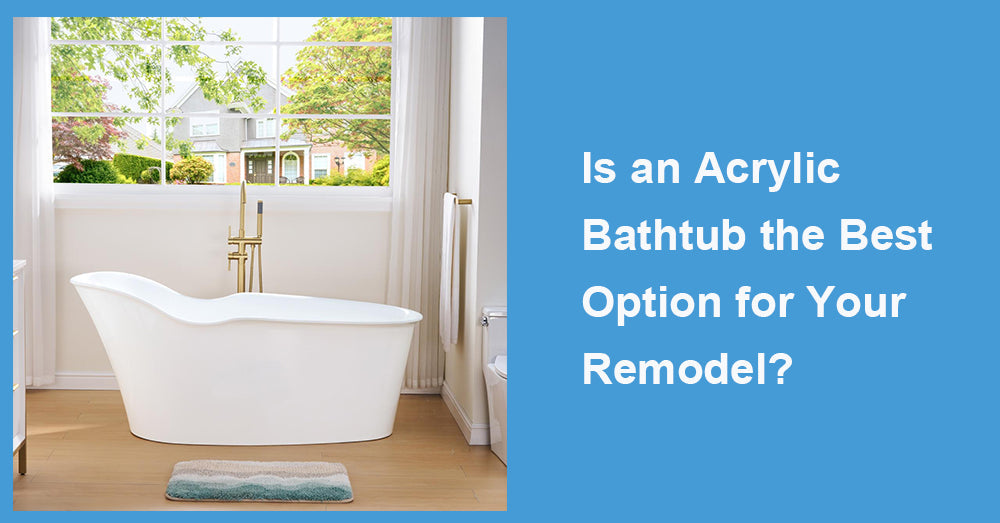
In bathroom renovation projects, the bathtub is often one of the core items prioritized in the planning list. With continuous advancements in material technology and manufacturing processes, acrylic bathtubs have gradually become a top consideration for many households during renovations. They demonstrate a strong balance between aesthetic design, construction difficulty, and overall cost, but whether they truly suit your renovation needs requires evaluation from multiple professional perspectives. This article will systematically analyze the applicability of acrylic bathtub in modern bathroom renovations from an industry standpoint.
1.Practical Considerations for Bathtub Material in Bathroom Renovation
Unlike new residential constructions, renovation projects are often constrained by existing spatial structures, piping layouts, and floor load-bearing conditions. This means the selection of bathtub materials is no longer solely based on appearance but also requires consideration of installation feasibility, user safety, and long-term maintenance costs. It is against this backdrop that acrylic bathtubs have gradually gained mainstream prominence due to their comprehensive characteristics.
2.Analysis of Material Characteristics of Acrylic Bathtubs
Acrylic is a thermoplastic material with good plasticity and stability, which can be processed into various shapes and structures. This gives acrylic bathtubs greater design freedom, enabling them to adapt to different bathroom styles and spatial proportions. At the same time, this material is easier to control thickness and curved structures during the molding process, which helps improve the consistency of the overall appearance.
From the perspective of industry applications, acrylic bathtubs usually have the following characteristics:
Smooth surface, gentle touch
Not easily affected by humid environments
Structural stability can be improved through multi-layer reinforcement.
In practical use, these characteristics also help reduce the risk of cracking or deformation.
These features make it stable for household-level use cases.
3. Comfort and Thermal Performance
For bathtub products, comfort of use is one of the core evaluation criteria. Acrylic material has relatively slow heat conduction, allowing the water temperature to remain stable for an extended period after filling.
Industry test data shows that under the same environmental conditions, acrylic bathtubs typically retain water temperature better than some metal bathtubs. This thermal performance is particularly important for users who enjoy long soaking baths.
4. Weight Advantage and Installation Flexibility
In renovation projects, the weight of the bathtub directly affects construction difficulty. Acrylic bathtubs are typically much lighter than cast-iron or stone bathtubs, with common weights of 70–120 pounds.
This lightweight feature makes it more suitable for installation in upstairs bathrooms or in older building structures, typically eliminating the need for additional floor-load reinforcement while also helping reduce transportation and manual installation costs.

5.Is durability sufficient for long-term use?
Many consumers have doubts about the durability of acrylic bathtubs. In fact, high-quality acrylic bathtubs usually have glass fiber or resin reinforcement layers added to the back to enhance overall structural strength.
Under normal household use, its lifespan can reach 10-15 years, meeting the long-term needs of most households. As long as abnormal impact and improper use are avoided, its stability can be guaranteed.
6.Daily maintenance and cleaning experience
From a maintenance perspective, acrylic bathtubs are relatively friendly. Its surface is not prone to stubborn stains, and daily cleaning usually requires only neutral cleaning agents.
Meanwhile, due to the relatively soft surface, it is necessary to avoid using highly abrasive cleaning tools to prevent scratches. However, even slight scratches can often be repaired by polishing.
7.Design style and spatial adaptability
Acrylic material offers good design flexibility, allowing bathtubs to present a variety of styles. Acrylic offers mature product solutions ranging from embedded to wall-mounted to freestanding bathtubs.
In modern, minimalist, light luxury, and transitional bathroom designs, acrylic bathtubs can blend well into the overall space without appearing abrupt.
8.Cost structure and cost-effectiveness analysis
From the market price perspective, acrylic bathtubs cover a wide range, with a common price range of about $300- $1200, depending on size, thickness, and reinforcement process.
Compared to stone or cast iron bathtubs, acrylic has more advantages in procurement cost, transportation cost, and installation cost, which is also one of the important reasons why it is widely used. For families who want to complete an overall bathroom upgrade while controlling their budget, this cost structure is more realistically attractive.
9.In which scenarios is an acrylic bathtub not the best choice?
Despite their obvious advantages, acrylic bathtubs are not suitable for all use cases. For example:
High-end customized projects, pursuing ultimate texture
Commercial or high-frequency usage environment
Space with extremely high requirements for impact resistance performance
In these cases, other materials may better align with long-term usage expectations.
10.Industry Trend: Continuous Upgrade of Acrylic Bathtubs
With advances in manufacturing technology, acrylic bathtubs continue to be optimized in terms of structure and performance. A multi-layer reinforced structure, improved surface treatment technology, and a more ergonomic design gradually eliminate the inherent impression of being an "entry-level product".
These upgrades make acrylic bathtubs competitive in mid to high-end renovation projects.
Conclusion: Is an acrylic bathtub suitable for your renovation project?
Based on industry experience, acrylic bathtubs offer a good balance of comfort, installation flexibility, maintenance costs, and price. For most home bathroom renovation projects, it is a practical and reliable choice.
Whether to use an acrylic bathtub as the final solution still needs to be judged based on space conditions, budget planning, and usage requirements. As long as the selection is reasonable and the construction is standardized, acrylic bathtubs can become a long-term solution for bathroom renovation that combines practicality and durability.








































Leave a comment
This site is protected by hCaptcha and the hCaptcha Privacy Policy and Terms of Service apply.