






















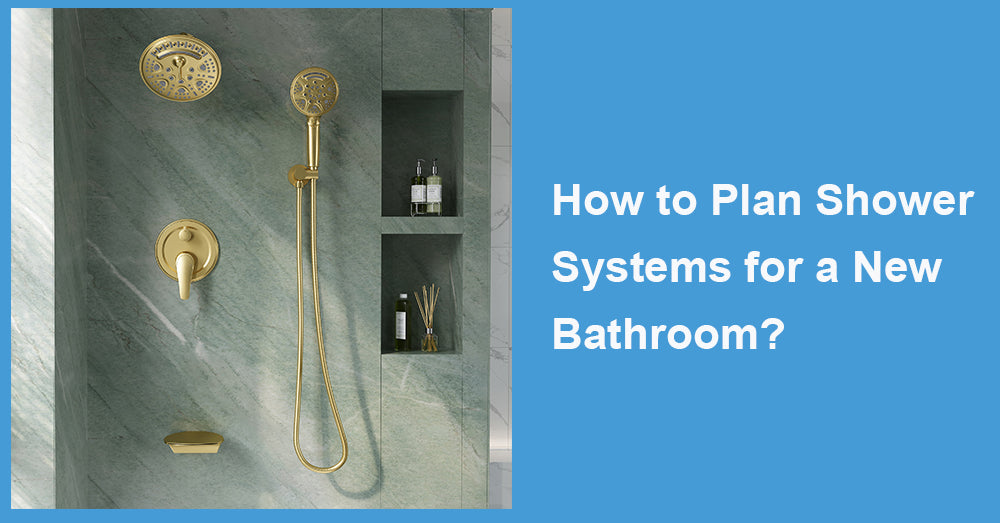
The selection and design of Shower Systems are becoming increasingly crucial in the overall planning of new bathrooms. Compared to the past, which only focused on "whether water can flow out, today's shower systems play a more critical role in improving comfort, optimizing usage processes, and enhancing spatial experience. Whether it's residential projects, renovation projects, or mid to high-end custom bathrooms, how to properly layout Shower Systems in the early planning stage has become an essential factor affecting final user satisfaction.
From an industry perspective, a successful Shower Systems plan is not a single product selection, but a careful consideration of spatial conditions, usage habits, waterway structure, and long-term maintenance.
1. First, clarify the usage requirements, rather than starting from the product style
One of the most common misconceptions when planning Shower Systems is to be attracted by the product's appearance or feature list first, while ignoring the actual usage needs. Different families and member structures have varying expectations for shower systems.
Some users value stable water pressure and simple operation, while others hope for multiple water-outlet options to enhance the relaxation experience, and others are more concerned about water conservation and the convenience of daily maintenance. From industry experience, it is more important to clarify "how to use it in daily life, "how frequently it is used, and "whether it is shared by multiple people" before determining the system type, rather than studying specific models. Only with precise requirements can there be no issues of functional redundancy or insufficiency in subsequent configurations.
2. Reasonably plan the system structure based on the proportion of bathroom space
The design of Shower Systems is closely related to the size of bathroom spaces. The more complex the system, the better, but it should be coordinated with the spatial proportion. If a small bathroom is equipped with too many water outlets, it not only affects visual order but may also compress the activity space. In a spacious shower area, having only a single showerhead may appear to lack functionality.
It is generally recommended in the industry to determine the combination of components, such as top spray, handheld showerhead, and side spray, based on the width, height, and wall layout of the shower area during the planning stage. A reasonable system layout should provide a comfortable, natural user experience without disrupting the action path.
3. Water pressure and waterway conditions are the foundation of system performance
Even the most advanced Shower Systems cannot achieve the desired effect if they ignore water pressure and pipeline conditions. The water supply conditions of different residential buildings vary, which directly affects the feasibility of system design.
In the planning of a new bathroom, the existing water pressure level should be evaluated as early as possible, and appropriate system configurations should be selected based on the actual situation. Industry insiders generally believe that, rather than pursuing complex, multifunctional systems, it is better to ensure that every outlet point is stable and reliable under controlled conditions. Reasonable waterway planning is not only about user experience but also affects maintenance costs later.
4. The shower control method determines the convenience of daily use
The control method of Shower Systems is an essential factor that affects the user experience. Whether the control is intuitive and the operation is easy is often repeatedly perceived during long-term use.
From an industry perspective, simplifying operational processes, reducing accidental touches, and streamlining steps are becoming important directions for system design. When planning, consider whether the valve body position, switching method, and temperature regulation logic are intuitive. A reasonable control layout allows users to quickly adjust in different scenarios without increasing operational burden.
5. Material and durability determine the lifecycle of the system
The bathroom environment is in a high-humidity state for a long time, which requires extremely high-quality materials from Shower Systems. The surface treatment, internal structure, and quality of connecting components all directly affect the stability of the system.
Industry observations show that durability is often more important than exterior design. Once the system is installed, the cost of replacement later on is relatively high. Therefore, in the planning stage, a design scheme that is structurally reliable and maintenance-friendly should be prioritized. This choice from the perspective of "long-term use" is gradually becoming mainstream.

6. Reserving maintenance and upgrade space is an essential sign of mature planning
Mature Shower Systems planning not only focuses on current needs, but also leaves room for future use. With the extension of residence time, maintenance, replacement, or partial upgrades are almost inevitable.
Industry recommendations include reserving necessary maintenance space during the design phase and selecting a highly standardized system structure for easier maintenance in the future. This kind of pre-planning can effectively reduce future usage risks and also reflects the professionalism of the overall design.
7. Incorporate Shower Systems into the overall bathroom design logic
Finally, Shower Systems should not be seen as a standalone device, but rather as a part of the overall bathroom design. From style coordination to proportional relationships, from functional zoning to visual unity, the appearance and layout of the system will all affect the integrity of the space.
In industry practice, successful bathroom design often reflects consistency in details. A well-designed shower system not only enhances the functional experience but also makes the bathroom space appear more organized, mature, and durable.
Conclusion
Overall, planning Shower Systems for a new bathroom is a task that requires prior thinking and systematic judgment. From usage requirements to spatial conditions, from waterway infrastructure to long-term maintenance, every aspect affects the final experience. As bathroom design gradually moves towards rationality and refinement, Shower Systems' planning is no longer just about choosing a set of equipment, but a deep understanding and response to lifestyle. Reasonable and mature planning often reflects its value in daily use.









































Leave a comment
This site is protected by hCaptcha and the hCaptcha Privacy Policy and Terms of Service apply.