






















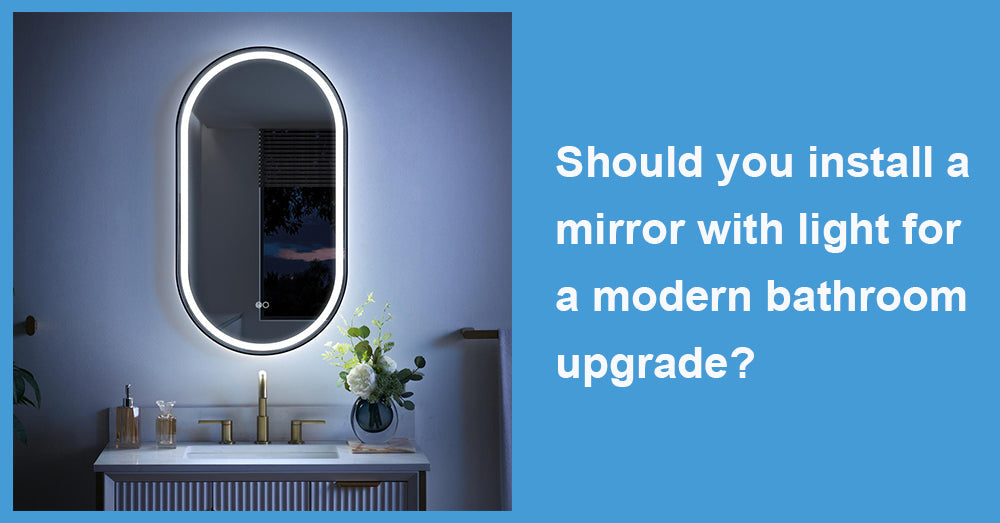
In recent years' bathroom renovation discussions, the question of whether it is necessary to install a mirror with light has gradually shifted from a designer's suggestion to a problem homeowners must face during the decision-making stage. Especially in modern bathrooms, where function and aesthetics are considered simultaneously, mirrors with lights are shifting from supporting roles to core components.
But is this choice really a "necessary upgrade"? Or is it just a temporary trend? From the perspectives of user experience, spatial planning, and long-term value, this issue deserves a more rational analysis.
1. The demand for bathroom lighting is undergoing structural changes
Traditional bathroom lighting is typically provided by ceiling or wall lights, but this approach is not always ideal for everyday use. The light source is far away from the face, which can easily create shadows on the eyes and jaw, making it unfriendly to details such as washing and care.
According to research on residential space lighting efficiency by the Lighting Engineering Association, when the primary light source is placed directly in front of the user and close to the line of sight, uniformity of facial illumination can be improved by about 25%-35% (source: IES.org).
This is also an important reason why mirror-integrated lighting is gradually being accepted.
A mirror with light is essentially an optimization of the lighting structure, rather than simply adding an appliance.
2. In the budget restructuring, the mirror configuration is moving forward
In the past, bathroom mirrors were seen more as accessories, with budget priorities far lower than showerheads or bathroom cabinets. But in recent years, this ranking has changed in overall renovation plans.
The bathroom renovation trend report released by Houzz shows that, in medium-sized renovation projects, the share of the budget for mirror-and-lighting combination products has significantly increased, with over 40% of projects choosing integrated illuminated mirrors (source: Houzz.com).
This change is not due to demand for luxury, but rather because a mirror can often replace additional lighting fixtures, making it more controllable within the overall budget.
3. Space efficiency: Having a light mirror does not necessarily "occupy more space."
Many people are concerned that mirrors with light may increase wall thickness or visual burden when making decisions, especially in bathrooms with limited dimensions.
From a structural perspective, the thickness of current mainstream products is usually concentrated between 1.5 and 2.5 inches, and compared to traditional mirror cabinets or wall light matching schemes, their actual space occupation has not increased significantly. On the contrary, due to fewer external lighting fixtures, small spaces are cleaner and more efficient.
The National Kitchen and Bathroom Association mentioned in its spatial planning recommendations that reducing the dispersion of wall functions is one of the essential ways to improve the integrity of bathrooms (source: NKBA.org).
4. The long-term impact of light quality on user experience
Brightness is not the only criterion for measuring whether lighting is appropriate. For the bathroom used every day, lighting stability and the ability to restore skin tone are equally important.
Energy Star's residential lighting research indicates that using stable LED light sources and controlling appropriate color temperature can significantly reduce visual fatigue without increasing energy consumption (source: EnergyStar.gov).
This is also why more and more upgrade projects are abandoning a single cold white light in favor of mirror lighting solutions in the 3500K-4000K range.
At this point, a mirror with light helps achieve continuous, soft light distribution.
5. Is functional integration really "necessary"?
The discussion of illuminated mirrors on the market often centers on additional features such as anti-fog, dimming, and sensing. So the question is: Are these functions essential?
Consumer Reports' research on the long-term usage rate of home renovation products shows that the closer the functionality is to daily high-frequency scenarios, the higher its actual value; and complex but low-frequency functions are often overlooked after one year of use (source: ConsumerReports.org).
From the feedback, anti-fog and stable lighting can significantly improve the continuity of use, while excessive intelligence may actually increase maintenance costs.
6. From the perspective of resale and long-term value, Mirror with Light
In addition to the current experience, bathroom upgrades are often included in the overall housing value considerations.
According to the Remodeling Cost vs. Value report, bathroom visual completion and lighting quality are essential factors that affect a space's "first impression" (source: Remodeling.hw.net).
Although a mirror with light is not a single factor determining value, it often significantly improves spatial presentation at a limited cost.
In other words, this is an upgrade where perceived value exceeds actual volume.
7. Should it be installed? The answer depends on the transformation goal
Suppose the goal of the renovation is to address functional shortcomings, improve daily comfort, and control the scope of structural changes. In that case, the cost-effectiveness of Mirror with Light is valid.
If pursuing complex lighting levels or dramatic effects, single mirror lighting may not be the most suitable solution.
The key is not whether it is popular, but whether it solves real usage problems.

8. Conclusion: Mirror With Light is transitioning from "Options" to "Basic Configuration."
From the overall trend, the mirror with light is no longer just a symbol of design style, but a natural evolution of modern bathrooms in terms of lighting efficiency, spatial integration, and long-term experience.
For bathrooms undergoing upgrades and renovations, this is more like a rational upgrade than an unthinking following of the trend. The decision on whether to install should ultimately rest on the spatial conditions, usage habits, and transformation goals themselves.









































Leave a comment
This site is protected by hCaptcha and the hCaptcha Privacy Policy and Terms of Service apply.