






















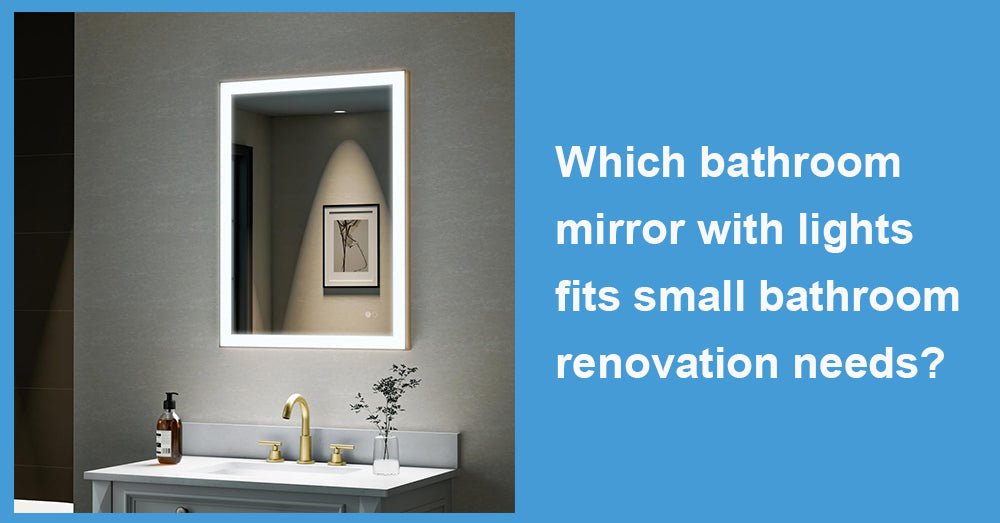
With the trend of bathroom renovation shifting towards functional integration and spatial efficiency, the design logic of small bathrooms is undergoing significant changes. Compared to large-scale spaces, every selection in a small bathroom will be magnified and tested, especially in high-frequency use areas such as mirrors and lighting.
In this context, bathroom mirror with lights have gradually replaced the combination of traditional mirrors and independent lighting fixtures, becoming one of the highly discussed configurations in small bathroom renovations.
But the question arises: with so many types of bathroom mirrors with lights on the market, which one is truly suitable for the decorative needs of small bathrooms?
1. The core demand of small bathrooms is not "completeness", but "efficiency."
In a bathroom space with limited space, whether the functions are complete does not necessarily mean a good user experience. Too many independent elements can easily confuse the flow, visual pressure, and maintenance burden.
Houzz noted in its trend report on residential bathroom renovations that small bathroom projects tend to choose multifunctional integrated products to reduce the functional dispersion of walls and countertops (source: Houzz.com).
This is also an essential reason for the rapid popularity of bathroom mirrors with lights - they integrate the basic functions of a mirror and lighting without adding additional equipment.
2. Size selection: For mirrors suitable for small bathrooms, the first step is to "restrain" them
In a small bathroom, a larger mirror is not necessarily better. A mirror that is too wide or too tall can easily make the space feel out of proportion and appear cramped.
The most common suggestion in the industry is:
The mirror width should be close to the bathroom cabinet, but should not exceed 1-2 inches beyond the cabinet. Standard and safer width ranges include:
24 inch: Suitable for a compact single-person hand washing area
30 inch: Balancing practicality and proportion
36 inch: Suitable for slightly wider countertops, but attention should be paid to leaving white space on the wall
The National Kitchen and Bath Association notes that in small spaces, reasonable proportions can improve overall comfort more than simply increasing size (source: NKBA.org).
3. Lighting design: Uniformity is more important than brightness
Many people are easily attracted by the high brightness when choosing a bathroom mirror with lights. But for small bathrooms, the key is whether the light is even.
A study by the Lighting Engineering Association shows that when the light source is close to the front of the face and evenly distributed, users' visual comfort during washing and care is significantly improved (source: IES.org).
This means that, compared to single-point direct light, surround- or border-illuminated designs are more suitable for small spaces.
4. Color temperature selection: Neutral light is more suitable for long-term use
In social media and display spaces, cool white light often appears bright and clean, but in daily high-frequency use, this type of light is not necessarily friendly.
Multiple lighting studies have shown that neutral light at around 3500K-4000K is more balanced between skin tone restoration and visual fatigue control (source: XXX.com).
For small bathrooms with limited space, a stable and durable lighting experience is far more practical than just "looking bright".
5. The thickness and installation method determine whether the space appears bulky
Another key point of a small bathroom is whether the wall elements appear "light".
The current mainstream bathroom mirror with lights usually has an overall thickness of 1.5 to 2.5 inches, and even when installed on the wall, it will not cause a significant outward protrusion.
Within a washing area with a width of 24-36 inches, this thickness is more visually acceptable and can also reduce the complexity caused by external lighting fixtures.
Research in the Remodeling industry suggests that reducing the dispersion of wall elements can help improve the cleanliness and integrity of spaces (source: Remodeling.hw.net).

6. Function configuration: It's not that more functions are better, but that the higher the frequency, the better
Standard additional functions of bathroom mirrors with lights include anti-fog, dimming, touch switches, etc. But in small bathrooms, functional choices need to be restrained more.
Consumer Reports' research on home product usage found that frequently used features over the long term are often concentrated in a few items (source: Consumer Reports, Reports.org).
Uniform lighting, anti-fog treatment, and intuitive operation can enhance the real experience far more than complex intelligent systems.
7. Energy consumption and maintenance: Small spaces require more stable performance
Functional transformation is not only about the present but also involves long-term use costs.
Energy Star's household lighting data shows that LED lighting has significant advantages in stability and energy consumption control, and can reduce replacement frequency (source: EnergyStar.gov).
For bathroom mirrors used multiple times a day, low maintenance is an important feature.
8. Which one is most suitable? The key is not the model, but the compatibility
Overall, bathroom mirrors with lights that are genuinely suitable for small bathrooms often have the following common characteristics:
Reasonable size control, priority given to 24-30 inches
Uniform lighting and location close to the daily use line of sight
The design is simple and does not increase the burden on the wall
Functionality revolves around high-frequency requirements rather than stacked configurations
It may not be the most complex or expensive product, but it is definitely the one that best matches the space conditions and usage habits.
9. Conclusion: A small bathroom is more suitable for a "just right mirror."
In small bathroom design, the key to success often lies not in adding more functions but in reducing unnecessary complexity.
A suitable bathroom mirror with lights can make the space brighter, more efficient, and more durable without changing the original structure.
From an industry perspective, illuminated bathroom mirrors are not a short-term trend but a natural result of small bathrooms moving towards functional integration and refined use.









































Leave a comment
This site is protected by hCaptcha and the hCaptcha Privacy Policy and Terms of Service apply.