






















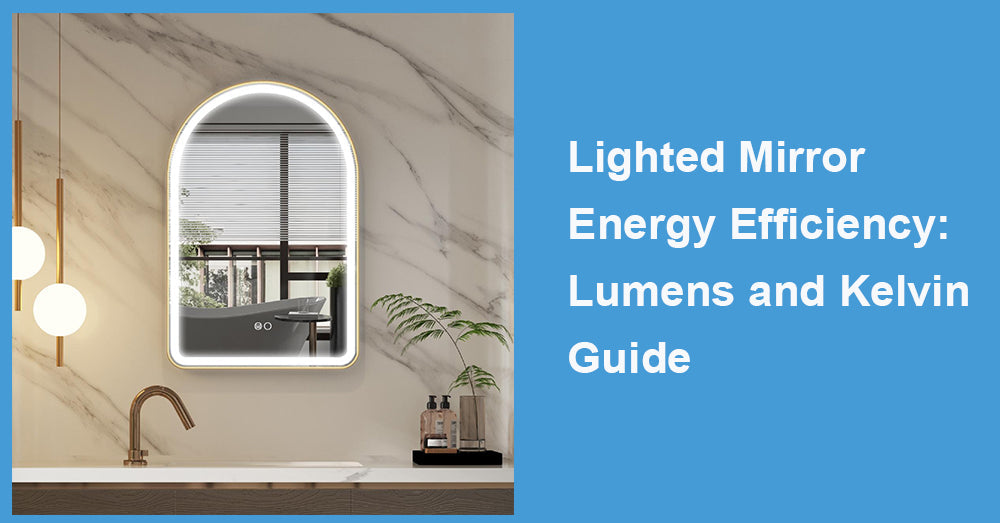
A lighted mirror can do much more than brighten a bathroom wall. It can improve grooming visibility, support a more comfortable daily routine, and reduce energy use simultaneously. That is one reason LED-based mirrors have become such a strong category in modern bath design. According to the U.S. Department of Energy, quality LED lighting products use at least 75% less energy than incandescent lighting and can last up to 25 times longer. That makes efficiency more than a side benefit. It becomes part of the product’s long-term value, especially in spaces where lighting is used every day.
1. Why Lumens Matter More Than Watts
When people shop for a lighted mirror, many still look first at wattage. That is understandable, but it is not the best way to judge performance. Watts tell you how much electricity a product uses. Lumens tell you how much visible light it produces. The Department of Energy is very clear on this point: lumens measure brightness, and buyers should think lumens, not watts, when comparing lighting products.
This matters because two mirrors can use different amounts of power and still produce similar brightness. A well-designed LED mirror may deliver strong light output while using only a fraction of the electricity older technologies required. That is the heart of energy efficiency. It is not just low power consumption. It is a useful light delivered with less waste.
For everyday shopping, lumen references help make specifications easier to understand. DOE guidance shows that about 450 lumens is comparable to the old 40-watt incandescent level, around 800 lumens is similar to a 60-watt bulb, about 1,100 lumens is comparable to a 75-watt bulb, and roughly 1,600 lumens compares to a 100-watt bulb. Those benchmarks are not perfect for every mirror design, but they give a practical frame of reference when reading a spec sheet.
2. How Bright Should a Lighted Mirror Be
The right lumen output depends on how the mirror is used. A decorative mirror in a guest bath may only need a gentle glow to complement existing lighting. A daily-use vanity mirror needs more. If the mirror is used for shaving, skincare, makeup, or detailed grooming, brightness should support visibility without forcing the user to rely on harsh overhead fixtures.
Mirror size also changes the equation. A compact mirror above a narrow sink does not need the same output as a larger model installed over a 48-inch or 60-inch vanity. The room itself matters too. Dark tile, matte finishes, and limited daylight can absorb light, making a mirror feel dimmer. White walls, glossy surfaces, and natural daylight can make the same lumen output feel brighter.
That is why the best approach is not to chase the highest number possible. It is necessary to choose a sufficient number of lumens for clear task lighting while maintaining a balanced visual effect. Too little light can make grooming frustrating. Too much can feel sharp and uncomfortable in the early morning or late evening. A good lighted mirror should feel useful, even, and flattering, not glaring.
3. What Kelvin Means in Real Use
Once brightness is covered, the next number to understand is Kelvin. Kelvin describes the color appearance of white light, also known as correlated color temperature. Lower Kelvin values look warmer and softer. Higher Kelvin values look cooler and crisper. In everyday terms, Kelvin shapes the mood of the light and the way surfaces, skin tones, and finishes appear. DOE purchasing guidance uses familiar reference points: 2,700K appears warm, 3,000K is warm but cleaner, 3,500K is more neutral, and 4,100K looks cooler and brighter.
For a lighted mirror, Kelvin is just as important as lumens. A mirror can be bright enough on paper and still feel wrong in the space if the color temperature does not suit the room. Warm light tends to feel softer and more relaxed. Neutral light feels balanced. Cooler light can sharpen visual detail and create a fresher, more polished effect.
This is especially important in bathrooms because mirrors interact with many reflective materials, including glass, porcelain, polished metal, and glazed tile. The same vanity can feel inviting under 3,000K and noticeably more clinical under 4,100K. Neither is automatically right nor wrong. The choice depends on the experience the buyer wants every day.

4. The Best Kelvin Range for a Bathroom Mirror
For most homes, the most practical range sits between warm and cool extremes. Around 3,000K to 4,100K is often the sweet spot because it balances comfort with functional clarity. That range is also flexible enough to work with many finish palettes, from warm wood vanities and brushed brass to crisp white stone and matte black hardware. DOE guidance supports this middle-zone approach by showing how 3,000K, 3,500K, and 4,100K each serve different but widely useful lighting goals.
If the bathroom is designed to feel spa-like and relaxed, a warmer setting may make more sense. If the goal is cleaner facial detail for shaving or makeup, a more neutral or slightly cooler setting often performs better. This is why adjustable color temperature has become such a valuable feature. Instead of forcing a single fixed look, it allows the user to adjust the mirror’s tone based on time of day, weather, and personal routine.
In practical terms, that flexibility helps one mirror do more. A warmer setting may feel better in the evening. A cooler setting may feel better during a fast morning routine. For an independent store, this is also easy to communicate to shoppers because it translates a technical spec into a visible, everyday benefit.
5. Efficiency Is Not Only About Energy Use
A mirror can save electricity and still disappoint if the light quality is poor. That is where color rendering comes into play. The color rendering index (CRI) describes how accurately a light source reproduces colors compared with a reference source. DOE notes that CRI is rated on a 0-100 scale, and ENERGY STAR-qualified bulbs must have a CRI of 80 or higher. NIST also explains that color quality remains an important issue in solid-state lighting and that the industry continues working to improve how it is evaluated and communicated.
For a lighted mirror, better color rendering can make skin tones look more natural, and finishes look more trustworthy. That matters in a vanity setting because people do not use mirrors only to check brightness. They use them to judge in detail. If the light is efficient but washes out color or makes tones look dull, the experience will not feel premium.
So when evaluating energy efficiency, the smartest view is broader. Look at lumens. Look at Kelvin. Look at CRI. Then consider how evenly the light is distributed across the face and the mirror surface. A balanced specification usually performs better than one oversized claim.
6. What Shoppers Should Look for Before Buying
A strong lighted mirror should clearly state its lumen output, not hide behind vague language like "bright LED glow." It should explain whether the color temperature is fixed or adjustable. It should mention dimming if it's included. And if the product is positioned as a premium option, CRI should not be ignored.
The broader direction of lighting technology is already clear. DOE describes LED lighting as one of today’s most energy-efficient and fastest-developing mainstream lighting technologies. That trend supports the continued rise of integrated LED mirrors in both renovation and new-build projects.
For buyers, the takeaway is simple. The best-lit mirror is not the one with the highest number in a given category. It is the one that combines the right lumens, the right Kelvin range, and dependable light quality for real daily use. When those elements come together, energy efficiency stops feeling like a technical checkbox and becomes a better design.











































Leave a comment
This site is protected by hCaptcha and the hCaptcha Privacy Policy and Terms of Service apply.