






















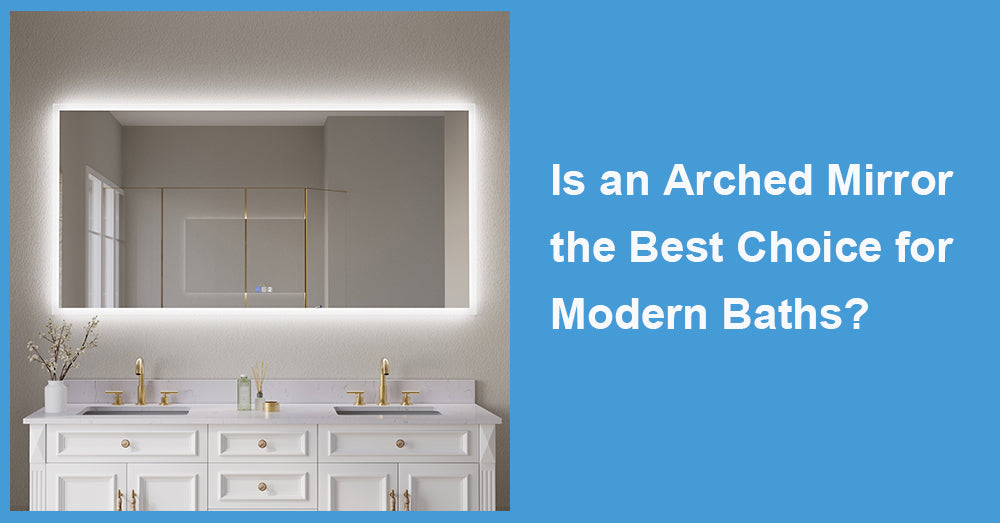
A bathroom mirror has become one of the most influential “finish decisions” in a remodel because it shapes the proportions of the vanity wall, lighting performance, and overall mood. In 2026, the arched silhouette is getting extra attention as design shifts away from hard-edged minimalism toward softer, more architectural forms. Pinterest’s 2026 forecast highlights a “Neo Deco” revival featuring geometric motifs like fan arches, signaling that curved profiles are back in a big way.
Why Arches Are Trending in 2026
What’s driving the arched mirror’s popularity is not one “style,” but a broader return to expressive geometry. Pinterest Predicts points to crisp patterns and fan arches as part of a modernized Deco comeback. That shows up in bathrooms because an arch is an easy way to add architecture without rebuilding walls.
Renovation momentum also keeps small, high-visibility upgrades attractive. Harvard’s Joint Center for Housing Studies projects annual homeowner spending on improvements will reach $518 billion by the end of 2026, favoring changes that deliver a noticeable “before/after” without moving plumbing.
What an Arched Mirror Does Better Than a Rectangle
A rectangle mirror reinforces straight lines already common in bathrooms: tile grids, vanity edges, shower glass, and countertop seams. An arch breaks that repetition and softens the room visually, which is why it’s often described as “architectural.” Some 2026 trend roundups specifically call out sculpted or dimensional arch mirrors (plaster-like edges, clay/resin looks, and softly rounded profiles) as a way to add texture without going ornate.
If your bath leans modern (flat-panel vanity, slab backsplash, minimal hardware), an arched mirror can soften the look without making it feel too sharp or sterile—especially in smaller spaces where every line is close to the eye.
The “Spacious Feel” Advantage: Height and Proportion
Arches excel at one thing: making the vanity zone feel taller. The curved top draws attention upward and can visually increase perceived ceiling height, even when the mirror is the same overall height as a rectangular mirror.
Practical sizing guidance (in inches) that tends to look intentional:
l 24-inch vanity: 20-inch to 24-inch W mirror, 30-inch to 36-inch H
l 30-inch vanity: 24-inch to 30-inch W mirror, 30-inch to 40-inch H
l 36-inch vanity: 30-inch to 36-inch W mirror, 34-inch to 40-inch H
l 60-inch double vanity: either two 24-inch to 30-inch W arches, or consider a wide rectangle if you want a continuous span
A simple rule that works in most listings: keep mirror width roughly 70% to 100% of vanity width, unless sconces require extra wall space.
Lighting Is the Real Reason Mirrors Are Evolving
In 2026 reporting, lighting isn’t treated as decoration—it’s treated as performance. NKBA’s 2026 Bath Trends release reports 92% agree task lighting should always be included in the primary bath, and 47% favor integrated lighting in mirrors over the next three years.
That matters for arched mirrors because the category is no longer “arched vs. rectangle.” It’s often:
arched LED mirror vs. traditional framed mirror, or
arched medicine cabinet vs. flat mirror plus extra storage
On the renovation side, Houzz reports lighted mirrors are rising, reaching 22% of upgraded light fixtures in renovated bathrooms.
Arched Mirrors Fit How People Actually Remodel
Mirrors are frequently replaced during bathroom renovations, which is why shape trends can move quickly. Houzz reports that during bathroom renovations, 59% of homeowners upgrade their mirrors; among those, 59% install a single mirror and 37% install two.
That pattern explains where arches shine:
Single-vanity bathrooms (powder rooms and guest baths): one arched mirror can become the focal point without creating symmetry headaches.
Primary baths with two sinks: two matching arches can look “boutique hotel” if spacing is right and ceilings support the height.

The Best Arched Mirror Styles for “Modern,” Not “Vintage.”
Not all arches read modern. For 2026, the most “current” executions tend to be:
l Thin metal frames (matte black, brushed nickel, warm brass tones) for crisp outlines
l Soft rounded corners (a “soft arch” rather than a tall cathedral arch) for a calm silhouette
l Frameless arched glass, when you want the shape without adding another finish to the room
Design guides focused on 2026 mirror trends highlight softer arches and sculpted edges to achieve a high-design look without heavy ornament.
When an Arched Mirror Is Not the Best Choice
Arched mirrors can be the wrong answer in a few common conditions:
l Very low ceilings: the curve can feel cramped if there isn’t enough “breathing room” above the mirror.
l Busy statement tile behind the vanity: an arch plus bold pattern can compete.
l Ultra-wide double vanities where you want a continuous span: a large rectangle (or one extra-wide lighted mirror) may look more cohesive.
Also, trend fatigue is real. Some designers and editors have started calling out “arched mirrors everywhere” as a look that can feel overdone when repeated without restraint. The fix is easy: choose an arch with a simpler profile (or keep the arch but go frameless).
What to Check Before You Buy (So It Looks High-End After Install)
An arched mirror only looks premium if the details are right:
Edge and frame quality: clean seams, consistent finish, no ripples in the frame line.
Moisture readiness: secure backing and bathroom-appropriate mounting hardware.
Lighting specs (if LED): even diffusion (no hot spots), dimming, and a practical color-temperature range for grooming.
Placement: center the mirror on the sink and faucet, not just on the countertop cutout; leave enough wall space for sconces if you’re using them.
If you’re choosing an arched lighted mirror, it’s smart to align with the direction industry research is pointing: layered lighting and integrated mirror lighting are becoming more common expectations, not niche upgrades.
So, Is an Arched Mirror the “Best” Choice?
It’s the best Choice when your remodel needs one move that adds softness, height, and a designed feel—especially over a single vanity or in a powder room. It’s less ideal when the space calls for strict symmetry across a long wall, or when the ceiling height and lighting plan don’t support the shape.
The bigger takeaway for 2026 is that mirrors are being specified like fixtures: sized for proportion, chosen for silhouette, and increasingly expected to support lighting performance.









































Leave a comment
This site is protected by hCaptcha and the hCaptcha Privacy Policy and Terms of Service apply.