
















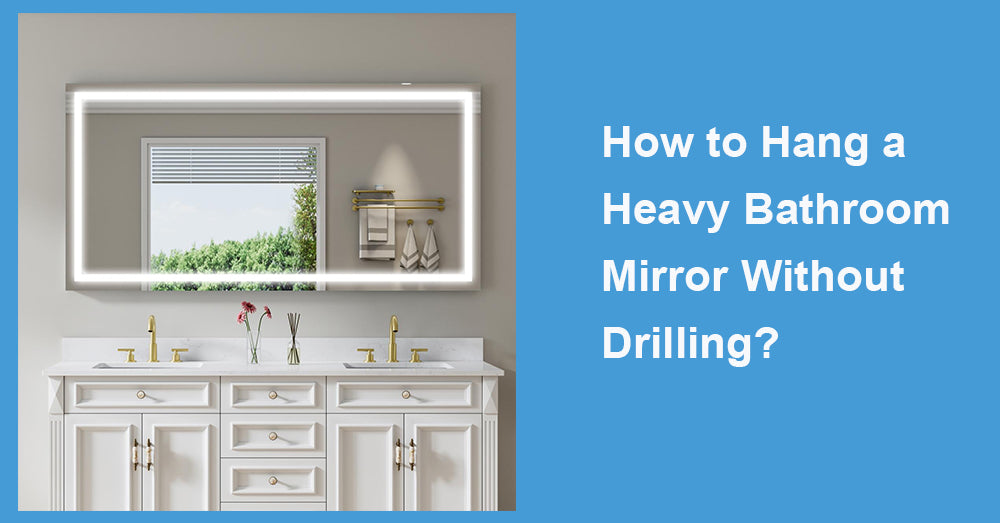
A “heavy” bathroom mirror and “no drilling” can coexist, but only within limits. The safest installs for truly heavy mirrors still rely on studs, anchors, or a French cleat. If you cannot drill, your best options become high-bond removable strips for moderate weights or mirror-rated adhesives with proper surface prep and temporary bracing. The key is to match the method to the mirror’s real weight, your wall surface, and the bathroom’s humidity swings, then build in a safety margin.
This guide explains the most realistic no-drill approaches, what they can and cannot do, and how to reduce the risk of a mirror falling.
1. First, Define “Heavy” With a Number
Before you choose any method, find the mirror’s weight in pounds. If you do not have packaging, use a bathroom scale:
1. Weigh yourself.
2. Weigh yourself holding the mirror.
3. Subtract.
Then decide which “no-drill lane” you are in:
· Up to ~10 lb: Many removable strip systems can work if the wall surface is suitable and prep is excellent.
· 10–20 lb: Still possible with removable strips, but the margin is thinner and bathroom humidity raises the stakes.
· Over ~20 lb: No-drill becomes high risk. Consider a low-impact hardware option or professional help.
Why the caution? Removable strip ratings are real, but they are sensitive to surface paint quality, humidity, and prep.
2. No-Drill Option A: Heavy-Duty Removable Hanging Strips
Removable “picture hanging strip” systems are the cleanest no-drill solution, but they are not magic. Use the manufacturer’s weight limits as your starting point, then underrate them for bathrooms.
For example, a Command™ product weight guide lists capacities such as 3 lb per set for narrow/medium and 4 lb per set for large picture hanging strips. (Source: Command™ Brand Product Weight Limits Guide.) That means you need multiple sets to reach higher weights, and the mirror must be small enough and rigid enough to distribute the load properly.
When strips work best
· Smooth, clean, well-bonded paint or sealed surfaces.
· Mirrors with a flat back plate (better contact area).
· Frames that allow many strip pairs to be spread wide (better load distribution).
· Low splash exposure and good ventilation.
When strips fail most often
· Matte or chalky paint, peeling paint, dusty walls, or textured surfaces.
· Steam-heavy bathrooms with poor exhaust.
· Narrow contact area (thin frame edges) that concentrates stress.
How to maximize strip success (no shortcuts)
1. Degrease the wall and mirror back with isopropyl alcohol and let dry fully (avoid household cleaners that leave residue).
2. Use more strip pairs than the math suggests. If the mirror weighs 12 lb, do not aim for 12 lb capacity; aim for 18–24 lb capacity.
3. Spread strips far apart (near the corners) to reduce peel forces.
4. Press firmly and hold per the strip instructions, then wait the full cure time before loading.
If your mirror is glass-only with minimal frame and limited bonding area, strips are a poor fit.
3. No-Drill Option B: High-Bond Acrylic Foam Tape (VHB-Style)
High-bond acrylic foam tapes can carry impressive loads when used correctly, but they require engineering-style prep and proper loading direction. A 3M™ VHB™ tape design guide explains these tapes distribute stress over the bonded area and provides guidance on static shear performance and design considerations. (Source: 3M VHB Tape Design Guide.)
A related 3M technical sheet describes long-term temperature tolerance in terms of supporting 250 g per 0.5 in² in static shear for a specified duration. (Source: 3M VHB technical data sheet.) That statement is useful because it highlights the real rule of tape: surface area and shear loading matter, and performance changes with temperature and conditions.
When VHB-style tape can work
· The mirror has a rigid back plate and large bonding surface.
· The wall surface is smooth, sealed, and stable.
· The mirror loads the tape mostly in shear (downward load), not peel.
The biggest risk: peel forces
Tape is strongest in shear and weakest in peel. Mirrors often experience peel at the top edge if the load is not perfectly distributed. That is why tape-only installs for heavier mirrors should be treated cautiously in bathrooms.
4. No-Drill Option C: Mirror Mastic or Construction Adhesive (Most Permanent)
Adhesives can hold a lot, but they bring two serious issues:
1. Surface compatibility (some adhesives can damage mirror backing or fail on certain wall finishes).
2. Removal (often destructive to drywall and paint).
Mirror-specific mastics exist for this reason. A Mirro-Mastic instruction sheet stresses surface preparation and warns against certain substrates like painted surfaces, wall coverings, or treated wood, and emphasizes clean, dry conditions. (Source: Mirro-Mastic technical sheet.) Another compatibility document warns about risks such as solvent-related damage and advises precautions like not installing on freshly painted walls without proper sealing. (Source: Depp Glass mirror compatibility with adhesives.)
If you choose adhesive, do it the safe way
· Use a mirror-rated mastic, not a random general adhesive.
· Avoid freshly painted walls unless fully cured and properly sealed.
· Apply adhesive in vertical beads so moisture does not get trapped behind the mirror.
· Use temporary bracing (painter’s tape and support blocks) for the full cure period.
A well-known construction adhesive data sheet shows high tensile shear numbers in lab tests, such as 590 psi in a wood-to-metal lap shear example. (Source: Loctite PL Premium Construction Adhesive data sheet.) Those numbers demonstrate how strong adhesives can be under controlled conditions, but they are not a guarantee for every bathroom wall, paint layer, or mirror backing. Use mirror-rated products and follow mirror-industry guidance.
5. The Bathroom Factor: Humidity Changes Everything
Bathrooms experience rapid humidity spikes. Higher humidity and condensation cycles can stress adhesives and reduce long-term reliability if ventilation is weak. Treat your no-drill plan as part of a system:
· Run the exhaust fan during showers and afterward.
· Keep the mirror out of direct spray zones.
· Avoid soaking the frame edges during cleaning.
The better your moisture control, the better any no-drill method performs.
6. A Practical Decision Chart
Choose removable strips if:
· Mirror is under ~15 lb, has a flat back, and you have a smooth, clean wall.
· You want removability and minimal wall damage.
· You can use enough strip pairs to build a wide safety margin. (Source: Command™ weight limits guide.)
Choose VHB-style tape if:
· You have large bonding area and understand that prep and surface area are everything.
· You accept that removal may damage paint or drywall. (Source: 3M VHB design guidance.)
Choose mirror mastic if:
· You need the strongest no-drill approach and accept permanent bonding.
· You can brace the mirror during cure and meet substrate requirements. (Source: Mirro-Mastic technical sheet; Source: Depp Glass compatibility precautions.)
If the mirror is truly heavy (often over ~20 lb) or irreplaceable:
· The safest answer is to use proper hardware into studs or hire a pro. “No drilling” becomes a higher-risk tradeoff.

Conclusion
You can hang a heavy bathroom mirror without drilling, but only if you respect the physics: maximize bonding area, minimize peel forces, and control moisture. Removable hanging strips are the cleanest option for moderate weights when used within published limits and with excellent prep. (Source: Command™ Brand weight limits guide.) High-bond acrylic tapes can work with enough surface area and correct loading, but they demand careful technique. (Source: 3M VHB Tape Design Guide.) Mirror mastics offer the strongest no-drill hold, yet require strict substrate compatibility and permanent commitment. (Source: Mirro-Mastic technical sheet; Source: Depp Glass compatibility precautions.) If your mirror is extremely heavy, drilling into studs remains the safest long-term solution.











Leave a comment
This site is protected by hCaptcha and the hCaptcha Privacy Policy and Terms of Service apply.