



















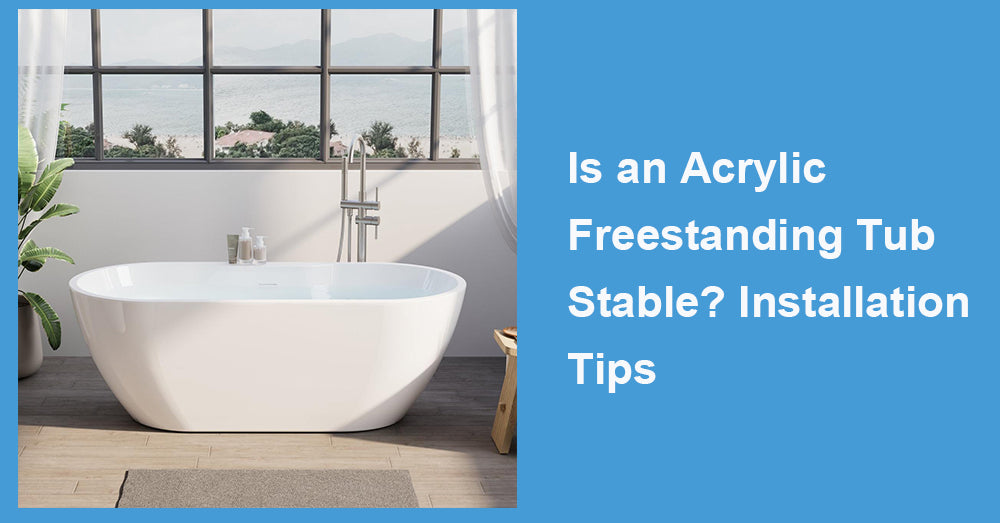
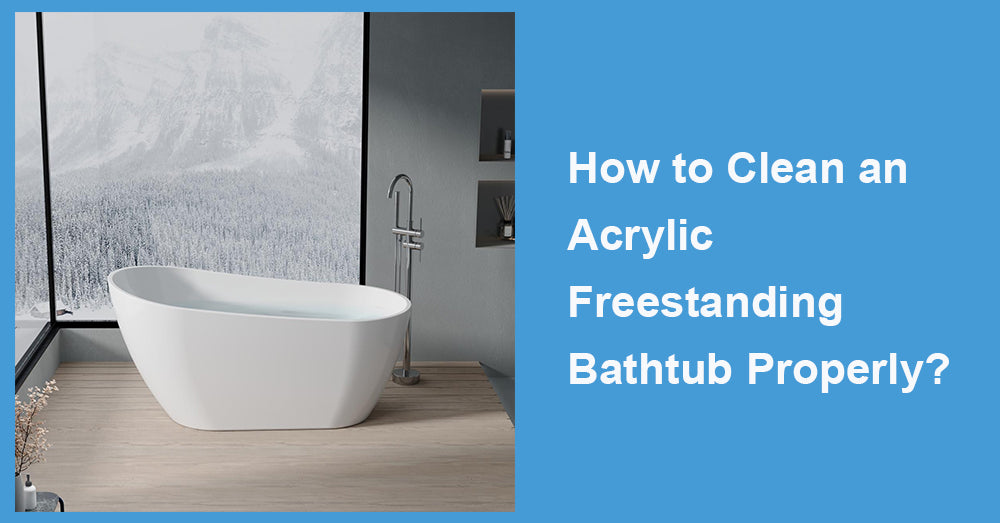
When shopping for bathtubs, many people are drawn to the aesthetic appeal of freestanding tubs, yet they also worry about a practical concern: "Is an acrylic freestanding tub stable?" Especially with lightweight acrylic materials, users often wonder, "Will it wobble? Will it shift? Will it feel unstable when seated?" In reality, the stability of most acrylic freestanding tubs doesn't hinge on "how light the material is," but instead on structural design, floor conditions, leveling methods, drain connections, and whether they're secured according to specifications. When installed correctly, acrylic freestanding tubs can be perfectly stable, quiet, and durable, showing no noticeable wobbling or shifting during daily use.
This article explains stability issues more practically, covering principles and hands-on implementation, and provides actionable installation tips and a list of common pitfalls to avoid.
Why do acrylic freestanding bathtubs appear "less stable"?
Acrylic bathtubs typically feature a vacuum-formed acrylic surface layer reinforced with fiberglass/resin. Their advantages include excellent heat retention, a warm tactile feel, design flexibility, and lighter weight. However, precisely because they are lighter, many mistakenly equate "heavy = stable," assuming lighter tubs will wobble.
Stability actually depends on three key factors:
l Load Path: When someone sits in the tub, does the weight transfer stably from the tub body to the floor, or does it concentrate pressure on the edges or specific points?
l Contact Area & Support Method: Does it make full-surface contact, point contact support the bottom, or use support brackets/pads?
l Floor levelness and leveling: Even the finest tub will wobble on an uneven surface.
Therefore, with proper bottom support, level flooring, adequate leveling, and necessary anchoring, an acrylic freestanding tub can be exceptionally stable.
Verify Before Purchase: Does Your Tub Design Have "Built-in Stability"?
The bottom structures of different freestanding tubs vary significantly, affecting stability. When selecting, focus on these key points:
1. Does it feature a "reinforced base plate/support frame"?
Many higher-quality acrylic freestanding tubs incorporate a reinforced base plate or metal support frame. This distributes weight more evenly and reduces hollow sounds. If stability is a priority, choose this type of construction.
2. Does it have adjustable leveling feet?
Adjustable feet serve more than just leveling. Crucially, they provide multi-point stable support on imperfect surfaces. Especially on tile floors, where minor unevenness can cause wobbling, adjustable feet significantly reduce this risk.
3. Is the Base Contact Area Sufficiently Large and Slip-Resistant?
Some tub bases feature small load-bearing areas or raised centers, requiring precise leveling for stability. Tubs with anti-slip pads or rubber mats on the bottom reduce shifting and noise.
Tip: If the manufacturer provides a base structure diagram or installation manual, be sure to review it; judging stability solely from exterior photos is difficult.
Pre-Installation Critical Factors: Floor and Space Conditions Set Limits
Many "unstable bathtub" cases stem not from the tub itself, but from the installation environment.
1. Floor Load-Bearing Capacity and Substrate Must Be Reliable
A freestanding bathtub filled with water becomes quite heavy (tub weight + water weight + user weight). For renovations in older homes, wooden floor structures, or installations on the second floor or higher, verify the substrate's load-bearing capacity and reinforcement plan beforehand. Stability means not just "no wobbling," but also no long-term sinking or tile cracking.
2. Floor Leveling Must Meet Standards
Tiles may appear level, but localized warping, hollow spots, or uneven slopes can cause uneven pressure on the bathtub corners. You can perform a simple check with a long straightedge or spirit level:
If the floor has noticeable slopes or undulations, prioritize leveling first.
Do not assume "sealing the perimeter with silicone caulk will stabilize it"—that merely creates adhesion, not structural integrity.
3. Precise Drainage Positioning
Freestanding bathtubs typically require precise alignment with floor or wall drains. Significant misalignment causes stress in hose or pipe connections, potentially leading to long-term strain on the bathtub base. This may result in slight displacement or unusual noises.

Practical Installation: 8 Core Techniques for Stabilizing Acrylic Freestanding Bathtubs
Below are the most common and effective methods for enhancing stability. You can follow them step-by-step in sequence.
l Position Dry First, Then Finalize Connections
Do not connect the drain immediately. First, move the bathtub into position, adjust it to your desired final location, check the gaps around the perimeter and distance from walls, and confirm access routes are clear before proceeding to the next step.
l Use a Level for "Cross-Directional Leveling."
Place the level on the front and back edges, as well as the left and right edges of the bathtub, to form a "cross-check."
With adjustable feet: Fine-tune each foot until the bubbles center.
Without adjustable feet: Address imbalance using shims or floor leveling (avoid relying solely on adhesive).
l Focus on Eliminating "Diagonal Wobble."
The most common instability is diagonal lift: Pressing the front left corner causes the rear right corner to move. Solution:
Identify which corner is unsupported.
Prioritize fine-tuning with adjustable feet or use high-strength, water-resistant shims for minor adjustments.
Re-check cross-level alignment after adjustments.
l Ensure "Stress-Free" Drain Connections
When installing drain components, ensure pipes connect naturally without forcing or pulling. "Stress" at joints will amplify over time due to thermal expansion/contraction and vibration from water weight, leading to displacement or leaks.
l Use Manufacturer-Recommended Methods for Fixing
Some acrylic freestanding tubs rely on "self-weight stability + silicone sealing," while others require bottom anchoring or support brackets. Always follow the manual:
Use mounting brackets where specified.
l Apply the bottom adhesive with compatible materials.
Never substitute with incompatible structural adhesives (making future repairs extremely difficult).
Common Causes of Instability and Quick Diagnosis
If your installation feels unstable after completion, use this logic for rapid troubleshooting:
l Slight wobble but clear leveling issues: Poor leveling—adjust first.
l Level but "clunk" when seated: Potential stress point, loose shims, or unsecured feet.
l No wobble but strange noises: Often caused by friction between the bottom and floor, stress at drain connections, or localized hollow spots.
l Wobbling appears after prolonged use: May result from hollow tiles, substrate settling, or micro-displacement enlargement due to aged sealant.
l Bathtub position gradually shifts: Lack of anti-slip/fixing at the bottom, or water film/cleaning residue on the floor, causing slippage.
Conclusion: Is an Acrylic Freestanding Tub Stable?
The answer is: Stable, and it can be very stable. What truly determines the stability of an acrylic freestanding tub isn't "how light acrylic is," but rather the bottom support structure, floor levelness, leveling precision, stress-free drain connection, and proper securing and sealing according to instructions. As long as the installation steps are followed correctly, it won't wobble during daily use and will feel very solid.































Leave a comment
This site is protected by hCaptcha and the hCaptcha Privacy Policy and Terms of Service apply.