






















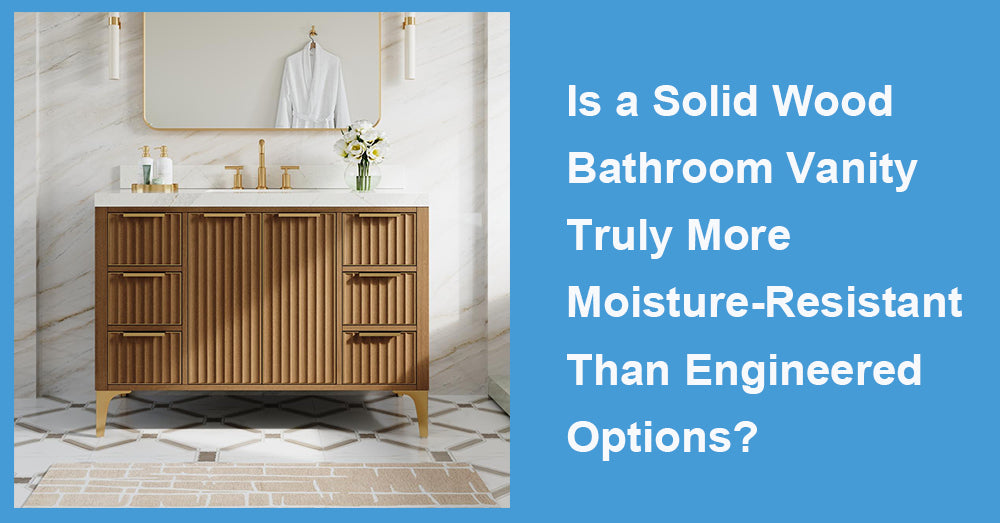
If you are shopping for solid wood bathroom vanities, you have probably heard two conflicting claims: solid wood is “naturally durable” in humidity, but engineered wood is “more stable” around water. Both statements can be true, depending on what the product is actually made of and how it is built, sealed, and maintained. In a bathroom, moisture resistance is less about the label on the listing and more about wood movement, surface protection, edge sealing, and long-term exposure.
What “Moisture-Resistant” Really Means in a Bathroom
Bathrooms expose cabinetry to several types of moisture, and each behaves differently.
· Humidity swings from showers cause wood fibers to expand and contract over time.
· Condensation forms on cool surfaces, especially around sinks and plumbing.
· Liquid water from splashes, leaks, or pooling is the most damaging because it can penetrate seams and edges.
A vanity that tolerates humidity may still fail if water repeatedly gets into unsealed joints or raw edges. True moisture resistance is a combination of material stability plus protective detailing.
How Solid Wood Reacts to Humidity
Solid wood is made from natural lumber. It is strong, repairable, and can last for decades, but it is also “alive” in the sense that it responds to changes in moisture.
The key advantage: structural strength and repairability
Solid wood frames, doors, and drawer fronts can handle years of normal bathroom humidity when the finish remains intact. If the surface gets scratched, it can often be sanded and refinished. Minor swelling or sticking drawers can be corrected by adjustment, shaving, or refinishing rather than replacing the entire cabinet.
The key limitation: seasonal movement
Solid wood expands across the grain as humidity rises and shrinks as it drops. Over time, repeated movement can stress joints if the design does not allow for it. Well-built solid wood components use joinery that tolerates movement and avoid wide, flat panels that are prone to warping.
In short, solid wood can be highly durable, but it is not automatically moisture-proof. It performs best when it is engineered in the right places, such as using solid wood for frames and doors while controlling wide panels and protecting vulnerable edges.
What “Engineered Wood” Covers and Why It Matters
“Engineered wood” is a broad category. Two vanities can both be called engineered, yet behave very differently in moisture.
Plywood: often the best engineered option for bathrooms
Quality plywood uses cross-laminated layers that resist warping and provide strong screw holding. When paired with a good finish and sealed edges, plywood boxes can be very stable in humid rooms.
MDF or particleboard: flat and consistent, but edge-sensitive
MDF and particleboard are smooth and cost-effective, which is why many painted vanities use them. The main risk is water intrusion at exposed edges or unsealed holes. Once water gets in, swelling can be difficult to reverse. A vanity can look perfect for years in normal humidity, then fail quickly after repeated splashes or a small leak under the sink.
So, engineered options can be excellent, but only if the product uses bathroom-appropriate substrates and protects the weak points.
The Finish and Sealing Often Decide the Winner
For both solid wood and engineered materials, the finish system is usually the deciding factor.
A moisture-resistant vanity should have:
· A durable topcoat, such as a catalyzed lacquer or multi-step painted finish.
· Fully sealed edges, including around doors, drawer fronts, and the cabinet base.
· Sealed cutouts and drilled holes, especially around plumbing openings.
· Tight construction that limits gaps where water can sit.
The most common failure is not “the wood type,” but water finding a path into raw material, especially at the bottom edges near the floor or around the sink where splashes are frequent.
Which Is More Moisture-Resistant: Solid Wood or Engineered?
A realistic answer looks like this:
· Against humidity alone, a well-made engineered box (especially plywood) is often more dimensionally stable than all-solid lumber panels.
· Against daily wear and long-term ownership, solid wood doors and frames can be more forgiving because they are stronger and easier to repair.
· Against real water exposure, either option can fail if edges and seams are not sealed, or if leaks are ignored.
So, solid wood is not automatically more moisture-resistant. It can be extremely durable, but engineered construction, when done correctly, can be equally or even more stable in a humid bathroom environment.
What to Look for When Choosing a Bathroom Vanity
Instead of focusing only on “solid wood” vs “engineered,” evaluate the build in a practical way.
1. Cabinet box material
· Prefer plywood for the cabinet box when available.
· If MDF or particleboard is used, confirm that surfaces and edges are well sealed.
2. Door and drawer construction
· Solid wood frames with stable center panels are a strong choice.
· Look for clean joinery and consistent gaps that suggest accurate construction.
3. Protective details at high-risk zones
· A sealed toe-kick and bottom edges.
· Water-resistant coating inside the sink cabinet.
· A design that keeps the vanity slightly off standing water and allows airflow.
4. Hardware and ventilation
Soft-close hinges and glides help doors close tightly, reducing humidity cycling inside drawers. Good bathroom ventilation, such as a properly sized exhaust fan, reduces moisture stress on any material.
Simple Habits That Extend Vanity Life
Even the best vanity benefits from basic care.
· Wipe splashes within a few minutes, especially along seams.
· Avoid leaving wet towels draped over doors where moisture can sit.
· Check under-sink plumbing every few weeks for slow leaks.
· Keep indoor humidity reasonable and run the exhaust fan during and after showers.
These steps matter because most vanity damage comes from repeated small exposures, not one dramatic event.

Bottom Line
A solid wood bathroom vanity can be an excellent choice, but it is not inherently more moisture-resistant than engineered alternatives. In many cases, a plywood-built cabinet paired with well-finished solid wood doors delivers the best balance of stability and longevity. When comparing options, prioritize construction quality, sealing, finish durability, and edge protection. Those factors will do more for real-world moisture performance than a simple material label on the product page.









































Leave a comment
This site is protected by hCaptcha and the hCaptcha Privacy Policy and Terms of Service apply.