






















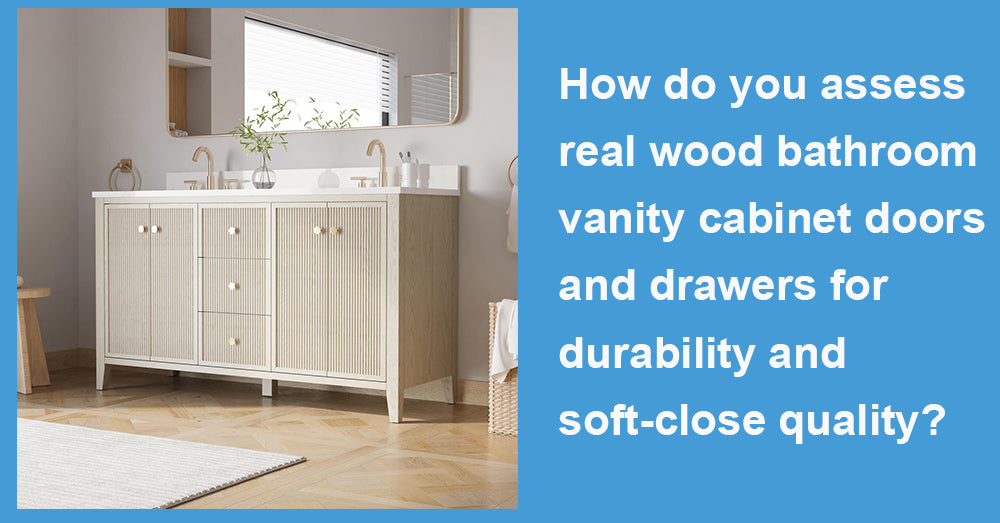
When you are comparing real wood bathroom vanity cabinets, the fastest way to separate “looks good today” from “still feels solid in five years” is to inspect the parts that take daily stress: door alignment, hinge stability, drawer box build, slide performance under load, and whether the soft-close action stays consistent at different closing speeds. Marketing terms like “soft close” and “solid wood” are not enough. You want clues that the vanity could survive standardized durability testing, and you also want simple hands-on checks you can do in a showroom or right after delivery.
1. Start with a durability benchmark you can reference
Even if you never buy a certified product, it helps to know what serious durability testing looks like.
· KCMA’s cabinet quality program describes drawer testing where drawers are loaded at 15 lb per sq ft and operated through 25,000 cycles, and they must remain operable without failure. (Source: KCMA, “Cabinets Certified to Last.”)
· KCMA also describes wall-mounted cabinet load testing where cabinets are gradually loaded up to 600 lb without visible failure (for certain cabinet categories and widths). (Source: KCMA quality certification page and A161.1 standard summary.)
· For hardware, ANSI/BHMA A156.9 explains grade-based cycle expectations, including that 100,000 cycles are required for a Grade 1 hinge (as an example within the standard’s discussion). (Source: ANSI/BHMA A156.9 hardware highlights PDF.)
You do not need to memorize standards. Just use them as a sanity check: if a brand can name their slide system, hinge grade, or testing approach, that is usually a better signal than vague claims.
2. Door durability: what to inspect in 2 minutes
Doors reveal build quality quickly because they show alignment, stability, and how well the cabinet box stays square.
A. Check “reveals” and squareness
Close both doors and look at the gaps around them. You want even spacing along the top, bottom, and center seam. Uneven reveals often mean the cabinet box is racked or the hinges are under-specced.
Quick test: open a door halfway and lift gently at the handle side.
· Minimal movement is normal.
· A loose “clunk” or visible hinge plate flex is a red flag.
B. Inspect the door construction, not just the finish
For real wood doors, the most stable build is usually a frame-and-panel style, where the center panel can move slightly with humidity while the frame stays straight. A one-piece wide solid wood slab can be more prone to seasonal movement if the environment swings humid and dry.
C. Confirm soft-close hinges are doing controlled work
Soft-close should feel like a “catch and glide,” not a slam that suddenly brakes. Test it three ways:
1. Close the door gently from 2 to 3 inches away.
2. Close it from about 8 to 10 inches away.
3. Give it a normal daily push.
A good hinge damper behaves consistently across all three.
3. Drawer durability: judge the box first, then the slides
Slides can be upgraded, but a weak drawer box will always feel cheap.
A. Drawer box construction checks
Pull the drawer out and look at corners and bottom panel support. Stronger drawer boxes typically show:
· Mechanical corner joinery (dovetail or locking joints) rather than only staples.
· A drawer bottom seated in a groove (captured) instead of simply pinned on.
· Thicker sidewalls that resist racking when fully extended.
Quick test: with the drawer fully open, press down gently on the front edge. Excessive flex suggests thin materials or weak joints.
B. Full-extension matters for durability and usability
Full-extension designs reduce the habit of “yanking” drawers to reach items in the back. Less yanking equals less long-term stress on slides and mounting screws. This is even more important in bathrooms where drawers get opened repeatedly for small items.
4. Soft-close drawer slides: what “quality” feels like
Not all soft-close systems are equal. Some rely on a small plastic damper that works only when perfectly adjusted. Better systems feel smooth even when the drawer is moderately loaded.
A. Ask for the slide type and load rating
A practical data point: Blum’s TANDEM undermount slides are commonly listed with a 75 lb dynamic load rating (and higher static ratings depending on the listing), which is a useful reference for what “premium residential” slide capacity can look like. (Source: CabinetParts and Wurth Baer product listings describing TANDEM load ratings.)
If a seller cannot name the slide system or provide a load rating, you can still evaluate performance with simple tests, but documentation is always better.
B. Do the “wiggle test” at full extension
Fully extend the drawer and gently move it left-right.
· A small amount of play is normal.
· Significant wobble suggests weak slides, weak mounting, or a drawer box that is not stiff enough.
C. Do the “two-speed close” test
Soft-close quality is about control, not just quietness.
· Close the drawer slowly and confirm it captures and pulls in smoothly.
· Then close it at normal daily speed and confirm it still glides, without bouncing back or stopping short.
D. Listen for grinding or clicking
A new drawer should not feel gritty. Grinding can indicate misalignment or low-grade bearings. Clicking can signal a soft-close mechanism struggling to engage consistently.
5. Look for alignment under load, not just empty showroom feel
Many drawers feel great empty. Real bathrooms load them with bottles, tools, and backups.
Use a simple “simulated load” idea: place a few items inside (or press down gently with your hand while sliding). A durable system stays smooth and does not twist.
This aligns with how serious testing is described: drawers operating through thousands of cycles while loaded. KCMA describes drawers loaded at 15 lb per sq ft through 25,000 cycles to represent repeated use under load. (Source: KCMA “Cabinets Certified to Last.”)
6. Hardware clues that predict long-term performance
Even if you do not see the brand name on hinges or slides, you can still look for signals that the hardware was not an afterthought.
· Hinges: look for solid mounting plates, multiple adjustment screws, and stable attachment into the cabinet frame or side panel.
· Slides: undermount slides often feel more stable and refined than low-end side-mount slides, but the build quality varies.
If you do see grade language, ANSI/BHMA A156.9 references cycle tests and provides examples like 100,000 cycles for a Grade 1 hinge. (Source: ANSI/BHMA A156.9 hardware highlights PDF.)
7. The practical checklist to use before you commit
Use this as a quick scoring system.
Doors
· Even gaps and flush faces when closed.
· No hinge-side sag, minimal handle-side lift.
· Soft-close engages smoothly from both gentle and normal pushes.
Drawers
· Drawer box corners feel rigid, bottom panel is well supported.
· Full-extension feel is smooth at full pull.
· Minimal wobble at extension.
· Soft-close captures and pulls in consistently, no bounce-back.
Documentation
· Slide type and load rating available (a clear spec is a good sign).
· Any mention of standardized cabinet durability testing is explained clearly, not as a vague badge. KCMA-style testing descriptions include measurable benchmarks like 25,000 cycles and 15 lb per sq ft drawer loading. (Source: KCMA “Cabinets Certified to Last.”)

Bottom line
To assess durability and soft-close quality on real wood bathroom vanity cabinet doors and drawers, focus on repeatable mechanics: stable alignment, rigid drawer boxes, smooth slides under load, and soft-close action that behaves consistently across different closing speeds. Use standardized testing benchmarks as your reference point, then trust the hands-on checks that reveal what marketing copy cannot.










































Leave a comment
This site is protected by hCaptcha and the hCaptcha Privacy Policy and Terms of Service apply.