
















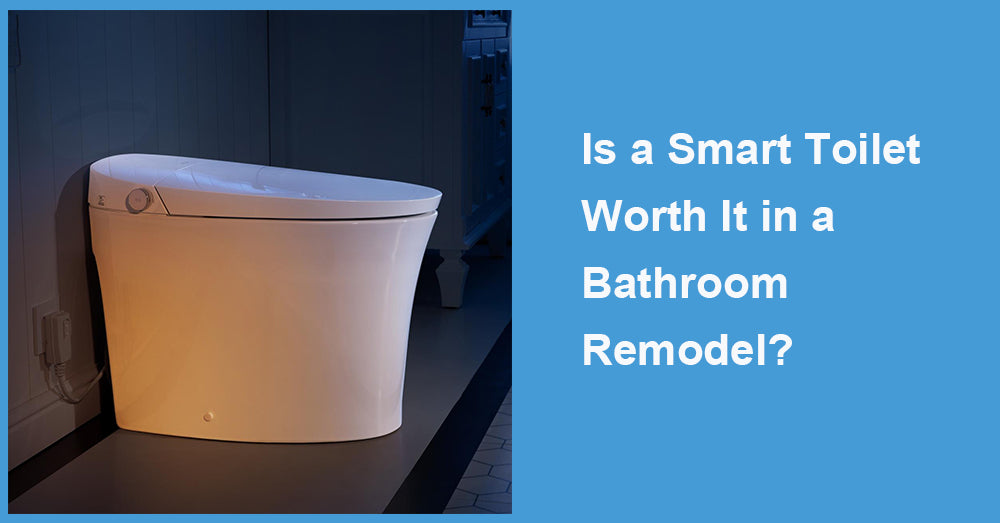
In bathroom renovation discussions, smart toilet are often among the most controversial options. Some people see it as a symbol of comfort and technological upgrades, while others view it as an optional add-on. However, from an industry perspective, whether smart toilets are worth including in renovation plans cannot be judged solely by novelty or price; it should be based on more fundamental factors such as frequency of use, functional value, spatial adaptability, and long-term maintenance costs.
1. In terms of usage frequency, the toilet is the most essential device in the bathroom
Among all bathroom equipment, the toilet has the highest frequency of use and is almost irreplaceable by other devices. Unlike bathtub or shower systems, toilet use is highly rigid, meaning any improvement or deficiency in experience will be repeatedly amplified in daily life.
Industry research shows that toilet use is much higher than that of washbasins or shower equipment. This is also why optimizing the comfort and stability of the toilet in functional upgrades can often significantly enhance the overall bathroom experience.
2. Intelligent functions are not just gimmicks, but are targeted at real pain points during use
The core value of smart toilets lies not in the technology itself, but in addressing long-standing pain points of traditional toilets.
For example, automatic flushing, seat heating, warm water cleaning, and warm air drying are all functions centered around "reducing manual operation" and "improving user comfort. For high-frequency usage scenarios, the value of such functions is not one-time, but continuously reflected in long-term use.
From industry feedback, once users form stable usage habits, their acceptance of traditional toilets often decreases significantly.
3. Size and installation conditions determine feasibility
Whether it is suitable to install smart toilets in renovation projects depends first on the space conditions and infrastructure.
In terms of size, the overall length of most smart toilets is concentrated at 26-30 inches, similar to standard toilets, but the rear structure is usually more complex and requires higher reserved space. The clear distance behind the wall, the location of the water supply, and the socket layout will directly affect the feasibility of installation.
In addition, a reasonable forward activity space of at least 24 inches should be provided to ensure comfort during use and maintenance. If the bathroom itself is compact, a more detailed layout evaluation is needed during the planning stage.
4. The change in cleaning methods is the core of experiencing differences
The traditional toilet mainly relies on paper cleaning, whereas the intelligent toilet switches to warm-water cleaning. From an industry perspective, this is not simply a "higher-end" change, but a structural shift in cleaning methods.
Warm water cleaning has significant advantages in cleaning efficiency and comfort, while also reducing dependence on consumables. In the long term, such changes often have greater value than appearance upgrades.
In addition, some smart toilets are equipped with automatic deodorization and self-cleaning nozzle features, which help maintain a stable sanitary environment.
5. Energy consumption and water use efficiency have not significantly increased
A common concern about smart toilets is whether energy consumption and water use will increase significantly.
According to industry data, modern smart toilets are quite mature in terms of standby energy consumption control and water efficiency. The amount of water required for a single cleaning and flushing is similar to that of efficient traditional toilets. In contrast, seat heating and warm water systems often use instant heating or energy-saving modes, resulting in lower energy consumption when not in use.
Therefore, under reasonable usage conditions, smart toilets will not become a significant energy burden.
6. Maintenance and reliability are key to rational decision-making
In renovation projects, any equipment with high integration must be considered for long-term maintenance.
Based on industry experience, the reliability of smart toilets largely depends on the quality of internal components and the overall design maturity. Models with clear structures and restrained functions are often more stable in the long term.
In addition, clarifying the power supply, waterproof rating, and accessibility for later maintenance before installation are essential factors to consider during the renovation phase.
7. Value differences under different family structures
Smart toilets do not have equal value for all households, and their actual benefits may vary depending on the user structure.
In multi-member households, the high-frequency use advantage of smart toilets is more obvious; in households that emphasize comfort and health, their cleaning methods and convenience are often better recognized. Relatively speaking, if the frequency of use is low or the renovation budget is limited, its priority may need to be reassessed.

8. Looking at investment return from the renovation cycle
From an industry perspective, a complete bathroom renovation typically lasts 10-15 years for its core equipment. During this cycle, the toilet is hardly replaced frequently.
Choosing whether to introduce smart toilets is essentially making a centralized decision for many years to come. Instead of regretting the inconvenience of using smart toilets after renovation, it is better to conduct a rational evaluation of their long-term value during the planning stage.
9. Conclusion
There is no unified answer as to whether smart toilets are worth including in bathroom renovation plans. A truly reasonable judgment should be based on a comprehensive analysis of usage frequency, spatial conditions, functional requirements, and long-term maintenance capabilities. For renovation projects that focus on comfort, efficiency, and long-term experience, smart toilets are often not just a functional upgrade, but a change in usage.



















Leave a comment
This site is protected by hCaptcha and the hCaptcha Privacy Policy and Terms of Service apply.