






















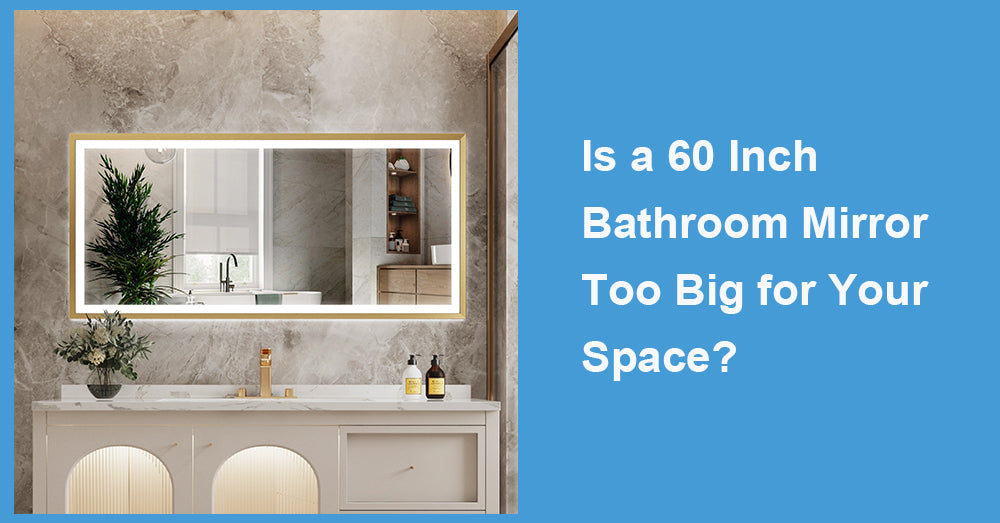
What you've always worried about isn't whether the mirror is "expensive," but whether it will look "oppressive," "crowded," or "out of proportion" once installed. A 60-inch bathroom mirror is indeed a size that can easily elevate the aesthetic quality—or just as easily backfire. It's not about being absolutely large or small, but whether your wall, vanity, lighting, and negative space can "carry" it. When the logic is sound, a 60 inch bathroom mirror becomes one of the most hassle-free and sophisticated choices.
Forget "Is it big?"—Ask "Where will it impact?"
A 60-inch mirror affects three key areas simultaneously:
Proportion: The mirror's width defines the visual center of the countertop area, directly influencing whether the space feels "upscale" or "top-heavy."
Traffic flow: Whether either side will bump into corners, door frames, switch plates, towel rings, or tall cabinet edges.
Lighting: Wider mirrors are more likely to clash with side sconces, vanity lights, or overhead spotlights, leading to positional conflicts or glare.
The real key is: Have you left "breathing space" and "lighting space" around the mirror?
Quickest Judgment Method: Check if Your Vanity is Close to 60 Inches
If your vanity itself is 60 inches (standard for double sinks), a 60-inch mirror typically isn't oversized—it creates harmony and unifies the countertop area.
A safer proportion: Make the mirror slightly narrower than the cabinet, leaving a small margin on each side. This makes the mirror appear securely supported by the cabinet, avoiding the oppressive feel of "filling the entire wall."
If your vanity is only 48 inches, 42 inches, or even smaller, installing a 60-inch mirror can lead to two awkward outcomes:
The mirror dominates the space, making the cabinet play a supporting role and throwing off the overall proportions.
Insufficient space on either side forces lighting fixtures or hardware into cramped positions, creating a cluttered look.
You think you're measuring the mirror, but you should actually measure the "net wall width."
Many people only measure the cabinet width, overlooking the actual usable net width on the wall:
Is there a door frame or corner trim on the left?
Are there tall cabinets, shower partition edges, towel bars, or shelves on the right?
Are switch plates or outlets near the mirror's edge?
Ideally, leave a small gap on both sides of the mirror. Even minimal space makes it appear lighter and more defined. Defined edges prevent the mirror from looking oversized, instead creating a clean, crisp look.
Height determines "oppressiveness": Hanging too low makes even the perfect fit feel cramped
Much of the "too big" feeling isn't caused by width, but by hanging the mirror too low:
When the bottom edge sits too close to countertops, it feels like a heavy panel pressing down.
Insufficient headroom above the mirror makes walls appear "sealed off."
Practical tip: Create adequate space between the mirror's bottom edge and countertop while ensuring the mirror's center aligns with your natural line of sight during daily use. At a comfortable height, even a 60-inch mirror will blend as "part of the space" rather than a "forced addition."

When is a 60-inch mirror "just right"?
If you meet any two of the following criteria, a 60-inch mirror will likely deliver outstanding results:
Your vanity is about 60 inches wide, and you want a cohesive, modern countertop area.
The wall is clean, without prominent door frames pinching the sides or tall cabinets looming overhead;
You want the space to feel brighter and more open, with the mirror serving as a visual "expansion" tool;
You prefer frameless or ultra-narrow-frame styles for a lighter visual weight.
In these cases, 60 inches isn't "too big"—it's perfectly proportioned.
When does it become "too big"? Common pitfalls
Cabinet is noticeably smaller: A mirror wider than the cabinet creates an unbalanced, top-heavy look.
Squeezed between walls: Door frames, corners, or tall cabinets trap the mirror in the middle, forcing edges to hug the walls and instantly making the space feel cramped.
Planned wall sconces but insufficient wall width: The mirror occupies the entire space, forcing sconces into awkward positions. Disrupted proportions make the setup look cheap.
Narrow bathroom layout: An overly broad mirror turns the counter area into a "full-wall" feature. Lacking negative space creates a suffocating effect.
If you glance at it and think, "Why does it feel so crowded?", it's likely one of these four issues.
Love Large Mirrors but Fear They'll Look Awkward? Three More Stable Choices
Slightly Smaller Than the Cabinet
For a grand yet sophisticated look, the most stable approach is to choose a slightly narrower mirror, leaving breathing space on both sides. You'll notice that just a slight difference makes a significant impact on the overall feel.
For a 60-inch double sink, use two mirrors to create distinct zones. This enhances visual refinement, facilitates placement of side sconces, and achieves a more designer-inspired look.
Functional Oversized Mirrors
Opt for mirror cabinets or illuminated mirrors. Transform "bulk" into "functionality." Even oversized mirrors won't feel like mere space-wasters when they serve a purpose.
Style Can "Steal Volume": Same 60-Inch Mirror, Dramatically Different Appearance
Why does the same 60-inch mirror look like a hotel suite in one bathroom and a giant pane of glass on a wall in another? The key lies in style:
Frameless/Ultra-Narrow Frames: Lighter boundaries make large sizes appear more airy.
Thick/Dark Frames: Stronger visual weight can feel oppressive in small bathrooms.
Rounded rectangles or arches: Softer lines mitigate the harshness of a "wall-to-wall" design.
If your bathroom is already compact, prioritizing lightweight borders matters more than obsessing over 1–2 inches.
Conclusion: 60 inches isn't "too big," it's about "getting it right."
If your cabinet is close to 60 inches, there's space on both sides of the wall, and the lighting fixtures aren't in conflict, a 60-inch bathroom mirror can instantly elevate the space, making it brighter, tidier, and more like a luxury hotel.
However, if your cabinet is noticeably smaller, space is constrained on both sides, or wall sconces are tightly positioned, avoid forcing a full-width mirror. Opt for a slightly narrower mirror with breathing room around the edges. This creates a more elegant, enduringly pleasing proportion.









































Leave a comment
This site is protected by hCaptcha and the hCaptcha Privacy Policy and Terms of Service apply.