






















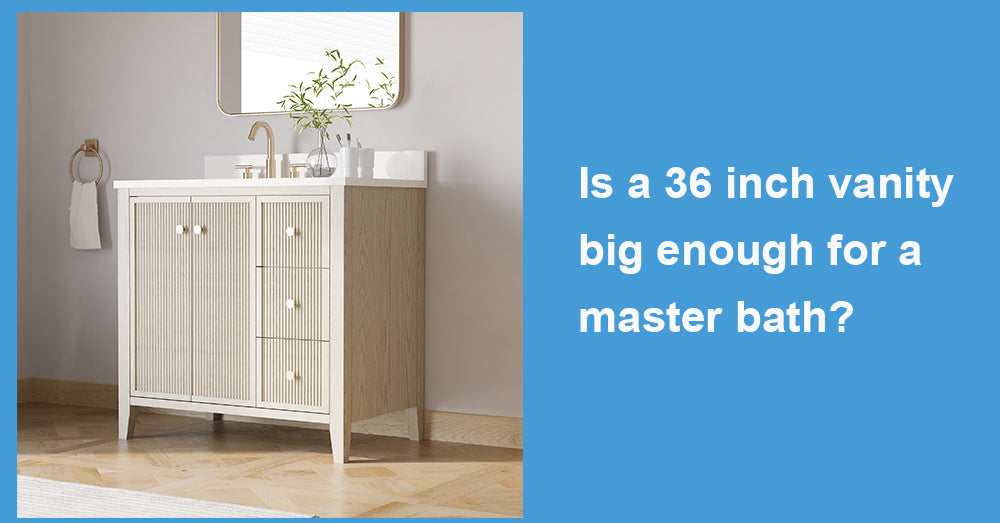
In master bathroom planning, a 36 inch vanity is often considered a representative specification for the "starting size". It is not only a standard configuration for many high-end projects, but also the most common choice in space-constrained layouts. But for larger, more frequently used, and functionally complex main bathroom spaces, whether a 36-inch bathroom cabinet is truly "sufficient" cannot be answered solely by size. From the perspective of industrial design and ergonomic data, the adaptability of this size depends on the coordinated relationship among layout, number of users, storage structure, and the overall space ratio.
1. Positioning of a 36-inch size in the central bathroom system
In mainstream residential design, standard specifications for bathroom cabinet width are concentrated in four intervals: 30 inches, 36 inches, 48 inches, and 60 inches. Among them, 36 inches is considered the watershed size for transitioning from "guest guard level" to "main guard level".
From the perspective of space occupancy:
Standard cabinet width: 36 inches
Common depth: 20 inches -22 inches
Table height: 32 inches -34 inches
On the premise of maintaining the standard channel width, the minimum clear width for the main bathroom with a 36-inch cabinet is usually between 60 and 66 inches to ensure at least 36 inches of operating channel in front of the washing area. This is also the minimum comfort level for single-person washing areas in most design specifications.
2. Single main guard usage scenario: 36 inch is usually "just qualified"
In a main bathroom primarily designed for daily use by a single person, the 36-inch functional configuration can meet basic needs. Industry ergonomics research shows that when washing alone, a countertop with an effective operating width of 30 inches or more can cover the main action areas, such as brushing teeth, skincare, and shaving.
On a standard 36-inch cabinet:
The width of a single-basin sink typically ranges from 18 to 21 inches.
The total remaining operating table on both sides is approximately 12 inches to 16 inches.
This configuration is reasonable for "single person high-frequency use" and can also ensure basic storage capacity. The storage capacity in a typical 36-inch cabinet is mainly concentrated in the 3.5-4.5 cubic feet range, which can accommodate daily toiletries, towels, and cleaning tools.
But the problem is that this configuration does not allow for "parallel use", and it is also challenging to perform the functions of the makeup, grooming, and organizing areas.
3. Dual master and parallel use: structural limitations of 36 inches begin to emerge
In scenarios where two main guards are used or during rush hour, the 36-inch limit is very apparent. Industry space utilization statistics show that when the width of the washing area is less than 48 inches, the efficiency of two-person parallel operation decreases by more than 40 percent, and the frequency of conflicts significantly increases.
The main limitations are reflected in three points:
Insufficient spacing between sinks
At 36 inches, it is almost impossible to arrange a double-basin structure. Even if double pots are forcibly set, the center-to-center distance between single pots is usually less than 18 inches, severely limiting elbow and shoulder movement.
The tabletop operation area is extremely compressed
After placing electric toothbrushes, skincare bottles, and hair dryers, the usable flat surface quickly decreases, increasing the likelihood of messy countertops.
The upper limit of storage capacity is too low
When the number of users increases from 1 to 2, the required storage volume usually increases by 70 percent -100 percent, and a 36-inch cabinet is difficult to carry for extended periods.
That is also why in high-end central bathroom planning, 48 inches is often considered the "starting size for two people".
4. Spatial proportion and visual scale: 36 inches tends to appear smaller in large main bathrooms
In main bathroom spaces with a net area exceeding 80-100 square feet, 36-inch cabinets often appear narrow in proportion. According to the visual design evaluation data, when the ratio of bathroom cabinet width to the entire wall is less than 40 percent, the spatial "sense of center" is significantly weakened, and the overall appearance appears scattered and unstable.
For example:
Wall width 84 inches
The 36-inch cabinet only occupies about 43 percent of the wall surface
At this ratio, additional compensation is often required through mirror cabinets, side cabinets, or decorative panels; the overall sense of grade and integrity will significantly decrease.

5. Function integration capability: the 36-inch expansion space is minimal
The modern main bathroom is no longer just a "face washing area", but integrates multiple high-frequency functions:
Electric shaving and grooming
Skincare and makeup
Hairdryer and styling
Socket and charging area
Industry functional layout data show that when the tabletop width is less than 42 inches, the feasibility of accommodating both the washing, makeup, and electrical areas decreases significantly. 36-inch cabinets often prioritize functionality, making it challenging to achieve multitasking collaboration.
That is also why more and more primary healthcare projects are adopting:
48-inch single pot
60-inch double basin
As a mainstream configuration solution.
6. Resale value and long-term adaptability: conservative advantage and upper limit of 36 inches
From the perspective of the house's long-term value, the advantage of a 36-inch is its strong versatility and low renovation cost. It is almost compatible with all standard water supply and drainage spacing, flexible for later replacement, and highly accepted by future buyers.
However, in high-end and improved residential properties, industry transaction feedback shows that:
Units with main bathroom configuration ≥ 48 inches
Display ratings that are on average 10 percent -15 percent higher under similar conditions
The sense of spatial sophistication and functional completeness is significantly better
This means that 36 inches is a "safe choice" at the resale level, but it is difficult to become a "bonus point".
7. From industry experience, when is 36 inches the "best solution for sufficient use" and when is it "clearly too small"
A more reasonable criterion for judgment is not whether one is the main guard or not, but whether the following four conditions are met simultaneously:
Suitable for selecting a typical 36-inch scenario:
One person mainly uses the main guard
Net width in the range of 60-66 inches
No planning for double basins and large makeup areas
Medium storage demand
Typical scenarios that are noticeably smaller:
Dual high-frequency parallel use
The net width of the main bathroom exceeds 72 inches
Plan to arrange dual basin or independent grooming areas
High requirements for spatial grade sense
8. Conclusion
Returning to the original question: Is a 36-inch vanity big enough for a master bath?
The answer is: under the conditions of "single main bathroom, small and medium-sized space, and restrained functional requirements", it is a reasonable and safe choice; But in the central bathroom system of "double occupancy, ample space, and pursuit of long-term comfort and grade", 36 inch is often only the "minimum qualification line" rather than the ideal configuration.
The true determinant of whether it is "sufficient" is not just the size of numbers, but the comprehensive results of spatial proportions, usage structure, and future adaptability. A suitable main bathroom cabinet is not only capable of holding a washbasin, but also a core component that can sustain the pace of life for the next decade.








































Leave a comment
This site is protected by hCaptcha and the hCaptcha Privacy Policy and Terms of Service apply.