






















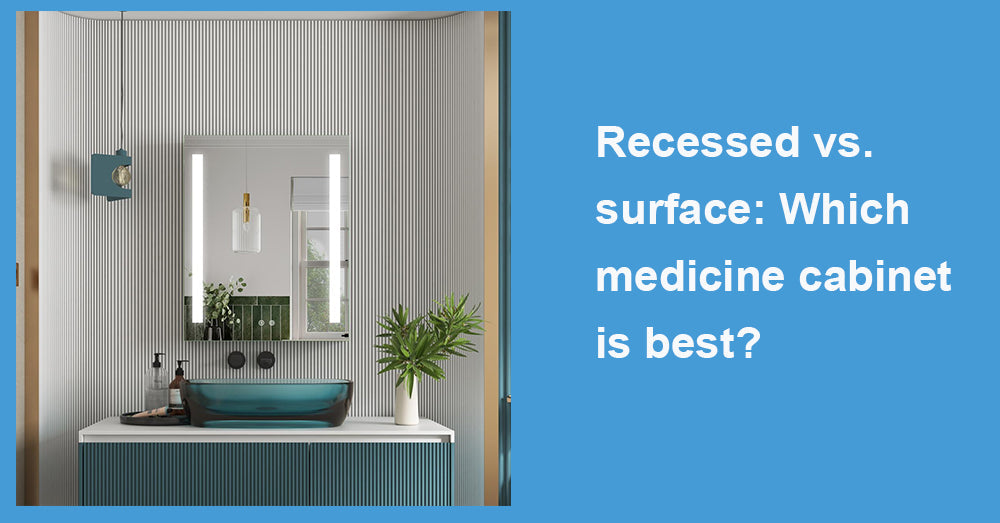
In modern bathroom planning, the bathroom medicine cabinet with mirror is no longer just a storage unit; it is a core component that integrates lighting, mirrors, and spatial design. With the continuous refinement of residential bathroom functions, the choice between recessed and surface mount installation methods directly affects storage efficiency, construction complexity, and overall visual effects. From the perspective of industry design and installation data, both solutions have their own advantages. The truly "most suitable" choice often depends on the spatial structure and usage mode, rather than simply preference.
1. The fundamental differences between the two structures
An embedded medicine cabinet has the cabinet body embedded in the wall interior, leaving only the mirror door exposed; the surface-mounted type mounts the entire cabinet to the wall surface. The standard width specifications are concentrated in 18 inches, 24 inches, and 30 inches, and the height is mostly between 24 inches and 36 inches. The depth of the cabinet is generally between 4 inches and 6 inches.
Under the same width conditions, embedded systems can leverage the wall thickness to achieve a larger internal volume. In contrast, surface-mounted systems rely entirely on the depth of the cabinet itself.
2. The core advantage of embedded systems: higher space utilization
The most prominent advantage of embedded medicine cabinets is their larger storage volume. Taking the standard 24-inch width x 24-inch height specification as an example, the embedded interior can achieve a net depth of nearly 4.5 inches, which is sufficient to accommodate most washing bottles with a height of around 6 inches.
Industry residential design data shows that in bathroom spaces with a net width of no more than 60 inches, embedded solutions can increase storage capacity by approximately 20%-30% without occupying additional access space. At the same time, the mirror is flush with the wall, making the overall facade more straightforward and significantly reducing visual clutter.
For main bathrooms with high storage requirements, limited space, or a minimalist aesthetic, an embedded design is often the ideal solution.
3. Advantages of surface-mounted: flexible installation, friendly modification
The most significant advantage of surface-mounted medicine cabinets is their low construction difficulty and strong adaptability. No need for wall slotting, can be directly fixed on existing walls, suitable for:
Completed renovation projects
Areas with dense pipelines inside the wall or load-bearing walls
Renovation scenarios with a tight schedule or a limited budget
Industry installation statistics show that the construction time of surface-mounted mirror cabinets is usually shortened by more than 40% compared to embedded cabinets, and the overall installation cost can be reduced by 20%-30%. At the same time, later disassembly, replacement, and maintenance are more convenient and have minimal impact on the wall structure.
In rental housing, partial upgrades, or phased renovation projects, surface-mounted construction is often a more secure choice.

4. Storage structure comparison: volume vs. flexibility
Embedded systems have an advantage in "total capacity", while surface-mounted systems have a greater advantage in "spatial segmentation flexibility". Due to the exposed cabinet, the surface-mounted type is more likely to form a multi-layer classification structure through adjustable shelves, allowing products of different heights to be placed in their respective positions.
Industry usage research shows that in households with more than 25 types of daily necessities, a reasonable hierarchical structure can improve retrieval efficiency by more than 30%. This is also an important reason why many multi-family families prefer surface-mounted mirror cabinets.
5. The influence of visual and spatial proportions
On the main bathroom wall with a width exceeding 72 inches, embedded mirror cabinets are more likely to create a continuous visual connection across the entire wall, enhancing the overall sense of style and grade. Especially in the 36-inch to 48-inch wide mirror configuration, embedded technology makes it easier to achieve the advanced effect of a "full mirror wall".
In small and medium-sized spaces, if the frame design is appropriate and the thickness is controlled within 5 inches, the surface-mounted design can also maintain a good sense of proportion and create design highlights through frame colors or light strips.
6. Moisture resistance and long-term stability
The potential risk of embedding lies in the moisture-proof treatment inside the wall. If the waterproof layer behind is not in place, long-term moisture may cause deformation of the laminated board or rusting of the hardware. Industry maintenance cases show that about 60% of early failures in embedded mirror cabinets are related to wall moisture.
The surface-mounted type offers more exposed space, better ventilation, and a relatively lower dependence on the installation environment. Its long-term stability in high-humidity bathrooms is easier to solve by improving ventilation.
7. How to choose a more reasonable one
From industry experience, the criteria for judgment can be simplified into four points:
Suitable for embedded scenarios:
Compact space but high storage requirements
New house or overall renovation stage
Pursuing a minimalist or high-end overall feel
Suitable for surface-mounted scenarios:
Renovation of existing space
The wall structure is restricted
Requires flexible adjustment or later replacement
8. Conclusion
Returning to the question itself: Recessed vs. surface: Which medicine cabinet is best?
The answer is not about which one is "more advanced", but about which one is more suitable for your spatial structure and usage. Embedded systems emphasize spatial efficiency and visual integrity, while surface-mounted systems emphasize flexibility and construction friendliness.
A genuinely excellent bathroom medicine cabinet with a mirror not only holds items, but also maintains structural stability, smooth storage, and natural integration with the overall bathroom style over many years of use. Choosing the correct installation method is often more important than selecting the size itself.







































Leave a comment
This site is protected by hCaptcha and the hCaptcha Privacy Policy and Terms of Service apply.