






















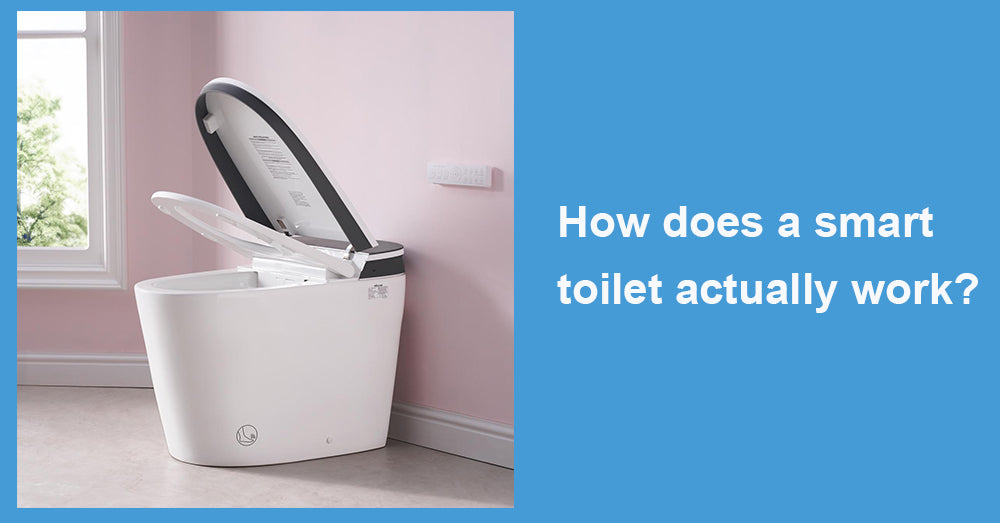
In the trend of bathroom upgrades in recent years, smart toilet are gradually shifting from "high-end optional" to core functional products. Compared to traditional toilets, smart toilets not only integrate heated seats, automatic flushing, and deodorization systems but also include sensing, heating, spraying, and electronic control modules, forming a highly integrated electromechanical system. From an industry perspective, smart toilets are not simply "multifunctional toilets" but comprehensive devices that integrate fluid control, electric heating, sensing technology, and human-computer interaction. Truly understanding its working principle helps to assess its long-term reliability and practical value.
1. The infrastructure of smart toilets: upgrading from mechanical equipment to electronic systems
From the perspective of appearance, most household smart toilets are about 26 to 30 inches long, 15 to 17 inches wide, and 15 to 17 inches high, which is highly compatible with traditional toilets. The real difference lies in the internal structure.
The core system usually consists of five modules:
Inlet and stabilizing system
Heating system (i.e., thermal or thermal storage)
Spray bar and spray washing control system
Sensing and control system
Drainage and automatic flushing system
Unlike traditional toilets that rely solely on mechanical drainage, smart toilets integrate multiple sets of solenoid valves, water-diversion valves, and electronic control boards, all of which are scheduled in real time by the central control system.
2. Heating and water supply: why instant heating systems have become the mainstream solution
Early smart toilets often used thermal storage tanks for heating, but as power and safety standards improved, mainstream products have now entirely shifted to instant heating systems. Its working logic is: when the sensor detects that the user is seated and the spray washing function is activated, cold water immediately enters the heating module, is heated to the set temperature within a few seconds, and then delivered to the spray bar.
Industry testing data shows that:
The start-up heating time of the instant heating system is usually completed within 3-5 seconds
The water temperature regulation range is mostly between 95 °F and 104 °F
Steady state effluent temperature fluctuation controlled within ± 1 °F
The advantage of this approach is that:
Unrestricted by water tank capacity, can be used continuously
Avoid the problem of water quality aging caused by long-term water storage
More controllable energy consumption
In high-end models, the heating module's power is mainly concentrated in the 1200W-1400W range, which is also why smart toilets require dedicated power sockets.
3. Spray washing system: key to precise angle and water pressure control
The spray washing system is the most essential functional unit of an intelligent toilet. The spray bar is usually hidden behind the seat ring and extends automatically upon activation. The industry-standard spray bar stroke range is 3-5 inches, which can be adjusted for front and rear positioning via a stepper motor or servo mechanism.
Water pressure control is usually divided into 3-5 levels, with a stable outlet flow rate of 0.15-0.25 gallons/min. Industry tests have shown that when the spray angle error is controlled within ± 2 °, cleaning efficiency and comfort are significantly better than with fixed-nozzle structures.
High-end models will also be equipped with:
Pulse water flow mode
Oscillatory spray washing mode
Female-specific nozzle angle
These functions are not simply "diverse", but by changing the structure of the water column, reducing single point impact, and improving cleaning uniformity.
4. Seat heating: long-term stability of a low-power constant temperature system
The heating seat ring is one of the most direct components that users perceive. The standard seat width is about 14-15 inches, with low-power heating film or heating coil embedded inside. Industry design standards typically specify a surface temperature range of 91 °F to 97 °F for seat rings to avoid discomfort from high temperatures or excessive energy consumption.
In energy-saving mode, the system will reduce power when the system is unmanned and quickly restore the target temperature after the sensor detects seating. Long-term test data show that the temperature recovery time of mature solutions usually does not exceed 60 seconds, and daily energy consumption is only a small fraction of that of traditional bathroom heaters or underfloor heating systems.
5. Sensing and automatic control: from "sensing flushing" to complete process management
Modern smart toilets are commonly equipped with multiple sets of sensors, including:
Infrared human body sensing
Seat ring pressure sensing
Water level detection sensor
Temperature sensing
When the user approaches, the system can automatically turn on the seat ring or night light, unlock the spray washing and heating functions after sitting down, and automatically start flushing after getting up. Industry statistics show that in automatic flushing mode, the flushing delay is usually controlled between 2 and 5 seconds to avoid accidental triggering and ensure hygiene.
More importantly, the intelligent system can automatically switch to water-saving mode based on usage status. The standard single-flush water volume is 0.8-1.3 gallons, which significantly improves water-saving efficiency compared to traditional toilets, which commonly use 3-5 gallons.
6. Deodorization and air circulation: not just a simple fan structure
The deodorization system of smart toilets is usually completed by combining activated carbon filters with micro fans. When the sensor detects the seating status, the fan begins to create a slight negative pressure inside the seat ring, drawing odorous air into the filtering module and discharging it. Industry testing shows that:
The deodorization start-up time is usually within 10-20 seconds
The effective odor reduction rate can reach 70%-90%
This "local negative pressure adsorption" method is more direct and effective than simple air fresheners or external ventilation.

7. Security system: multiple protection mechanisms between electricity, water, and the human body
Due to the direct contact between water, electricity, and the human body, the safety system design of smart toilets is particularly critical. Mainstream products generally adopt:
Leakage protection module (cut-off time less than 0.1 seconds)
Low voltage control circuit (mostly DC 12V-24V)
Waterproof level not lower than IPX4
In abnormal situations, such as abnormal water pressure, temperature exceeding the limit, or circuit abnormalities, the system will immediately interrupt heating and spraying. This is also the basic guarantee for the long-term stable operation of smart toilets in high-humidity environments.
8. From an industry perspective: where is the actual technological value of smart toilets
From an engineering perspective, the core value of smart toilets does not lie in the "number of functions", but in three points:
Stable control of water temperature, water pressure, and injection angle
Long-term reliability of electronic systems in high-humidity environments
Systematic optimization of water conservation and energy efficiency
Multiple residential equipment lifespan statistics show that smart toilets with mature structural design and electronic protection can generally have a stable service life of 10-15 years or more, and key modules (heater, spray bar, electric control board) can be independently maintained and replaced.
9. Conclusion
Returning to the original question: How does a smart toilet actually work?
It is not a "toilet with electricity installed", but a complex electromechanical device that integrates a heating system, a precision water control system, a sensing system, and a safety system. From water intake, heating, spraying, and deodorization to automatic flushing, every step is precisely coordinated by an electronic system.
When these systems remain stable, quiet, water-saving, and operate safely after years of use, the value of smart toilets is truly reflected: it is not just a configuration to enhance comfort, but also an engineering-level solution to improve the hygiene experience and long-term usage efficiency.









































Leave a comment
This site is protected by hCaptcha and the hCaptcha Privacy Policy and Terms of Service apply.