






















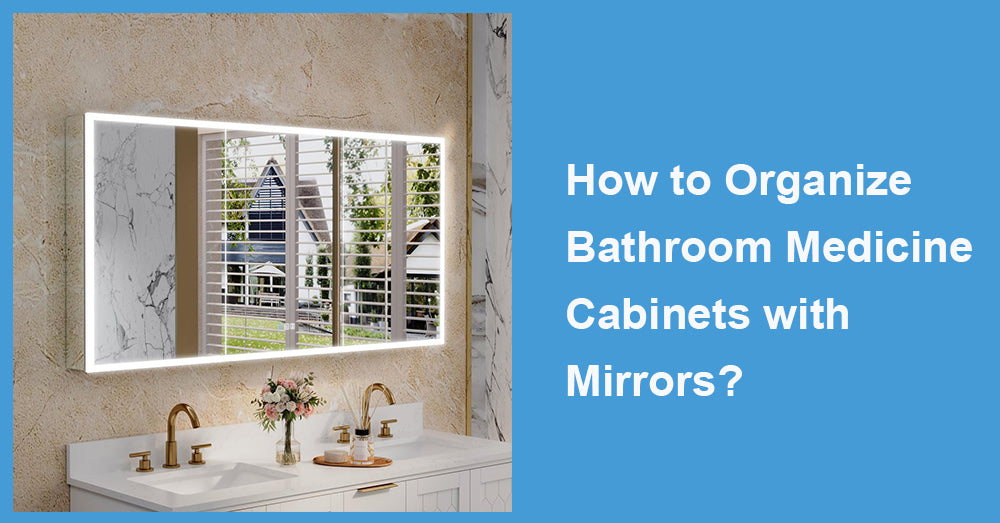
Many people assume that too many items make a medicine cabinet messy. In reality, the more common reasons are the absence of "designated spots" and "usage logic." When you're rushing in the morning and evening with wet hands, any step that requires thinking—"where to put this?" or "where to find that?"—can throw the entire system into chaos. Once the cabinet gets messy, the countertop follows suit; once the countertop gets dirty, the whole bathroom instantly loses its polished feel.
The most significant advantage of bathroom medicine cabinets with mirrors is their dual capability: concealing clutter to enhance visual tidiness while keeping frequently used items within easy reach. Below is a more comprehensive, sustainable organization method you can complete in one go or split into two sessions.
Before organizing, define the "mirror cabinet's scope of responsibility."
The mirror cabinet isn't meant to hold everything in the bathroom. First, decide what must go in the mirror cabinet and what should be moved to the vanity cabinet, drawers, or other locations.
We recommend that the mirror cabinet primarily handle these two categories:
A. Daily High-Frequency Access Zone (used every day)
Toothpaste, dental floss, daily skincare, contact lens care, shaving supplies, deodorant/antiperspirant, regular hair wax or styling products, lip balm, cotton swabs, etc.
B. Light Stockpile & Emergency Zone (used occasionally but must be easily accessible)
Band-Aids, disinfectant wipes, thermometer, common pain relievers/ allergy medication, travel-size items, small tools (nail clippers, tweezers, etc.).
Items not recommended for long-term storage in mirror cabinets:
Bulk stockpiles (overcrowd the space, leading to "the more you organize, the messier it gets")
Items clearly susceptible to moisture or requiring strict storage conditions (as needed)
Low-frequency, bulky items (e.g., large hair masks, oversized tub cleaners)
The key to a functional mirror cabinet isn't "how much it holds," but "how easily you can access items."
Empty: Removing everything at once is 3x more efficient than sorting as you go
Take everything out of the cabinet. Lay a towel or paper towels on the countertop and quickly sort items into these four piles (don't overthink it—just pile):
Daily use
Weekly/occasional use
Emergency meds/first aid supplies
Discard/expired/duplicates/unused.
This step often reveals a stark reality: you'll discover "half the cabinet's contents you barely touch." Removing these items means you're halfway to a successful mirror cabinet overhaul.
Your goal isn't "more detailed categorization," but "shorter routines."
The biggest mistake many people make when organizing is over-categorizing. The more detailed the categories are, the harder it is to stick to them. We recommend dividing your mirror cabinet by "usage scenarios" instead, because your daily actions are scenario-driven:
l Morning Zone: Cleansing, moisturizing, sunscreen, shaving/styling, deodorant
l Evening Zone: Makeup removal, repair, serum, lip care
l Emergency Zone: Band-Aids, disinfectant, pain relief/fever reducers, allergy relief (adapt to household needs)
l Guest Zone: Disposable toothbrushes, travel-size products, cotton swabs/pads, spare hair ties
l Tool Zone: Nail clippers, eyebrow tweezers, tweezers, small scissors, spare razor blades
Imagine brushing your teeth half-asleep: You won't think "toothpaste belongs in oral care"—you want "to grab it instantly." That's the value of scenario-based organization.
Define the "Golden Tier" first, then organize the other tiers
The most accessible space in your mirror cabinet is typically between eye level and chest height. Define this as the "Golden Tier." The rule is simple:
Only place 10–15 "daily essentials" in the Golden Tier.
After placing items, ask yourself:
If I'm rushing tomorrow morning, is this item worth its prime spot?
If the answer is no, move it to one of these two zones:
Less-frequent layer (weekly use)
Stockpile/emergency box (low-frequency but must be accessible)
You'll notice: Once the golden layer is sparse, your mirror cabinet instantly feels "premium, uncluttered, and easy to maintain."
Tackling the Three Most Challenging Items to Organize: Tall Bottles, Tubes, and Round Containers
Mirror cabinets easily become cluttered, often due to these three types of items:
Tall Bottles (Sprays, Sunscreen, Styling Products, Small Mouthwash Bottles)
l Method: Group them on one side and arrange vertically from tallest to shortest.
l Key Point: Avoid scattering tall bottles across multiple shelves, as they'll knock into each other.
l Tubes (toothpaste, cleanser, hand cream)
l Method: Consistently position all tubes with the "end facing outward" or "end facing inward."
l Benefit: Prevents knocking over adjacent tubes when you grab one.
l Round jars (face cream, hair wax, cleansing balm)
l Method: Place in shallow trays; pull out the entire tray when retrieving.
l Benefit: Round jars roll easily; trays keep them stable and organized.

Medicine organization: Three rules for safety and order
Don't scatter medicines across shelves—you'll rummage through the cabinet every time you need something.
Recommend the "3-Box System":
Frequently Used Medications: Pain relievers, allergy meds, digestive aids, etc. (based on household needs)
First Aid Supplies: Band-Aids, antiseptic wipes, gauze, iodine solution, etc.
Prescription/Personal: Medications clearly belonging to one person, stored in a separate box
Add a lightweight maintenance point:
Quickly check for expirations every 3 months (it really takes just 3 minutes)
For households with children/pets: Store medications on higher shelves and consolidate them in boxes to reduce the risk of accidental ingestion.
Electric devices are the "most chaotic"—designate a dedicated appliance zone
Electric toothbrushes, razors, replacement brush heads, blades, cleaning solutions, charging cables... Without a "fixed corner," they will plunge your mirror cabinet into perpetual disarray.
Recommended approach:
Designate an appliance zone (in one corner of the mirror cabinet)
Store replacements in a small labeled box: e.g., "Brush Heads/Blade Heads."
Keep cleaning solutions separate from medications to avoid mix-ups.
Group cables on one side without crossing shelves (crossing leads to tangles and visual clutter)
Even without outlets, establish the "electronics zone" logic: fixed, centralized, and easily returned.
Visual secrets to make your mirror cabinet "look more expensive": Negative space + Alignment + Uniform orientation
Mirrors magnify both clutter and order. To achieve that "showroom-ready" effect upon opening, focus not on fancy storage boxes but on these three principles:
l Negative space: Leave at least 10%-20% space per shelf; avoid overfilling
l Alignment: Keep similar items at uniform heights or arrange them from tallest to shortest
l Unified Orientation: Ensure all labels or fronts face the same direction
Achieve these three points, and your mirror cabinet will transform from merely "functional" to "both beautiful and practical."
Maintenance Doesn't Rely on Willpower: Use "One In, One Out" and "30-Second Reset."
The hardest part of organizing isn't doing it once, but keeping it up. The secret to consistency lies in simplicity:
l 1-in-1-out: When a new item arrives, immediately remove an empty container of the same type.
l Keep stock to 2 items max: Anything more becomes clutter, not reserves.
l 30-second weekly reset: Push items that have tipped or shifted back into place (no need to re-sort).
This maintenance routine keeps your mirror cabinet stable in the long term, preventing it from reverting to chaos after a month.
Conclusion: The essence of organizing your mirrored cabinet lies in minimizing daily searches, rummaging, and indecision.
A genuinely excellent bathroom medicine cabinet with mirrors isn't about cramming it full—it's about streamlining your morning and evening routines: open—grab—use—return, without a second thought. Transform your cabinet into a system with clear zones, designated spots, and intentional space, and your bathroom will instantly feel cleaner, more sophisticated, and more relaxing.









































Leave a comment
This site is protected by hCaptcha and the hCaptcha Privacy Policy and Terms of Service apply.