




















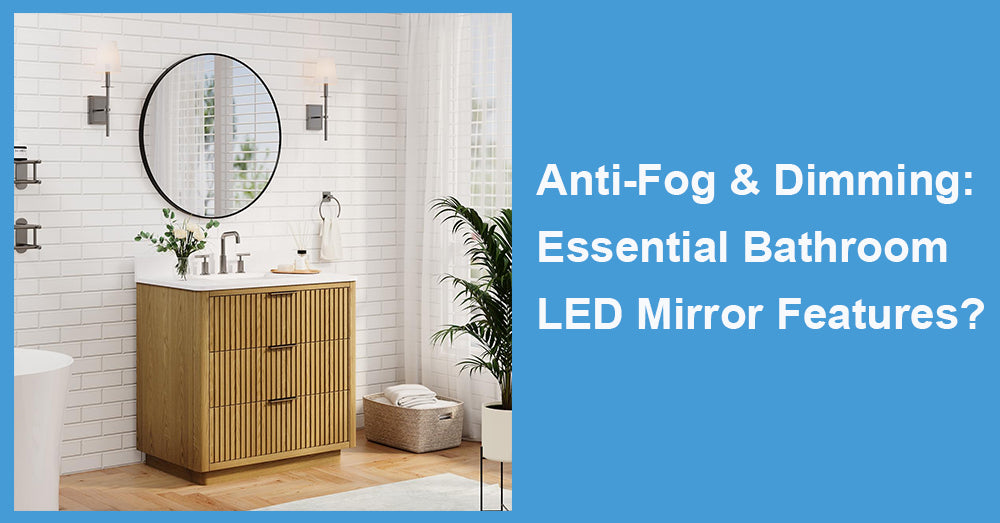
1. Why is the bathroom LED mirror feature list getting longer
The modern bathroom led mirror is no longer treated as a simple reflective surface. It’s increasingly specified as both a lighting fixture and a comfort appliance: it affects grooming accuracy, morning routines, and how quickly a space returns to “normal” after a hot shower. That shift is happening alongside rising renovation budgets, which tend to push shoppers toward higher-performance, higher-convenience upgrades. Houzz reported the median spend for bathroom renovations increased from $13,500 in 2022 to $15,000 in 2023, an 11% jump.
2. Fog is a humidity problem first, and a mirror problem second
Fog forms when warm, moisture-laden air meets a cooler surface and condenses. The most reliable way to reduce that moisture load is still ventilation and humidity control. The U.S. Environmental Protection Agency recommends keeping indoor humidity below 60% RH, ideally between 30%–50% RH, to help prevent moisture-related issues such as mold.
Ventilation guidance is also concrete. The Home Ventilating Institute summarizes minimum bathroom exhaust needs by size: bathrooms under 50 sq ft typically target 50 CFM, and 50–100 sq ft often use about 1 CFM per sq ft of floor area.
This matters because anti-fog doesn’t replace ventilation. It clears the mirror surface, but the room can remain humid unless the fan is running.
3. Anti-fog technology: what it is, how it works, and what it costs to run
Most anti-fog mirrors use a thin heater pad behind the glass. The goal is simple: warm the mirror slightly so its surface stays above the dew point. One installer-focused explainer explains how the pad warms the mirror surface to around 104°F to prevent condensation.
Energy use is usually modest, but it isn’t zero. A real-world wattage example: one large 30" × 40" defogger pad is listed at 141 W. Using the latest average residential electricity price of 17.78¢/kWh (November 2025) from the U.S. Energy Information Administration, running that 141 W pad for 15 minutes uses about 0.035 kWh, which works out to roughly $0.006 per use, or about $0.19 for 30 uses in a month.
What to look for in anti-fog specs:
1. Coverage clarity: Some heaters only clear a central zone, not edge-to-edge.
2. Timer behavior: auto-off (like 30–60 minutes) prevents “forgot it on” waste.
3. Independent control: separate anti-fog and light controls let users choose comfort without constantly powering both.
4. Dimming is about comfort, but it also protects performance
Dimming gets marketed as mood lighting, but its real value is control: bright for shaving or skincare, lower for late-night use, and adjustable when the bathroom is also used as a “wake-up” space. It can also reduce energy use because power consumption typically decreases as light output decreases. On efficiency, the U.S. Department of Energy notes residential LED products can use at least 75% less energy and last up to 25 times longer than incandescent lighting.
However, the dimming quality depends heavily on the driver and control method. DOE’s solid-state lighting guidance explains that dimming can maintain source efficacy. Still, compatibility issues can introduce flicker and other side effects, and the LED driver’s capability largely determines performance.
Practical dimming features that matter on an LED mirror:
1. Low-end dimming stability: whether it can dim smoothly down to low output without flicker or dropouts.
2. Memory function: returns to the last brightness level after power cycling (beneficial with wall switches).
3. Control type: touch controls are convenient, but many projects still rely on wall controls—compatibility matters.

5. Flicker and dimming compatibility: the quiet spec that affects user trust
As more mirrors ship with integrated LEDs and electronic drivers, flicker becomes a quality divider. The IEEE publishes recommended practices on LED flicker and dimming, including how modulation can interact with dimming approaches and why this matters.
For buyers and spec writers, the takeaway is not to chase obscure metrics, but to demand proof of good performance under real controls. The National Electrical Manufacturers Association also highlights the practical risk: some LED lamp-and-dimmer combinations can flicker or hum, and using matched, compatibility-marked components can help reduce these issues.
A strong “industry-grade” approach is to test the mirror with common dimmer types (if wall dimming is intended) and specify a driver designed for smooth dimming rather than “dimmable” as a checkbox.
6. Safety and moisture ratings: don’t treat the mirror like a dry-room lamp
Because the mirror sits in a humidity-heavy zone, safety certification and location ratings matter. Underwriters Laboratories describes UL 1598 as a key luminaire safety standard covering lighting products intended for installation on branch circuits, helping establish baseline safety expectations for lighting equipment.
For bathroom placement, the critical concept is whether the lighting system is suitable for humid environments (often “damp location”) versus direct water exposure (“wet location”). While exact requirements depend on placement relative to the shower/tub zone and local code interpretation, the practical buying rule is simple: a vanity-area LED mirror should be clearly labeled for appropriate moisture exposure rather than treated like general dry-room décor lighting.
7. What “essential” really means: a priority stack that matches real routines
Anti-fog and dimming are often sold as premium extras, but they become “essential” when they solve daily friction. In real bathrooms, the feature priority tends to look like this:
1. Reliable anti-fog clearing for households that shower back-to-back or have limited ventilation performance. (Anti-fog restores visibility even while the room is still humid.)
2. Stable dimming without flicker for comfort at night and task precision in the morning.
3. Humidity-first fundamentals: ventilation sized to the room (CFM guidance) and indoor humidity targets that reduce overall condensation events.
If a product forces trade-offs—great lighting but weak defog, or strong defog but unstable dimming—the “premium” experience quickly collapses.
8. Closing: the spec is moving from “nice to have” to “baseline expectation.”
Anti-fog and dimming are gaining ground because they translate directly into time saved and comfort gained. Anti-fog heaters clear the surface by gently warming the mirror, often with manageable energy use in typical timed routines. Dimming adds control, but quality depends on driver design and control compatibility, with flicker management becoming a defining performance line.
In short, the “essential” LED mirror is the one that stays clear when humidity spikes, dims smoothly without distractions, and carries appropriate safety ratings for the environment it lives in—because the bathroom is where specs meet real life every single day.



































Leave a comment
This site is protected by hCaptcha and the hCaptcha Privacy Policy and Terms of Service apply.