






















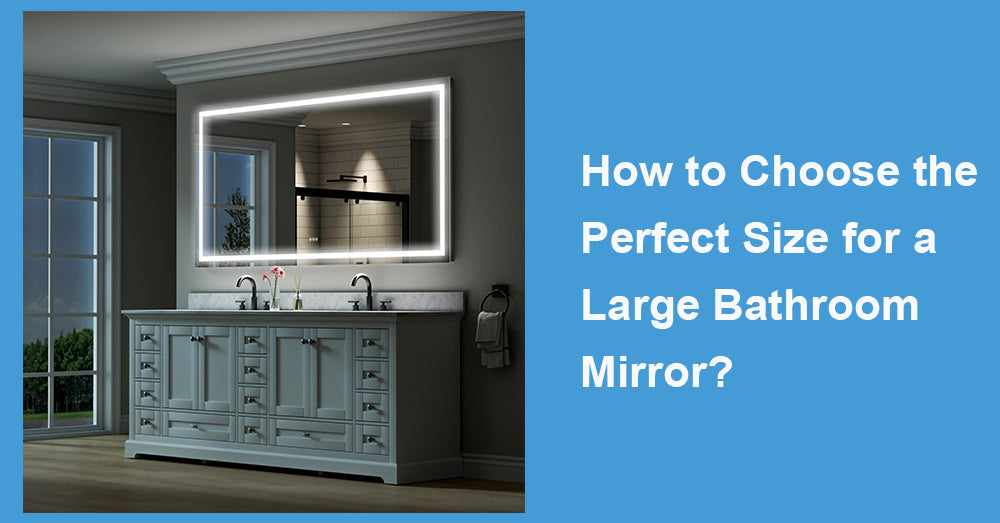
In bathroom space design, a large bathroom mirror often serves not only basic mirror and grooming functions but also plays a significant role in the overall visual presentation and lighting atmosphere. As bathroom design increasingly emphasizes comfort and spatial expression, large mirrors have gradually become the core element in hand-washing areas, dressing areas, and even as whole-wall decorations. However, choosing the appropriate size for different spaces is a problem many families face during the decorating stage.
1. The visual and practical value of large bathroom mirrors
Compared to standard-sized mirrors (such as those 20-24 inches wide), large mirrors can effectively expand the visual space and make the bathroom look more spacious. Especially for the walls and the area behind the washbasin, when the mirror reflection comes from windows, lights, or glossy tiles, it creates a visual extension effect, making the space feel more transparent.
In addition, large mirrors can provide a more complete and uniform field of view, which can make morning washing, shaving, and makeup, or nighttime skin care, more convenient. According to industry research on bathroom design, over 63% of new bathroom projects in the past three years have chosen medium- to large-sized or oversized mirror solutions for hand-washing areas, and about one-third use full mirror wall designs (source: Houzz.com).
2. How to choose the mirror size based on sink width
One of the core principles in selecting a large bathroom mirror is to coordinate the visual proportion between the mirror and the sink. The commonly used reference suggestions are:
The mirror can be slightly narrower than the sink, leaving edge space and creating a clean boundary.
Or the mirror's width should match the washbasin's, creating a visual integration.
For example, if the washbasin is 36 inches wide, the mirror can usually be selected in a 30-36-inch size. If the washbasin is a double basin with a width of 60-72 inches, the mirror surface can generally be selected as 48-72 inches. Even an extended mirror surface can be used.
In practical design, the mirror is slightly narrower than the washbasin by about 2-4 inches, which highlights the boundaries and balances proportion. If pursuing a simple, open, or "hotel style" design, mirrors of equal width or wider will have a more cohesive feel.
3. Mirror height selection: visual range + light distribution
In addition to the mirror's width, its height also affects the daily user experience. The height range for most bathroom mirrors is 28 to 40 inches, while large bathroom mirrors are more often 36 inches or higher.
When choosing a height, two key factors can be considered:
Visual coverage range: The mirror should cover the user's head to at least the chest when standing, avoiding situations where they need to stand on tiptoe or bend down to see.
Light reflection optimization: Higher mirrors can better reflect natural light or lighting, making the space brighter.
If the bathroom is equipped with wall or mirror lights, the light can be coordinated with the mirror cabinet position to allow it to diverge from both sides or the top, rather than creating shadows.
Data shows that mirror areas that reflect more natural light can increase the overall brightness of a bathroom by about 8% -14% (source: KitchenBathDesign.org).
4. Choose a mirror size based on the bathroom area
The size of the bathroom space directly affects the ideal size of the mirror.
Small bathroom (5-35 sq ft range): You can choose a medium mirror that spans the width of the washbasin, with a recommended width of 24-36 inches to avoid visual oppression.
Medium-sized bathroom (36-90 sq ft): Consider a 36-60 inch mirror to increase illumination and visual extension while ensuring proportional coordination.
Larger bathroom (90+ sq ft): It is recommended to use mirrors of 60 inches or more, or even full-face mirrors. If the layout allows, wall-to-wall installation can enhance the hotel-style luxury of the space.
It should be noted that the larger the mirror, the more critical it is to consider the wall's load-bearing capacity and the installation method, especially when the glass thickness exceeds 5mm, as the installation support structure becomes particularly important.
5. Choose a single mirror, a double mirror, or a full mirror? Depends on the layout and usage requirements
When determining the size of a large bathroom mirror, different mirror layout forms can also affect the final visual effect and usability. Common structures can be divided into three types: single large mirror, dual-mirror partition, and full-wall mirror design.
Single large mirror: The most classic and standard form, extending upward from the washbasin to create an apparent, unified visual effect. The overall lines are neat and straightforward, suitable for modern or minimalist styles, or for spaces that pursue a broad visual sense. It can make the hand-washing area look cleaner and reduce the visual division in the composition, making the space appear cleaner.
Dual mirror design: If the bathroom is equipped with dual washbasins, a dual mirror parallel design can be chosen, corresponding to each usage position. This will be more practical when used frequently in the morning and evening, avoiding the "mirror competition" that occurs when multiple people use it at the same time. The dual-mirror design also emphasizes the spatial distribution of the hand-washing area, making the spatial order more straightforward.
Full-wall mirror: In some larger bathrooms, the entire mirror wall becomes an essential element for enhancing visual effects. These mirrors often extend from the washbasin to the full width or even the full height of the wall, creating a strong magnification and light-reflection effect in the space. The entire mirror wall often creates an immersive atmosphere similar to that of a hotel or SPA space in the bathroom, making it suitable for designs that pursue visual tension and spatial ceremony.
There is no absolute superiority or inferiority among the three; the main differences lie in spatial layout, daily user numbers, and the desired style and atmosphere to be presented. Simple, unified, and visually coherent spaces are better suited for single- or full-mirror walls. At the same time, layouts that require clear zoning and emphasize functionality are better suited for dual-mirror designs.

6. The impact of additional features on size selection
Nowadays, large bathroom mirrors are gradually incorporating features such as lighting, defogging, touch switches, and intelligent brightness control. If the mirror has LED light strips or anti-fog heating areas, it is necessary to reserve a wall power supply position and installation depth.
Illuminated mirrors usually slightly increase the width of the border or light strip area. For example, a mirror with a nominal width of 40 inches may have a visual mirror area of about 38 inches. Therefore, when planning, the "actual mirror size" should be distinguished from the "visible mirror area".
According to a survey on bathroom intelligence trends, mirrors with lighting or anti-fog features have grown by approximately 9%-12% over the past five years (source: NKBA.org).
7. Summary
Choosing the size of a large bathroom mirror is not about "bigger is better" or "using the width of the washbasin as the sole reference". More importantly, comprehensive consideration should be given to the bathroom area, sink ratio, lighting conditions, mirror height, usage habits, and aesthetic style.
A suitable large mirror will make the bathroom appear brighter, wider, and more orderly, and enhance the comfort and ceremony of daily grooming.









































Leave a comment
This site is protected by hCaptcha and the hCaptcha Privacy Policy and Terms of Service apply.