






















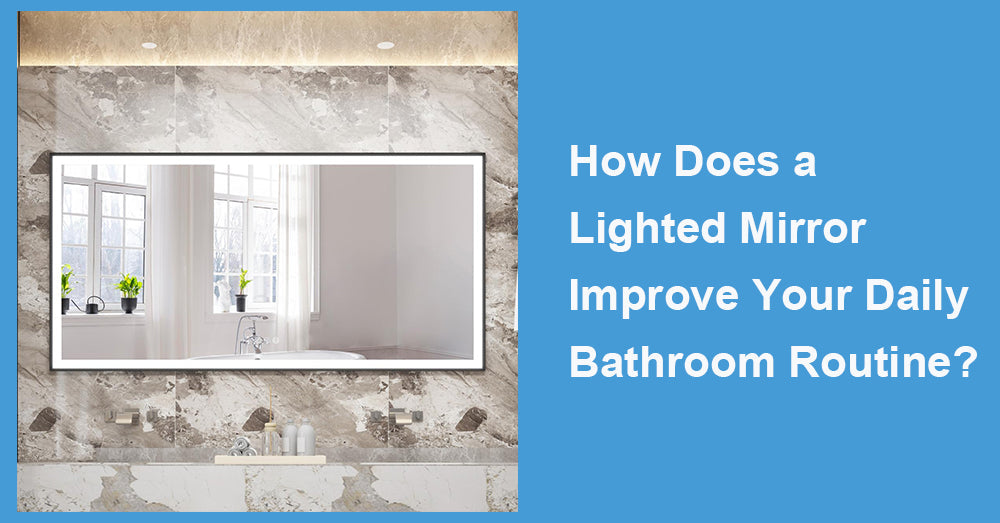
In modern bathroom design, mirrors are no longer just simple reflective tools but an essential component closely integrated with lighting, spatial perception, and user experience. With the changing demand for living and the acceleration of the pace of life, people's expectations for bathrooms have also changed - not only to be "usable", but also to be "easy to use", "durable", and "comfortable". It is in this context that lighted mirror have gradually shifted from design upgrade options to a standard configuration in an increasing number of bathroom renovation projects.
From an industry perspective, the popularity of illuminated mirrors is not due to short-term trends, but somewhat because it improves the daily bathroom experience on multiple levels and solves long-standing but easily overlooked usage problems.
1. More precise mirror illumination significantly improves daily efficiency
There has been a common problem with bathroom lighting for a long time: the overall brightness is sufficient, but the light in front of the mirror is insufficient or unevenly distributed. Traditional top lighting can easily cast shadows on the face when looking into a mirror, affecting delicate tasks such as grooming, shaving, makeup, and skincare.
One of the core values of an illuminated mirror is to integrate the light source directly around the periphery or back of the mirror, allowing light to be evenly projected from the front. This lighting method is closer to the user's perspective, reduces shadow interference, and makes facial details clearer. From practical feedback, this "targeted lighting" not only improves operational efficiency but also reduces the need for repeated posture adjustments or supplementary lighting, making daily processes smoother.
2. Improve the overall lighting environment of the bathroom, rather than simply adding a light
Unlike installing mirror lights separately, illuminated mirrors are typically designed with the mirror and light as a whole. This integrated design makes the light softer and more continuous, avoiding the visual fragmentation caused by scattered light sources.
In industry practice, well-designed illuminated mirrors can improve the overall lighting feel of bathrooms without significantly increasing brightness. The space appears brighter but not glaring; Clearer yet not stiff. This kind of optimization in the lighting environment is often only truly perceived during long-term use, and it is also an experience upgrade that many users only realize after replacement.
3. Enhance visual perception and alleviate pressure in a limited space
The bathroom area is often limited in residential areas, especially in secondary bathrooms or apartment projects. Making a space look more spacious without changing the structure is a common design challenge.
The combination of light and specular reflection in an illuminated mirror can effectively enhance the sense of depth and hierarchy in space. A uniform backlight or edge light source can weaken the wall boundary, making the mirror seem like a part of the space rather than a separately suspended object. This visual extension effect is particularly friendly to small bathrooms and is one of the important reasons why many designers are willing to recommend lighting mirrors.
4. Unify functionality and aesthetics to reduce design trade-offs
In traditional bathroom design, a trade-off between functionality and aesthetics often needs to be made: adding lighting fixtures for the sake of lighting effect may damage the overall style; For the sake of simplicity in appearance, it may also sacrifice the convenience of use. The emergence of illuminated mirrors has, to some extent, alleviated this contradiction.
By hiding the lighting within the mirror structure, the illuminated mirror avoids the visual interference of unnecessary lighting fixtures, making the bathroom facade cleaner and more orderly. This "low presence" design approach is in line with the current trend of pursuing simplicity and restraint in bathroom decoration, and it is also easier to maintain coordination in spaces of different styles.
5. Improve daily comfort, rather than just serving specific scenarios
Many people initially pay attention to illuminated mirrors, often for particular needs such as makeup or shaving. Still, in actual use, they find that the changes it brings are far more than that. Daily scenes such as morning washing, nighttime tidying, and simple care will become easier due to more stable lighting.
Industry observations have found that when bathroom lighting no longer requires deliberate adjustment, people's psychological burden when using the space decreases. Seemingly subtle experience improvements will gradually accumulate over long-term use, leading to greater satisfaction with the space.

6. Adapt to the industry trend of integrated development of bathroom products
From a broader perspective, the popularity of illuminated mirrors reflects the overall trend towards integrated and systematic development of bathroom products. Instead of constantly adding independent features in the later stages, it is better to integrate relevant requirements during the design phase.
This trend not only helps simplify installation and usage logic but also better meets current consumers' expectations for "efficient configuration. In this industry context, illuminated mirrors have gradually become a rational choice in bathroom configurations, rather than a simple upgrade option.
7. From a long-term usage perspective, it has more sustainable value
Although illuminated mirrors may require more consideration in initial planning, in the long run, their convenience and stable experience often offset the initial investment. Reducing the number of additional lighting fixtures, optimizing lighting structures, and improving space utilization efficiency are all part of the long-term value.
In the industry, more and more projects are starting to view illuminated mirrors as a "one-time in place" configuration, rather than a decorative element that can be easily replaced. This transformation also reflects the maturity of consumers' perception of bathroom quality.
Conclusion
Overall, the improvement of daily bathroom experience through illuminated mirrors is not reflected in a single function, but rather through the comprehensive enhancement of lighting, spatial perception, and usage efficiency, reshaping the way people use the bathroom. It makes the previously overlooked details more friendly, and also makes the bathroom, a high-frequency use space, more in line with the pace of modern life. As bathroom design continues to move towards rationality and long-term value, illuminated mirrors are becoming a timeless choice, rather than just a trendy design element.







































Leave a comment
This site is protected by hCaptcha and the hCaptcha Privacy Policy and Terms of Service apply.