






















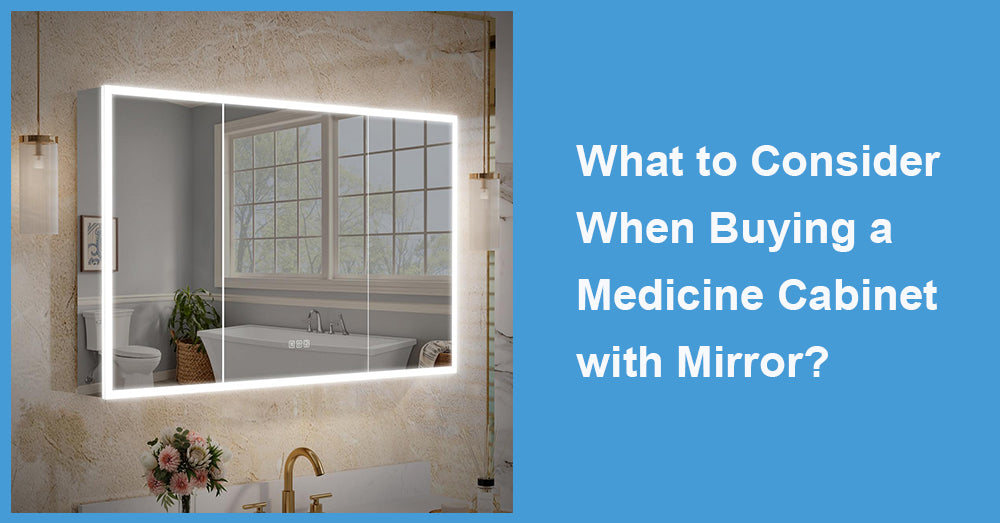
In the current bathroom decor and renovation market, consumers' attention to functional products is increasing significantly. The bathroom is no longer just a space for basic cleaning needs; it is gradually becoming an important area that emphasizes order, efficiency, and a comfortable experience. It is in this context that medicine cabinet with mirror has become one of the key configurations in an increasing number of projects.
However, when faced with products that differ significantly in size, structure, material, and functionality, making rational choices has become a common concern for many consumers and design practitioners. It is widely believed in the industry that choosing a mirrored medicine cabinet is not just about looking at its appearance, but a systematic decision that requires careful consideration of space conditions, usage habits, and long-term maintenance costs.
1. The degree of match between size and bathroom space is the primary prerequisite.
The selection of any bathroom product must be based on spatial conditions. A medicine cabinet with a mirror is usually installed above the washbasin, and its width, height, and depth directly affect comfort and the overall proportions of use.
If the medicine cabinet is too small and its storage capacity is insufficient, it will soon be replaced by other temporary storage methods; however, if it is too large, it may compress the visual space and even affect the safety of the washing area. Industry advice suggests that before purchasing, the width of the washbasin, the available height of the wall, and the space required for door opening should be clearly defined to ensure that the medicine cabinet does not interfere with normal flow in both closed and open states.
2. Embedded or surface-mounted determines the installation logic
At present, medical cabinets on the market are mainly divided into two structures: recessed and surface-mounted. This choice is often closely related to whether the bathroom is a new construction project or a renovation project.
Embedded medicine cabinets can be flush with the wall, creating a cleaner visual effect and suitable for pre-planning when wall conditions permit. The open installation style offers greater installation flexibility, especially ideal for renovation projects or spaces where wall structures cannot be modified. The industry generally recommends prioritizing embedded systems when structural conditions permit, provided the construction phase can be coordinated in advance.
3. Mirror quality directly affects long-term user experience
Mirrors are a core component of medicine cabinets, and their quality not only affects visual appearance but also durability. High-quality mirrors should exhibit high clarity, realistic reflections, resistance to deformation, and good moisture resistance.
In high-humidity environments, ordinary mirrors are prone to oxidation, blackening, or edge corrosion. It is usually recommended to choose a mirror structure that has undergone industry-standard moisture-proof treatment to extend the product's lifespan. This factor is easily overlooked at purchase but often becomes the key determinant of satisfaction over the years of use.
4. Internal storage structure is more important than capacity
Many consumers tend to only focus on "how many things can be stored" when choosing a medicine cabinet, while ignoring the rationality of the internal structure. In fact, the number of layers, adjustability, and the distribution of internal height all directly affect the actual efficiency of use.
A reasonable internal layout can provide suitable positions for items of different sizes, reducing stacking and clutter. Industry experience shows that flexible, adjustable internal structures are often more practical and better suited to long-term use than simply pursuing large capacity.
5. The opening method of the door affects daily convenience
The door structure of the Medicine Cabinet is also worthy of attention. Single door, double door, or multi-door designs can affect the opening angle and usage habits. Whether the door is easily obstructed by other facilities in a bathroom with limited space is a common problem encountered in practical use.
In addition, the smoothness of opening and closing, the quality of hinges, and whether there is a buffer closing function are directly related to the user experience and product lifespan. From an industry perspective, these 'detailed configurations' often determine whether a product has actual long-term value.
6. Whether an integrated lighting function is needed should be judged based on the usage scenario
With the increasing demand for bathroom lighting, more and more medicine cabinets are integrating lighting functions. Lamp design can improve the illumination conditions in front of the mirror, reduce shadows, and enhance visibility during daily care and organization.
However, industry insiders also pointed out that whether to choose a medicine cabinet with lights should be comprehensively considered in conjunction with the overall lighting scheme. If the bathroom already has sufficient and reasonable mirror lighting, the necessity of additional integrated lighting may be reduced; On the contrary, in spaces with insufficient lighting or limited layout, lighting design is more practical.
7. Moisture resistance and durability determine the product's lifecycle
The requirements for materials in bathroom environments are much higher than those in other living spaces. The cabinet body, hardware components, and internal shelves of the medicine cabinet all need to have good moisture resistance. If the material selection is improper, problems such as expansion, deformation, or metal corrosion may occur in the short term.
It is generally recommended in the industry to pay attention to the stability of the cabinet material and whether the hardware is suitable for humid environments when purchasing. This is not only related to appearance, but also directly affects the reliability of the product after many years of use.
8. Style compatibility is more important than popular elements
Mirror medicine cabinets belong to "high presence" products in the bathroom, and their style selection has a significant impact on the overall space. Compared to chasing short-term popular elements, the industry tends to recommend designs with restrained style and simple lines.
A neutral appearance is easier to coexist with different decoration styles and can also maintain coordination in future space upgrades. This approach is critical in the current trend of emphasizing long-term living experience in decoration.
9. Installation and maintenance costs should not be ignored
In addition to the purchase cost itself, installation complexity and post-maintenance are also part of the overall decision-making process. Some products with complex structures or high levels of customization may incur additional costs during installation and maintenance.
From an industry perspective, a well-structured and highly standardized medicine cabinet is often more conducive to controlling overall project risks and is more suitable for long-term use.

Conclusion
Overall, purchasing a medicine cabinet with a mirror is not a simple product choice, but a decision closely related to spatial planning, usage habits, and long-term maintenance. Factors such as size matching, structural form, mirror quality, storage design, and durability collectively determine whether a product is truly suitable for a specific bathroom space. With the trend towards rationalization and systematization in bathroom decoration, fully understanding these key considerations can help consumers and practitioners make more mature and long-term value choices.









































Leave a comment
This site is protected by hCaptcha and the hCaptcha Privacy Policy and Terms of Service apply.