






















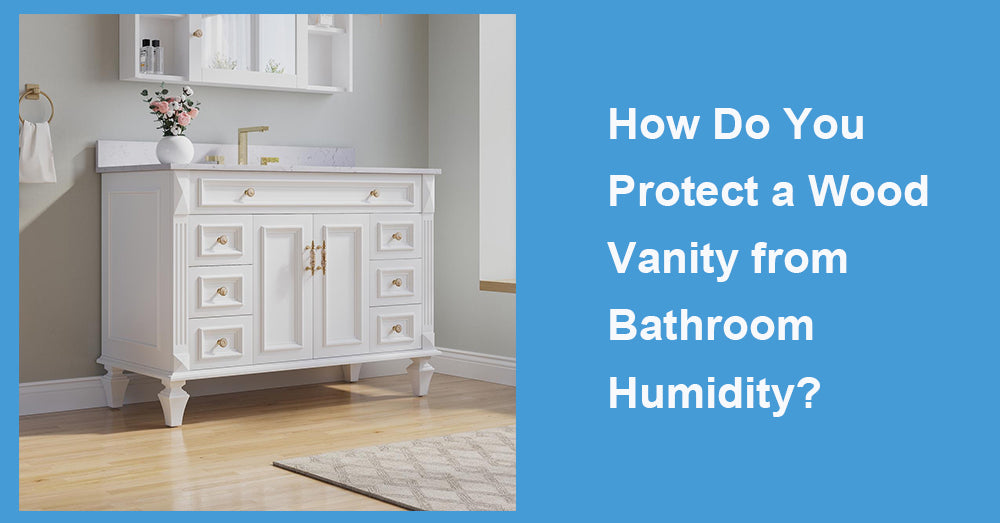
In bathroom design that emphasizes natural texture and a warm atmosphere, a wood vanity remains an important element of high-end and classic spaces.
From a 36-inch single-pot structure to a 60-inch or 72-inch double-pot layout, wooden cabinets can add layers and temperature to the space.
However, the bathroom environment has long been characterized by high humidity and alternating hot and cold conditions, posing a severe challenge to the wood structure.
Industry material testing data show that when the relative humidity remains above 65%, the probability of slight deformation or warping in solid wood panels that have not been fully sealed increases significantly within 12 months.
Therefore, scientific protection and daily maintenance have become the key to extending the service life.
1. Understanding the impact of humidity on wood
Natural wood has moisture absorption and release properties.
When air humidity increases, wood fibers absorb moisture and expand.
When humidity decreases, they shrink.
Research shows that when relative humidity increases from 40% to 70%, the width of solid wood panels may change by about 1/8-inch, depending on the type of wood and panel thickness.
For Vanity countertop structures with depths typically ranging from 21 inches to 22 inches, even small size changes can cause door panel misalignment, drawer jamming, or seam cracking.
Therefore, controlling humidity and surface sealing are the first steps in protection.
2. The importance of surface sealing treatment
High-quality wood vanities are typically treated with multiple layers of sealing coatings, including primer, topcoat, and waterproof coating, before leaving the factory.
The typical coating thickness is 3 to 5 layers, forming a moisture-resistant protective barrier.
Test data shows that the moisture absorption rate of wooden boards treated with multi-layer polyurethane coatings can be reduced by about 30% to 40%.
If it is an open wood grain or matte wax finish, additional attention should be paid to regular maintenance.
For customized or on-site renovation projects, it is recommended to seal all exposed edges before installation, especially the bottom and back panel areas against the wall.
These areas are often the most hygroscopic.
3. The key role of ventilation and air flow
Even with good sealing, prolonged exposure to high humidity can still increase the wood's burden.
The ideal relative humidity range for the bathroom should be 40% to 55%.
Data shows that in bathrooms without exhaust systems, humidity can rise above 75% within 10 minutes after showering and remain above 75% for more than 30 minutes.
If used multiple times a day, this humidity fluctuation will have a long-term impact on the wood.
Installing an exhaust fan and ensuring it runs continuously for at least 15 to 20 minutes after showering can effectively reduce peak humidity.
In addition, in bathrooms with an area less than 100 square feet, an exhaust volume of 50 CFM or more is ideal.
4. Structural details to prevent direct water contact
The most vulnerable locations for wooden cabinets are usually at the connection between the countertop and the cabinet, the edge of the bottom plate, and the lower edge of the door panel.
It is recommended to use high-quality silicone sealing strips in the connection area between the basin and the countertop to prevent water from seeping in.
If the front and sides of the countertop are made of solid wood, regular inspections should be conducted to check for cracks.
Data shows that in the presence of slight water seepage for a long time, the moisture content of wooden boards can increase by more than 5% within a few weeks, leading to local expansion.
In addition, if the bottom of the cabinet is less than 3 inches from the ground, moisture on the ground may also affect the structure.
Properly raising the bottom structure or using moisture-proof pads can reduce the risk.
5. The influence of daily usage habits
Many humidity issues stem from everyday details.
For example, if water accumulates for a long time without wiping, if a wet towel is left directly on a wooden surface, or if water accumulates at the bottom of a water cup and stays on the countertop.
Research shows that if surface water stains are wiped dry within 30 minutes, their impact on wood is limited. If they remain for more than 2 hours, they are more likely to penetrate small seams.
Therefore, it is recommended to develop the habit of wiping down countertop water stains after showering and to avoid storing items that are not completely dry inside the cabinet.
6. The influence of material selection on moisture resistance performance
Not all wood vanities have the same structure.
The stability of a solid wood frame combined with a plywood structure is usually better than that of a pure solid wood whole board.
Plywood has a low humidity deformation rate due to its multi-layered staggered structure.
Test data show that the dimensional stability of high-quality plywood in environments with changing humidity is about 20% higher than that of solid wood panels.
Understanding the cabinet's structural materials is equally important during the selection stage.
7. Long-term maintenance and periodic inspections
Even with adequate protective measures, regular inspections cannot be ignored.
It is recommended to check the cabinet joints, door panel flatness, and sealant status every 6 to 12 months.
If local coating wear is found, it can be repaired promptly.
For oil- and wax-based finishes, it is usually recommended to apply a maintenance coating every 12 months to maintain the integrity of the protective layer.

8. Conclusion
A wood vanity is both elegant and warm in bathroom environments, but its durability depends on proper care and maintenance.
From controlling humidity between 40% and 55% to ensuring the integrity of the countertop seal to maintaining good ventilation and timely cleaning, every detail directly affects the service life.
Understanding the moisture-absorption characteristics and structural stability of wood, combined with appropriate construction and maintenance strategies, can achieve long-term stability and aesthetic effects across different-sized layouts, such as 36-inch, 60-inch, or 72-inch.









































Leave a comment
This site is protected by hCaptcha and the hCaptcha Privacy Policy and Terms of Service apply.