






















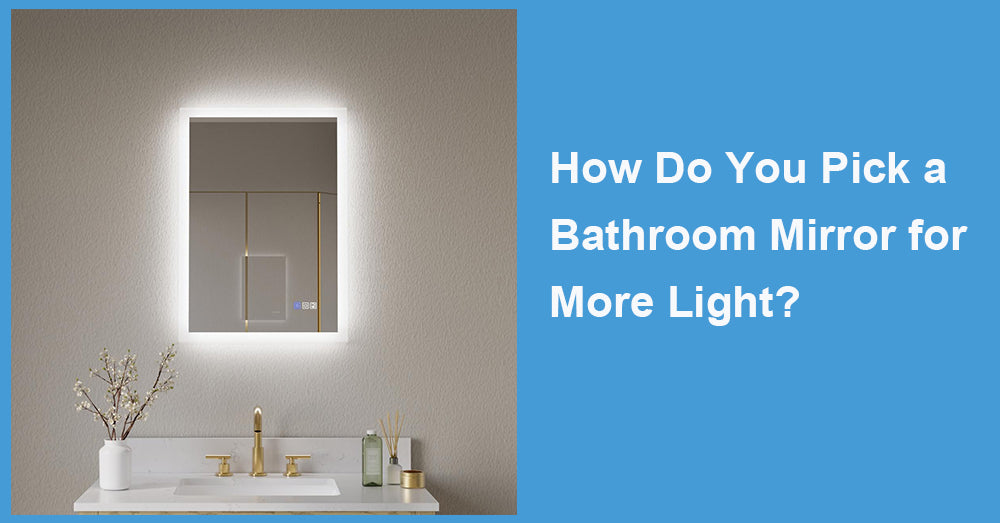
In bathroom renovation or space optimization, a bathroom mirror is often seen as a component that has already been identified and does not require further consideration. But from an industry perspective, the choice of mirrors largely determines the overall lighting quality, visual brightness, and spatial transparency of the bathroom. Especially in bathrooms with limited natural lighting or average main lighting conditions, mirrors are not just passive reflectors of light but also key tools that affect the efficiency of light distribution.
1. Mirrors themselves do not "create light", but they can amplify the effect of light
From a physical principles perspective, mirrors do not produce light, but they can change the path of light propagation through reflection. Industry research shows that under the same lighting conditions, a bathroom with a reasonable mirror configuration can perceive a higher overall brightness than a space with an unreasonable one.
This is also why, under the same lighting power, some bathrooms appear bright and even, while others remain dark. The problem is not necessarily with the light, but instead with the mirror's position, size, and reflection angle.
2. The influence of mirror size on light amplification
The size of a mirror is the primary factor affecting the efficiency of light reflection. Generally speaking, the larger the mirror surface area, the more light can participate in reflection, but this does not mean that the mirror can be infinitely enlarged.
In practical applications, the mirror width in the main washing area is usually close to the countertop width, typically 30-48 inches. This size range can cover the primary user's line of sight and effectively reflect light sources from above or to the side.
In terms of height, the standard range for mirrors is 26 to 32 inches. This height not only aligns with the visual habits of most standing users but also better reflects light vertically, reducing facial shadows.
3. The position of the mirror is more important than the mirror itself
In industry practice, a common misconception is to focus only on the mirror's size and overlook its relationship with the light source.
When the mirror faces the natural light source or the main illumination area, its reflection efficiency will be significantly improved. For example, installing a mirror on the opposite wall near the window can redirect natural light deeper into the bathroom, thereby reducing dark areas.
In the absence of natural lighting, the relative position of mirrors and lighting fixtures is particularly crucial. If the mirror covers the main reflection area below or on the side of the lamp, it can effectively reduce the amount of light absorbed by the ceiling or a dark wall.
4. The influence of mirror shape on light distribution
From a morphological perspective, flat, large-area mirrors are more conducive to overall brightness improvement than multi-segmented and small-sized mirrors. Continuous mirror surfaces can form stable reflective surfaces, making light distribution more uniform, whereas mirror structures with strong splicing or decorative properties are prone to reflection breakage.
Circular or elliptical mirrors have decorative advantages, but in scenes purely pursuing brightness enhancement, their effective reflection area is usually smaller than that of rectangular mirrors of the same width. This does not mean circular mirrors are not suitable for use; instead, it means a trade-off is needed based on space requirements.
5. The "Hidden Influence" of Borders and Materials on Brightness
Although the frame of a mirror may seem like a decorative element, it has an undeniable impact on lighting performance.
Dark or thick borders visually compress the mirror surface and reduce reflection efficiency; borderless or extremely narrow borders are more conducive to light diffusion. According to industry feedback, frameless mirrors are more commonly used in bathroom designs that emphasize brightness.
In terms of mirror material, high-transparency silver mirrors offer greater clarity and brightness in reflections than ordinary mirrors. Especially after long-term use, they are less prone to darkening or edge corrosion.
6. The role of illuminated mirrors in increasing brightness
In recent years, the use of illuminated mirrors has gradually shifted from "functional upgrades" to mainstream choices, with its core value not just increasing the number of light sources but optimizing light direction.
A light source surrounding the mirror or mounted on its back can provide uniform illumination in front of the face, reducing shadows cast by traditional ceiling lights. This lighting method is particularly evident in delicate operations such as makeup and shaving.
In practical applications, the adjustable color temperature range is concentrated in the 3000K-6000K range for mirror lighting, which is easier to adapt to different time periods and usage needs. It can also achieve a balance between brightness and comfort.
7. The synergistic relationship between the mirror and the wall color
Mirrors do not exist in isolation; the color and material of the surrounding walls influence their reflection.
Light-colored walls are more conducive to secondary light reflection, and when combined with large mirror surfaces, can create an overall brightening effect. On the contrary, if dark or light-absorbing materials surround the mirror, even if the mirror itself is sufficiently large, the overall brightness improvement will be limited.
Therefore, in pursuit of a brighter bathroom design, mirrors should be selected to coordinate with the wall material.
8. Avoid discomfort caused by "excessive reflection."
Brightness enhancement does not equal infinite reflection. Industry experience has shown that excessive mirror reflection or unreasonable angle reflection may lead to glare or visual fatigue.
A reasonable mirror configuration should allow the light to diffuse gently, rather than forming strong reflection points. That's also why, in high-quality bathrooms, mirrors are often paired with diffuse lighting rather than single-point bright light sources.
9. Looking at the stability of mirrors from a long-term usage perspective
From an industry perspective, the typical lifespan of a bathroom mirror is 8-12 years. During this cycle, the moisture-proof structure, back panel sealing, and mirror coating quality will directly affect whether brightness performance deteriorates.
Once the mirror appears foggy, darkened, or corroded at the edges, even with unchanged lighting conditions, the overall brightness will decrease significantly. Therefore, brightness improvement is not only an initial effect, but also a long-term performance.

10. Conclusion
Choosing a mirror that can enhance the brightness of the bathroom is not simply about "choosing a larger mirror" or "adding more lights. The truly effective solution comes from a systematic understanding of size, position, reflection relationships, and overall space. A well-chosen selection of bathroom mirrors can significantly improve the brightness and comfort of the space without increasing energy consumption, making it an irreplaceable value in bathroom design.









































Leave a comment
This site is protected by hCaptcha and the hCaptcha Privacy Policy and Terms of Service apply.