




















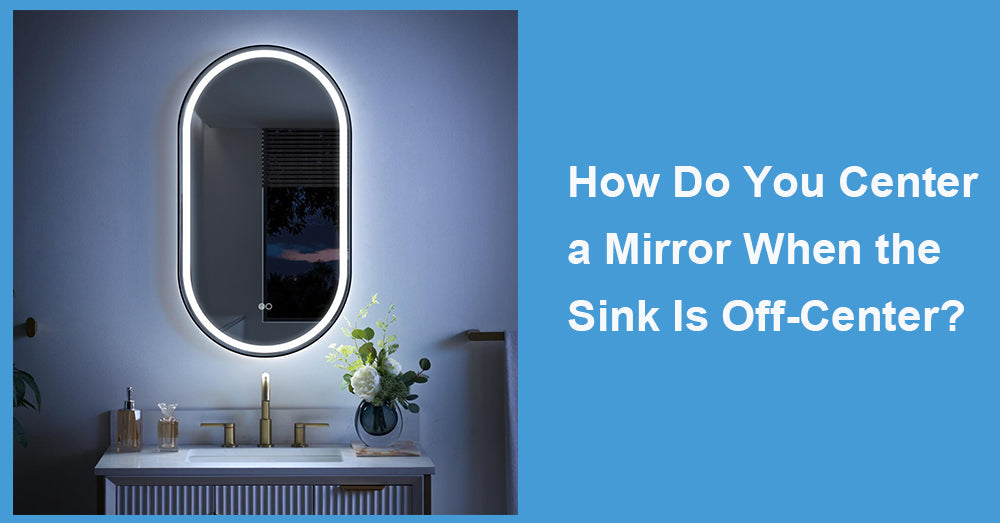
An off-center sink can make a vanity wall feel “wrong,” even when the plumbing and cabinetry are perfectly installed. The key is realizing that a mirror does not have to be centered on the wall to feel centered in the room. A bathroom mirror should align with what people actually use: the faucet, the lighting, and the face area where grooming happens. With a few measurements and a clear decision about which “center” matters most, you can make the layout look intentional rather than accidental.
This guide walks through practical, repeatable ways to place a mirror when the sink is off-center, using inches-based measuring and proven visual-balancing tactics.
1. Choose Your Primary Centerline (You Cannot Please Every Center)
When the sink is off-center, you are juggling three different “centers”:
1. The sink or faucet centerline (best for daily function).
2. The vanity/countertop centerline (best for symmetry across the cabinet run).
3. The wall or room centerline (best for architectural alignment with trim, windows, or lighting).
In most bathrooms, the sink centerline is the most important because people stand at the faucet. If your mirror is not aligned to the sink zone, grooming can feel awkward, even if the wall looks symmetrical. That said, there are cases where vanity or wall centering looks better, especially in a powder room where the mirror is more decorative and less task-driven.
2. Measure the Offset in Inches (This Tells You Which Strategy Will Work)
Do not guess. Use painter’s tape and a pencil to mark these vertical lines:
· Faucet centerline (or drain centerline).
· Vanity centerline (vanity width ÷ 2).
· Wall centerline (use the wall space between trim edges if trim frames the vanity wall).
Now measure the distance between the sink centerline and the vanity centerline.
A helpful way to interpret the number:
· 0"–1.5": often easy to ignore visually, and multiple strategies will look fine.
· 1.5"–4": “noticeable but fixable” with mirror sizing and lighting choices.
· 4"+: usually needs a deliberate, clearly planned approach (either commit to sink centering or use optical centering and strong symmetry cues).
3. Strategy A: Center the Mirror Over the Sink (Most Practical)
If the bathroom is used daily for shaving, skincare, or makeup, this is usually the safest choice. Centering the mirror on the faucet makes the user experience feel natural, even if the mirror is not centered on the wall.
Sizing matters here. A widely used guideline is to choose a mirror that is about 70%–90% of the vanity width for balanced proportions (Source: Edward Martin mirror sizing guidance). A mirror that is too small makes the sink offset feel more obvious because everything looks tightly framed. A slightly wider mirror makes the whole vanity area read as one “composition,” which reduces the sense that something is off.
How to execute it cleanly:
· Align the mirror center to the faucet centerline.
· Choose a mirror wide enough to feel anchored to the vanity (often within the 70%–90% range).
· If your sink is significantly off-center, do not force equal left and right margins between the mirror and vanity edges. Let function win.
When this works best:
· Single-sink vanities where one person uses the space most.
· Bathrooms where lighting is already limited and the mirror must help with grooming.
· Remodels where plumbing constraints caused the sink offset and moving the sink is not realistic.
4. Strategy B: Center the Mirror on the Vanity, Then Rebalance the Sink Visually
Sometimes the wall must look symmetrical. Maybe the vanity is centered in a niche, tile lines are perfectly balanced, or you have a centered light fixture that you cannot move. In that case, you can center the mirror on the vanity and “pull” the sink zone back into balance using supporting elements.
Three tools make this work:
A. Symmetry in lighting
Center the light bar on the mirror, or place two sconces evenly on both sides of the mirror. Lighting symmetry often becomes the dominant visual cue, and the eye reads the mirror-light pair as a single centered unit.
Lighting references commonly place bathrooms in a general range that can reach roughly 20–50 foot-candles depending on the task and design (Sources: IES recommended light level compilations published by Waypoint Lighting and Modern.Place). You do not need to measure foot-candles to benefit from this. The point is that balanced, face-friendly lighting reduces harsh shadows and makes the entire vanity zone feel intentional, which reduces attention on small offsets.
B. Countertop “weight”
If the sink sits closer to one side, the open counter space on the other side can look like an accidental gap. You can visually rebalance by adding a small tray, soap set, or low-profile accessory on the side that looks too empty. Keep it minimal. The goal is to create visual weight, not clutter.
C. Repetition and alignment
Straight grout lines, aligned hardware, and consistent finishes help the brain accept the layout as planned. If your mirror is centered on the vanity but the faucet is off-center, you want everything else to feel organized and consistent.
When this works best:
· Powder rooms or guest baths where function is lighter.
· Offsets under about 2"–3".
· Spaces where the mirror is also a decorative focal point.
5. Strategy C: Optical Centering (Split the Difference)
If the offset is moderate, the best result is often “neither fully centered on the sink nor fully centered on the vanity.” Instead, you shift the mirror slightly toward the sink so grooming feels better, but you keep enough symmetry that the wall still reads as balanced.
This idea is rooted in optical alignment: humans judge balance by perception more than exact geometry, and small adjustments can make a layout look more “right” than perfect mathematical centering (Source: Klein Pixel Agency optical alignment guide).
A practical rule of thumb:
· If the sink is off by 4", shift the mirror about 1"–2" toward the sink.
· Use a wider mirror so the shift is less noticeable.
· Keep the lighting centered on the mirror so the mirror-light composition still feels orderly.
This is often the most “designer” solution because it improves function without making the wall look obviously shifted.
6. Use Mirror Size to Reduce the Perceived Problem
Mirror size is your simplest lever. A small mirror amplifies misalignment. A slightly larger mirror calms the wall.
A common sizing guideline is to select a mirror that is 2"–4" narrower than the vanity on each side for a proportional look (Source: Wayfair mirror sizing guidance). You do not have to follow it rigidly, but it is a useful check for whether your mirror will look undersized.
In off-center layouts, a wider mirror often helps more than a taller mirror because the width creates a stronger “anchor” across the vanity.
7. Do Not Fix an Offset by Mounting the Mirror Too High
When something looks off, people sometimes move the mirror up or down hoping it will feel more centered. That usually makes the bathroom less comfortable.
A helpful reference point from accessibility standards is that for mirrors above lavatories/countertops, the bottom edge of the reflecting surface is commonly set at 40" maximum above the finished floor (Source: 2010 ADA Standards, Section 603.3). Even if you are not designing to accessibility specs, this number is a useful reminder: do not mount the mirror so high that real users have to tilt their heads or step back to see themselves.

Conclusion
To “center” a mirror when the sink is off-center, start by deciding which centerline matters most: sink comfort, vanity symmetry, or wall alignment. For most daily-use bathrooms, centering the mirror over the faucet is the most practical choice. If you want a symmetrical wall, center the mirror on the vanity and rebalance with lighting symmetry and controlled countertop styling. If you want the best blend, use optical centering: shift the mirror slightly toward the sink while keeping the mirror-light composition orderly. With accurate measurements and the right mirror size, an off-center sink can look deliberate and well designed.





























Leave a comment
This site is protected by hCaptcha and the hCaptcha Privacy Policy and Terms of Service apply.