














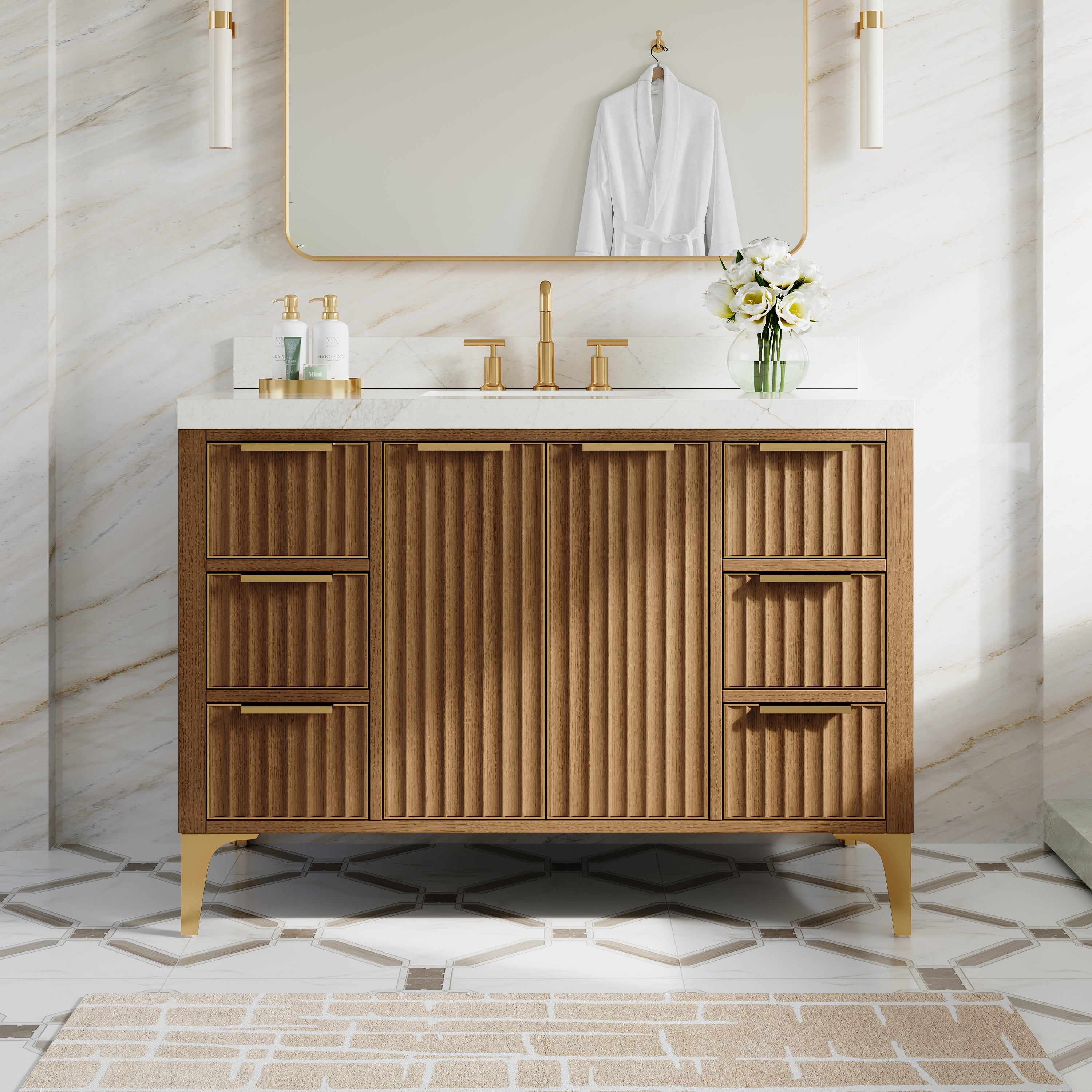
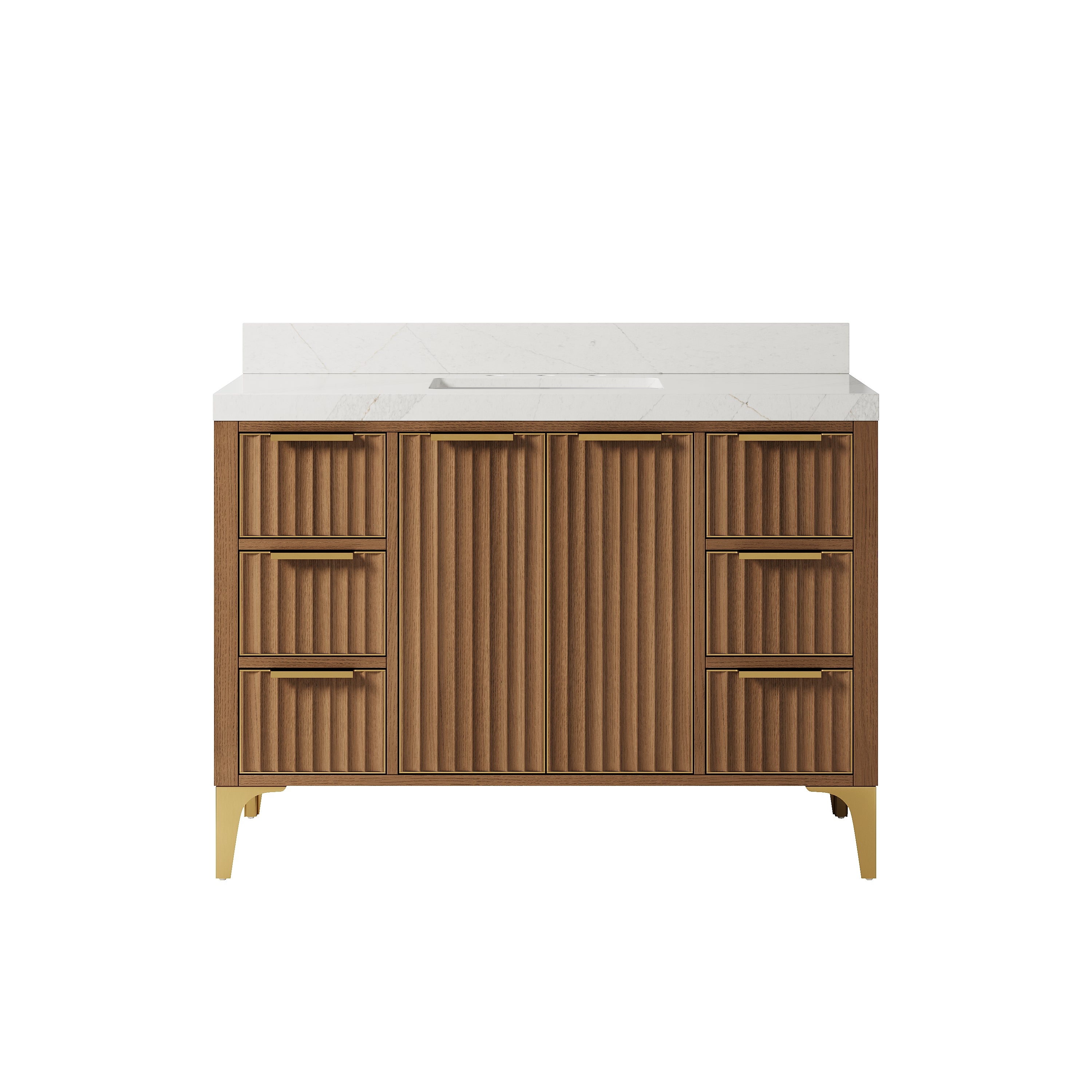



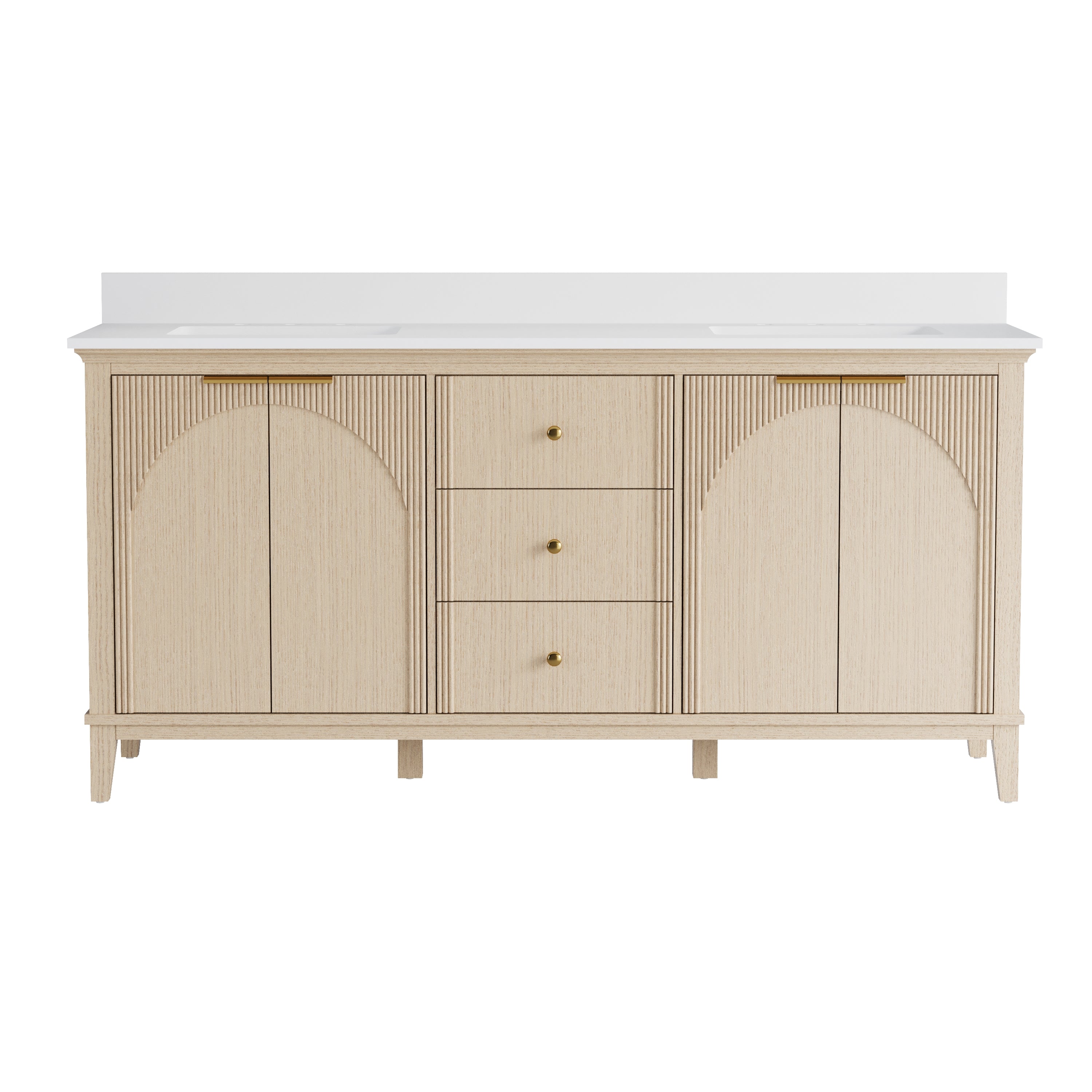
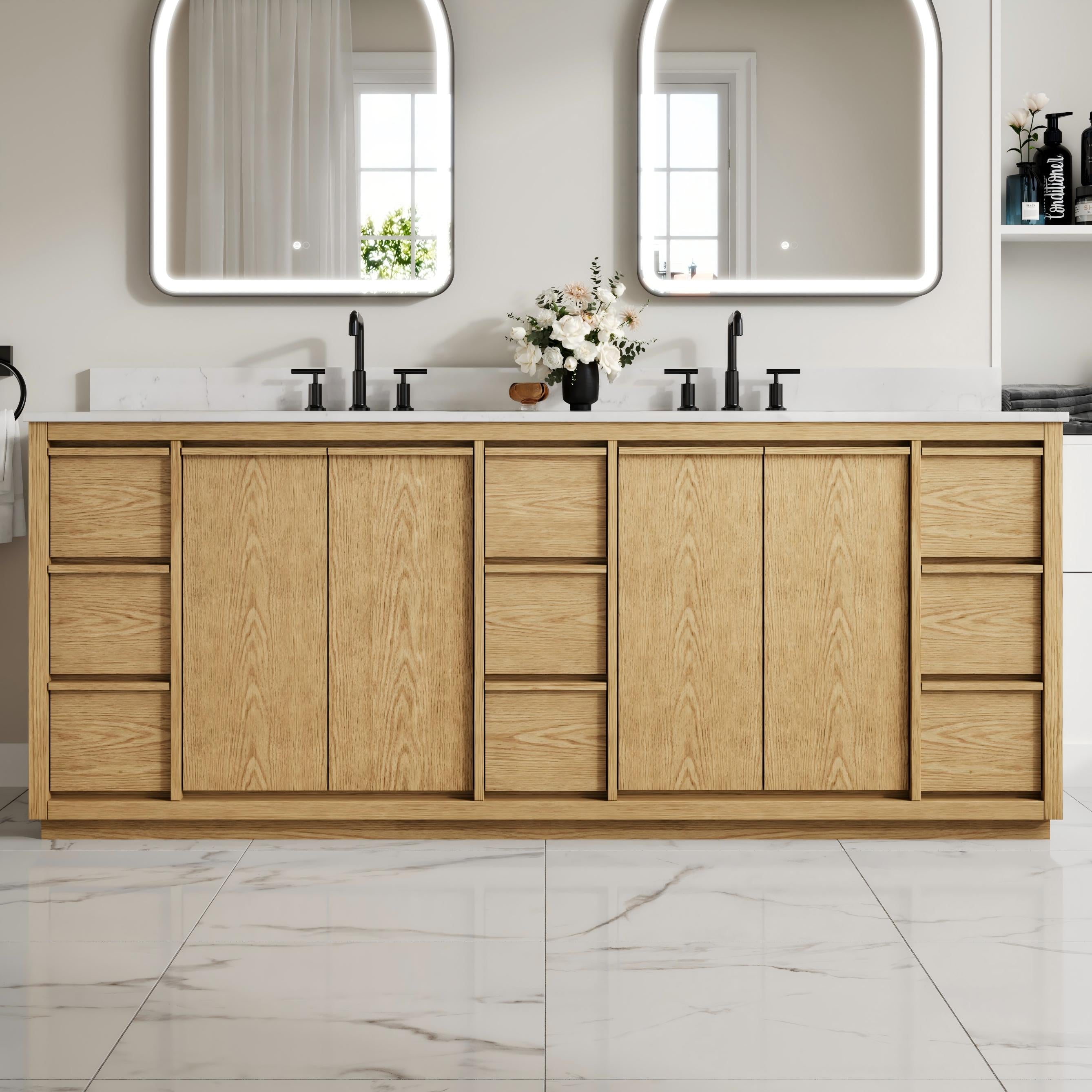
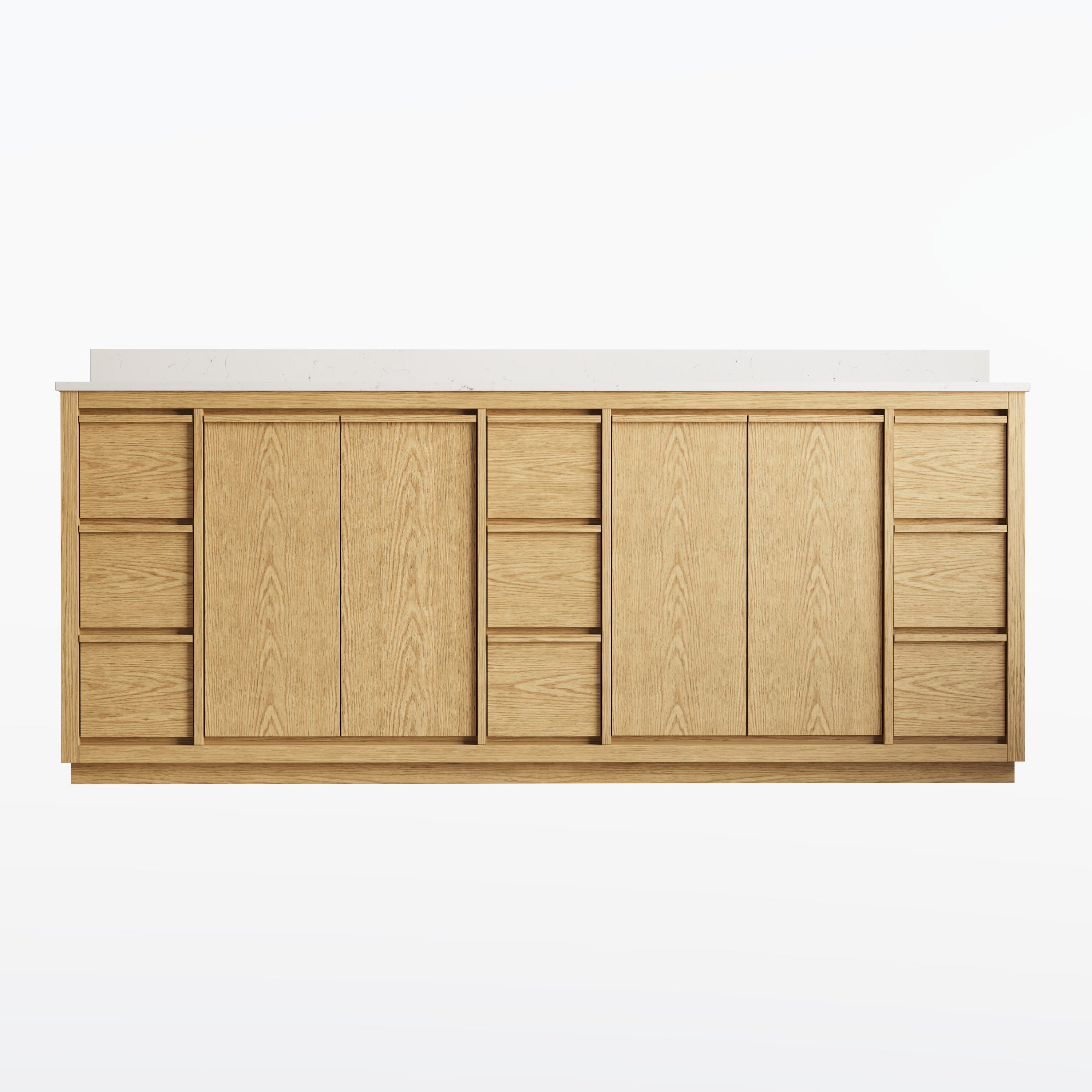
If you are shopping for a real wood bathroom vanity, the goal is not to “avoid veneer at all costs.” Veneer can be high-quality and stable when done right. The real goal is to confirm what parts are truly solid wood, what parts are wood veneer over a core, and whether the construction matches the price and durability claims. Below is a practical inspection routine you can do in a showroom, at delivery, or while unboxing, using only a flashlight and your eyes.
1. Start by learning the most common “real wood” marketing structures
Most “wood” vanities fall into a few honest configurations:
A. Solid wood face frame and doors, plywood box.
B. Solid wood door frames with a veneer panel (or plywood panel) in the center.
C. Veneer over MDF, particleboard, or plywood for large flat areas, plus solid wood trim.
D. Mostly composite core with veneer everywhere visible.
None of these are automatically bad. What matters is whether the listing clearly states the materials and whether the cabinet is built to perform in a bathroom environment.
A useful perspective: the KCMA A161.1 quality certification program tests cabinetry for structural strength, drawer performance, and finish durability under simulated years of use. It includes tests like drawers cycled 25,000 times while loaded at 15 lb per sq ft, and wall-mounted cabinets loaded up to 600 lb without visible failure. (Source: KCMA A161.1 Quality Certification overview.)
1. The fastest “tell”: check edges and hidden surfaces, not the front face
Veneer is a thin layer of real wood bonded to a substrate. A typical veneer thickness often referenced in woodworking is about 1/52 inch. (Source: AWI-QCP, “What Is Wood Veneer?”)
Because veneer is thin, the easiest way to detect it is to inspect places where the outer layer ends:
A. Look at the bottom edge of doors and side panels
Open the doors and use a flashlight along the bottom edge. Ask yourself:
· Do you see a separate edge banding strip?
· Does the grain abruptly stop, then restart with a different look on the edge?
· Do you see a uniform, “fabric-like” pattern that looks like MDF under a thin skin?
Solid wood often shows continuous grain behavior and may show end-grain cues at some edges. Veneer constructions often rely on edge banding to hide the core.
B. Inspect the inside of doors and drawer fronts
Many vanities look premium on the outside but use a different material inside. Check if the interior face of the door is the same wood species and same grain character as the outside. A veneer door may have veneer on both sides (common and fine), but a low-quality version may have a different interior surface or a very uniform “printed” look.
C. Check the back panel and the cabinet underside
The back and underside are where manufacturers often reduce cost. Look for:
· Thin hardboard back stapled on, versus a captured back panel in grooves.
· Raw composite edges that are not sealed.
· A very smooth, uniform brown core typical of MDF or particleboard.
This does not prove “fake,” but it tells you where materials were downgraded.
1. Grain logic tests: what real wood usually cannot fake well
A. The “grain wrap” test
On solid wood parts, grain direction and pattern changes logically as the piece changes direction. Veneered panels sometimes try to “wrap” grain around corners, but if you see a perfect grain flow around a sharp corner on a mass-produced vanity, that is often a sign of veneer or a decorative wrap.
B. Repeating patterns across wide panels
Stand back and look at large flat areas (side panels, door panels, drawer fronts). If the grain pattern repeats in a very regular way, it is more likely veneer sheets arranged for yield, or in worst cases a printed pattern. Solid wood can be consistent, but it rarely repeats like wallpaper.
C. End-grain presence where it should exist
If a seller claims a thick solid wood panel, you should be able to find at least one edge where end-grain behavior makes sense, unless it is fully framed or banded. If every edge is perfectly “face grain looking” with no transition, it may be veneered or banded.
1. Hardware and joinery clues that correlate with honest material choices
Material claims and build quality often move together.
A. Drawer box construction
Pull out the drawers and inspect the drawer sides and corners:
· Are the corners mechanically interlocked (dovetail, locking joint), or just stapled?
· Is the drawer bottom captured in a groove, or simply nailed on?
· Does the drawer side material look like layered plywood, solid wood, or uniform MDF?
Even if you do not care about joinery aesthetics, stronger joinery usually means the manufacturer expects the cabinet to last under humidity swings.
B. Slide performance under load logic
KCMA’s testing uses a loaded drawer cycling protocol (15 lb per sq ft for 25,000 cycles). That does not tell you what your vanity has, but it tells you what “durability language” looks like. If a brand is serious, they can explain their slide type, load class, and testing approach rather than just saying “soft-close.” (Source: KCMA A161.1 Quality Certification drawer tests.)
1. Ask for documentation that forces a clear answer
You do not need a laboratory test to confirm materials. You need a spec sheet that names parts.
Ask these questions in writing:
· “Which components are solid wood: doors, drawer fronts, face frame, side panels, bottom, back?”
· “For veneered parts, what is the core: plywood, MDF, or particleboard?”
· “Is the cabinet KCMA A161.1 certified, or built to that standard?” (If yes, ask for the certification reference.) (Source: KCMA certification explanation.)
· “If composite wood panels are used, are they TSCA Title VI compliant?”
Why the last question matters: TSCA Title VI sets formaldehyde emission standards for hardwood plywood, MDF, and particleboard, with commonly cited limits such as 0.05 ppm for hardwood plywood, 0.11 ppm for MDF, 0.13 ppm for thin MDF, and 0.09 ppm for particleboard. (Source: Williams Mullen summary of EPA TSCA Title VI limits; Composite Panel Association guide.)
A seller who can answer these cleanly is usually selling an honestly specified product.
1. A simple “real wood” scoring checklist you can use in 5 minutes
Give 1 point for each “yes.”
· I can identify at least one clearly solid-wood component (often a face frame, door frame, or drawer box side).
· Large flat panels show consistent veneer logic (edge banding is clean, no bubbling, no peeling).
· The door interior is finished and looks like the same species or a legitimate matching veneer, not a random substitute surface.
· Drawer boxes and slides feel structurally confident (no severe racking or wobble at extension).
· The listing or spec sheet names materials by component, not just “real wood” as a vague phrase.
· The seller can answer TSCA Title VI compliance for composite panels if they are used. (Source: TSCA Title VI standards overview and related guidance.)
1. Common traps and how to avoid them
A. “Solid wood” often means “solid wood parts,” not “solid wood everywhere.”
It is common for listings to highlight the most marketable component while the box uses plywood or MDF.
B. Veneer is still real wood, but it is not solid wood.
A veneer surface can be genuine hardwood and still be a thin layer. AWI notes veneer is thin slices of wood applied to panels, and standard thickness is often around 1/52 inch. (Source: AWI-QCP.)
C. Bathroom durability is not guaranteed by solid wood alone.
Steam and splashes punish edges, seams, and finishes. The best products match good material choices with good sealing and construction, and some back that up with standardized testing approaches like those referenced in KCMA programs. (Source: KCMA A161.1 Quality Certification testing categories.)

Bottom line
You can confirm a real wood bathroom vanity is not “just veneer” by inspecting edges and hidden surfaces, applying grain logic tests, and requiring a component-level material list. In many well-built vanities, you will find a mix of solid wood, plywood, and veneer by design. What you want is transparency, clean execution (especially at edges), and construction details that match long-term bathroom use.















Leave a comment
This site is protected by hCaptcha and the hCaptcha Privacy Policy and Terms of Service apply.