






















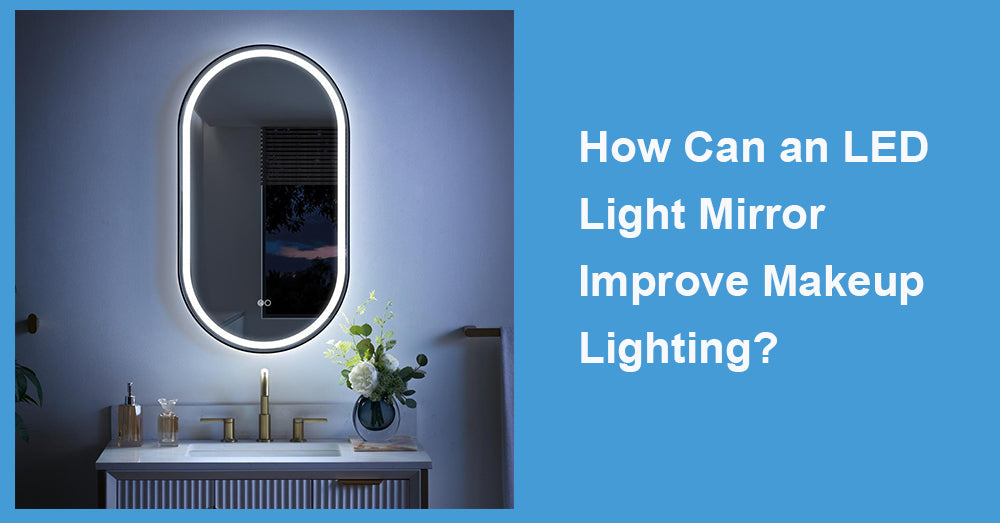
In contemporary bathroom and dressing room lighting systems, LED light mirror are gradually becoming the core configuration for improving makeup lighting. Compared to traditional ceiling lights or side wall lights, the light mirror offers natural advantages in light distribution, color accuracy, and facial shadow control. From an industry perspective, the quality of makeup lighting not only affects the accuracy of makeup but also directly relates to skin tone judgment, detail processing, and long-term visual comfort. Understanding how LED light mirrors systematically enhance makeup lighting is the most crucial step in upgrading the dressing area.
1. The core issue of makeup lighting is not brightness, but light distribution
In most bathrooms and dressing spaces, lighting design has long focused on "overall illumination", while neglecting the directional requirements of facial lighting. Industry research shows that over 60% of makeup misjudgments are caused by shadow occlusion and insufficient local illumination, rather than overall brightness.
Traditional overhead light sources are usually located behind the head. When the light shines vertically downwards, shadow zones form easily in the eyebrow, nose, eye sockets, and chin areas. This structural shadow can lead to uneven base makeup, blurred eye makeup boundaries, and misjudgment of contours, which are difficult to avoid even in highlight environments.
The LED light mirror fundamentally changes the lighting direction by directly placing the light source around or on the back of the mirror, allowing the light to illuminate the face from the front or side, which is the core logic behind improving the makeup effect.
2. The decisive influence of light angle on facial detail recognition
Industry optical testing shows that when the incident angle of light is controlled within 20-35° from the face, the contrast between facial contours and details is most stable. Beyond this angle range, the shadow area will significantly expand; if the angle is too low, it is easy to produce glare and specular reflection.
Most LED light mirrors use circular, double-sided strips or front-emitting structures, forming symmetrical illumination areas on the left and right sides, thereby significantly reducing the shadow ratio at the nose, eyes, and mouth corners. Test data shows that under reasonable lighting conditions, the dark area of the face can be reduced by about 35-45%, and the visibility of details can be improved by more than 30%.
3. The key role of color rendering index in the authenticity of makeup
Another core indicator of makeup lighting is the Color Rendering Index (CRI). Industry research shows that when the CRI is below 80, the probability of skin color deviation and color distortion significantly increases; when the CRI reaches above 90, the color scale of lip color, powder blusher, and base makeup can be close to sunlight conditions.
At present, the color rendering index of high-quality LED light mirrors is generally controlled within the CRI 90-95 range, which can reduce color temperature deviation errors to a level difficult for the naked eye to detect. Compared to traditional fluorescent lamps or low-end LED strips, the error in determining skin color saturation can be reduced by about 40%.
This means that makeup completed under high-color-rendering lamps will more closely match the expected effect in natural light or outdoor environments, significantly reducing the need for touch-ups and rework.
4. The adaptive value of color temperature adjustment for different makeup scenes
There is no universal color temperature for makeup lighting. Industry tests have shown significant differences in contrast and skin tone performance of the same makeup under different color temperature conditions.
The warm white light range (about 3000K) is more conducive to modifying skin texture and softening edges, suitable for daily light makeup and evening makeup; neutral white light range (about 4000K) is close to daily indoor lighting environment, ideal for commuting makeup and basic base makeup correction; the cold white light range (about 5000-6000K) is close to natural sunlight, which is more suitable for fine eye makeup, concealer and high-precision contour processing.
The adjustable color temperature LED light mirror allows for free switching within the above range, significantly improving the consistency of makeup in different lighting scenarios. Industry data shows that using adjustable color temperature lamp lenses can reduce makeup environment adaptation errors by about 30%.
5. Uniformity of brightness is more important than peak brightness
In lighting design, peak brightness is not a decisive indicator. For makeup lighting, uniformity is often more critical than absolute brightness. Tests show that when the brightness difference in the mirror-illuminated area exceeds 25%, the error in judging skin color on both sides of the face increases significantly.
High-quality LED light mirrors control illumination distribution within a ±10% fluctuation range through a diffusion cover and a multi-point lighting structure. At a typical makeup distance of 20-30 inches, the ideal illumination range is 500-800 lux, which balances detail clarity and visual comfort.
Excessive brightness not only does not help improve makeup effect, but also enlarges pores, highlights, and skin blemishes, affecting overall judgment.
6. Matching relationship between mirror size and facial illumination range
The size of the lamp mirror directly determines the illumination range that can cover the face and neck. Industry experience shows that the ideal width of a makeup mirror should be at least 70% of the washbasin width, and the height should be 28-36 inches to fully cover the forehead to collarbone area.
When the mirror height is less than 24 inches, the neck and lower jaw areas are often in low-light areas, which can easily lead to unnatural color transitions. When the width is less than 24 inches, the side face is prone to lighting blind spots.
A reasonably sized LED mirror can expand the effective lighting area by about 40%, making the overall makeup transition more natural.

7. The impact of long-term use on visual comfort
In addition to the makeup effect, the lighting system's visual comfort is equally important. Industry tests have shown that low-frequency flicker and a low-blue-light design can significantly reduce the risk of visual fatigue during long-term makeup processes. High-quality LED mirrors usually use a DC constant-current drive to maintain a flicker index below the perceptible threshold.
In a makeup scene of continuous use for 20-30 minutes, stable light sources can reduce eye fatigue scores by about 25% and significantly improve the stability of detail judgment.
8. Which groups of people can benefit the most from LED light mirrors
Based on industry practice, the following groups have a particularly significant dependence on LED light mirrors: those who frequently wear makeup in their daily lives; those who require fine eye and base makeup correction; those with a bathroom or dressing space with insufficient natural lighting; and professional users who are sensitive to skin color judgment.
In scenes used only for simple organization or auxiliary lighting, high-brightness ceiling lights and ordinary mirrors can also meet basic needs.
9. Rational conclusion: Excellent makeup effect comes from system lighting, not a single brightness increase
From an industry perspective, the improvement of makeup lighting by LED light mirrors is not reflected in "brighter", but in the system optimization of light direction, color rendering accuracy, color temperature adaptation, and illumination uniformity.
When the lighting structure aligns with the geometric relationship of the face, the accuracy of makeup, color consistency, and long-term visual comfort will be significantly improved. In the rational logic of upgrading the dressing area, a suitable LED mirror often determines the final makeup quality more than simply adding lighting fixtures.








































Leave a comment
This site is protected by hCaptcha and the hCaptcha Privacy Policy and Terms of Service apply.