






















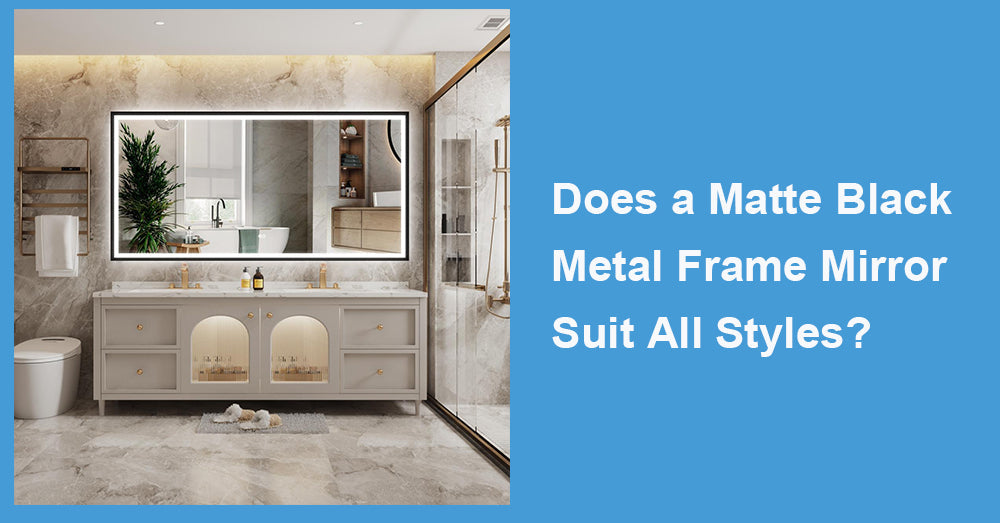
In bathroom retail showrooms and online listings this season, the matte black metal frame bathroom mirror has become one of the most frequently recommended “safe choices.” Brands position it as modern, clean, and easy to match, while installers like it for its clear lines and predictable sizing. But does it truly suit all styles? Industry feedback suggests a more realistic answer: it fits many looks well, yet it still needs the correct surrounding details to feel intentional rather than forced.
Why matte black frames are trending again
The renewed popularity is not accidental. First, matte black creates a strong visual outline that instantly makes a bathroom look more “finished.” In a market where many projects use white walls, light gray tile, and wood-tone vanities, black serves as a crisp border, adding contrast without clutter. Second, manufacturers can more easily standardize production. Metal frames, standard sizes, and consistent finishes allow faster stocking for distributors and smoother sales on e-commerce platforms. For retailers, it’s a product that sells across price tiers: entry-level options focus on simple frames, while premium lines add improved coatings, anti-fog, or lighting.
Where it matches best: modern, minimal, and industrial
From a style perspective, matte black metal frames work well in modern and minimalist bathrooms. The reason is simple: these spaces depend on clean shapes and clear structure. A black frame gives the mirror a “graphic” edge that supports that design language.
Industrial style is another obvious match. Concrete textures, darker tiles, exposed metal, and black shower frames all connect easily with matte black mirrors. The mirror doesn’t feel like a separate item—it feels like part of the system.
Even “light luxury” (the popular mid-to-high segment that mixes stone, glass, and warm lighting) can use matte black effectively. When the frame is thin and the finish is smooth, it reads as calm and premium rather than heavy.
Can it work with Nordic, farmhouse, and Japandi?
Yes—often. Nordic and Japandi bathrooms often feature light woods, soft whites, and calming textures. A matte black frame can be a good accent if it stays refined. Industry designers say the trick is choosing:
· thinner frames rather than thick borders
· round, oval, or softly arched shapes to reduce sharpness
· Warm lighting so the black doesn’t feel cold
Farmhouse style is possible, too, but it requires balance. If the room has black handles, black faucets, or black lighting, the mirror makes sense. If the bathroom is all brushed nickel and warm wood, the black frame can look like an “extra piece” that doesn’t belong.
Where it struggles: classic, ornate, and strong traditional themes
This is where the “fits all styles” claim becomes weak. In classic European, ornate vintage, or heavily decorative bathrooms, the focus is often on curves, carved details, and richer materials. A simple matte black metal frame can feel too modern and too strict. It may create a visual mismatch, especially if the vanity, wall décor, and lighting are detailed and traditional.
That doesn’t mean black is banned—it means the mirror choice must change. Designers suggest:
· choosing an arched frame instead of a strict rectangle
· matching black to other black elements (faucets, sconces, shower hardware)
· using softer wall colors to reduce contrast
If you try to “drop” a black metal frame into a classic bathroom with gold fixtures and ornate lighting, it often looks like a mistake.

The three “no-regret” rules retailers keep repeating.
Across showrooms, these three points come up again and again because they reduce returns and complaints:
1. Match the hardware color story.
2. If your faucet, shower frame, towel bars, or light fixtures are black, a matte black mirror is an easy win. If everything is brushed nickel or warm brass, think carefully.
3. Watch the vanity tone.
4. White and light wood vanities are the easiest match. Dark walnut or reddish wood can clash with black unless the frame is thin and the room has other black accents.
5. Choose the right shape for the room size.
6. Small bathrooms often look better with round or oval mirrors (they soften the space). Larger bathrooms can handle rectangular mirrors, double vanities, or wide frames without feeling crowded.
Finish and durability: what buyers ask about now.
As matte black moves from trend to “standard option,” buyers are asking more about durability than appearance. In humid bathrooms, a metal frame needs strong corrosion resistance and a stable coating. Store staff report that customers increasingly check:
· Whether the finish shows fingerprints easily
· whether the coating scratches during cleaning
· Whether corners or seams rust over time
· What warranty terms are offered
This is also why some premium brands highlight improved powder coating or upgraded surface treatments. The finish may look similar on day one, but performance over two or three years is what protects reputation.
Feature upgrades: anti-fog and lighting, but keep it simple
Anti-fog, backlighting, and adjustable color temperature are becoming common add-ons, especially in midrange and premium categories. However, installers warn that the “more features” approach can create new problems if quality is inconsistent: uneven light, overly blue color temperature, or complex wiring can cause dissatisfaction.
Many retailers recommend keeping the decision simple:
· If the bathroom has intense ceiling lighting, choose a basic framed mirror with a good coating.
· If lighting is weak, consider a backlit or front-lit model, but verify color and brightness in person if possible.
So, does it suit all styles?
The honest industry answer: it suits most modern lifestyles and many mainstream design directions, but not automatically every style. A matte black metal frame bathroom mirror works best when it is part of a coordinated look—supported by matching hardware, compatible vanity tones, and the right mirror shape.
If you treat it as a “universal fix,” it can feel too sharp or too modern in classic settings. If you treat it as a design tool—one that adds structure, contrast, and a clean border—it can deliver a high-end look at a reasonable cost. That is why, in today’s bathroom market, matte black frames are staying popular: they are flexible, but only when used with a bit of planning.







































Leave a comment
This site is protected by hCaptcha and the hCaptcha Privacy Policy and Terms of Service apply.