










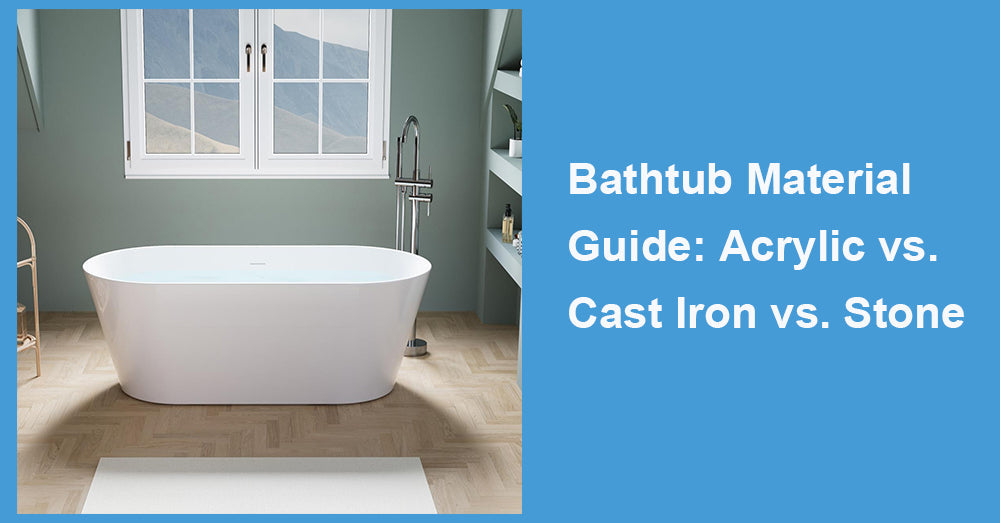
Against the backdrop of continuous growth in bathroom upgrades and residential renovations, the choice of bathtub material has become an important factor affecting comfort, durability, and spatial value. From lightweight Acrylic to traditional sturdy cast iron, and then to high-end textured stone bathtubs, different materials have significant differences in weight, insulation performance, installation requirements, and long-term Maintenance. Industry data shows that in new construction and renovation projects, the market share of acrylic bathtubs has exceeded 60%, cast iron accounts for about 20%, and stone and composite stone products have maintained a stable growth trend. Understanding the characteristics of the three mainstream materials can help find the best balance between budget and performance.
1. Acrylic: a lightweight and cost-effective choice
Acrylic bathtubs are widely used for their lightweight, flexible design. The weight of a standard 60-inch x 30-inch acrylic bathtub is usually between 70 and 110 pounds, which is about over 200 pounds, which is less than that of cast iron products of the same size. This lightweight structure has significant advantages in second-floor or renovation projects, reducing the requirement for ground load-bearing capacity.
In terms of insulation, the acrylic bathtub with a multi-layer reinforced structure has good insulation performance. Material testing data shows that high-quality acrylic bathtubs typically maintain a 3-5 °F temperature drop within 30 minutes of filling, outperforming traditional metal bathtubs.
In terms of durability, the acrylic surface has a certain degree of elasticity and is not easily cracked by minor impacts. Industry evaluations show that under normal household usage conditions, its lifespan can reach 10-15 years or more. Daily Maintenance is also relatively simple; avoid strong acid and alkali cleaning agents.
However, the rigidity of Acrylic is relatively low compared to cast iron and stone, and if the bottom support is insufficient, it may cause slight shaking. Therefore, during installation, it is necessary to ensure that the bottom filling and supporting structure are firm.
2. Cast Iron: A Traditional Durable Heavyweight Choice
Cast iron bathtubs usually use thick iron cores and are covered with enamel layers, making the structure extremely sturdy. The weight of a standard 60-inch x 30-inch cast iron bathtub is typically between 300 and 400 lbs, which is three to four times that of acrylic products.
The advantages of this high-density structure lie in stability and durability. Data shows that high-quality cast iron bathtubs can last for more than 30-50 years under normal use, with excellent scratch resistance and resistance to fading of the glaze.
In terms of insulation performance, cast iron can maintain temperature for a long time after heating, but it will absorb some heat during the initial water injection. Therefore, it is recommended to use a higher water temperature for preheating. Experimental data showshow that the water temperature drops by about 4-6 °F within 30 minutes after preheating, which is similar to that of high-end Acrylic.
3. Stone: High-end texture and natural aesthetics
Stone bathtubs include two types: natural stone and composite stone. Common sizes are 60 or 67 inches long, and the weight is usually between 250 and 500 lbs, depending on the material density.
The biggest advantage of stone bathtubs lies in their appearance and tactile feel. Natural stone has a unique texture, and each product has its own differences. Composite stone is made by combining natural powder with resin, balancing stability and design freedom.
In terms of insulation performance, stone has a strong heat storage capacity due to its high density. Data shows that after being filled with water for 30 minutes, the water temperature typically drops by 3-4 ° F, outperforming most metal materials.
In terms of durability, composite stone structures can be used for more than 20 years. Natural stone requires regular Maintenance to prevent infiltration and surface damage.
The shortcomings of stone bathtubs are high cost and strict requirements for ground load-bearing and handling during installation.
4. Weight and installation comparison
From the perspective of structural weight:
Acrylic: Approximately 70-110 lbs
Cast iron: approximately 300-400 lbs
Stone: Approximately 250-500 lbs
For second-floor or renovation projects, Acrylic is more flexible. Cast iron and stone are better suited for spaces with good load-bearing capacity.
5. Comparison of insulation performance
At standard room temperature, the water temperature changes approximately 30 minutes after being filled with water as follows:
Acrylic: Drop 3-5 ° F
Cast iron: decrease by 4-6 ° F
Stone: Decreased by 3-4 ° F
It can be seen that the difference between the three is not extreme, but stone and high-end Acrylic have slightly better insulation performance.
6. How to choose suitable materials?
When selecting materials, one can judge from the following dimensions:
Budget and installation conditions
Floor load-bearing capacity
Thermal insulation and comfort requirements
Style and Visual Effects
If emphasizing lightweight, flexible installation, Acrylic is the mainstream choice; if pursuing traditional durability and a classic texture, cast iron offers greater advantages; if emphasizing design and a high-end appearance, stone is more attractive.

7. Conclusion
Bathtubs made of different materials have their own advantages in terms of weight, insulation, durability, and cost. With continuous advances in material technology, acrylic structures are more stable, cast iron processes are more refined, and stone-composite technology is also more mature.
When planning bathroom space, a comprehensive evaluation should be conducted based on dimensions (such as 60-inch or 67-inch specifications), structural load-bearing conditions, and long-term usage needs. Only by rationally comparing material characteristics can we achieve the best balance between comfort, durability, and budget, and realize the ideal bathroom upgrade plan.















Leave a comment
This site is protected by hCaptcha and the hCaptcha Privacy Policy and Terms of Service apply.