






















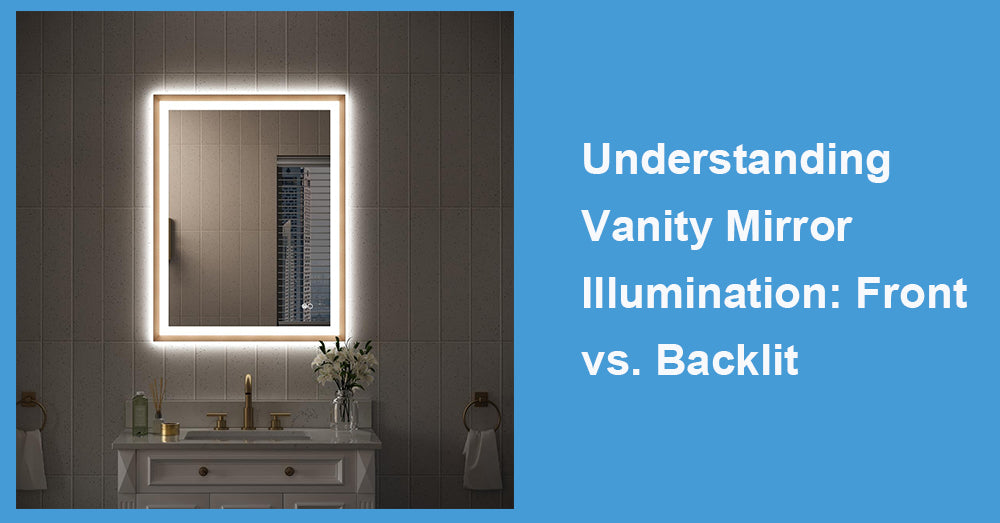
In modern bathroom and dressing space design, vanity mirror illumination has become an important technical link that affects the accuracy of makeup and overall spatial texture. Mirror lighting is no longer just a simple lighting tool, but a core factor that directly determines facial shadow control, skin tone restoration, and spatial atmosphere creation. With the development of LED technology, the two mainstream structures of front-lit and backlit are gradually forming differentiated application scenarios. Industry data shows that in products with light mirrors, the front light-emitting structure accounts for more than 60%. In contrast, the back-light-emitting structure has grown significantly in recent years, especially in modern minimalist-style spaces.
1. Front luminous structure: centered on precise functionality
Front-illuminated mirrors usually embed LED light strips along the front or edge of the mirror surface, allowing light to be projected directly onto the face. Common forms include surround light strips or left and right vertical light strips.
The biggest advantage of this structure is that the light falls directly on the face, resulting in fewer shadows. The lighting industry recommends using light sources with a color rendering index (CRI) above 90 in the dressing environment to ensure foundation makeup and skin color appear natural and true. Data show that in environments where high-color-rendering pre-luminous mirrors are used, the accuracy of makeup color restoration improves by about 20% or more.
In terms of color temperature, most front-illuminated mirrors support an adjustable range of 3000 K to 6000 K. The 4000K-4500K range is considered closest to natural daylight and has the highest proportion in daily use.
In terms of spatial dimensions, common front-illuminated mirror widths include 24 inches, 30 inches, 36 inches, 48 inches, and 60 inches or more. Design suggestion: Set the mirror width to 80%-100% of the tabletop width. For example, a 36-inch countertop is more coordinated with a 28-36-inch mirror surface.
2. Back illuminated structure: emphasizing atmosphere and hierarchy
Backlit mirrors hide LED light strips on the back of the mirror, allowing light to spill over onto the wall, creating a soft halo effect. This structure does not directly illuminate the face, but enhances the environment's brightness through reflection.
Data shows that the use of backlit mirrors in modern style spaces has increased by about 30% in recent years. Its advantages lie in:
Soft visual effect
Enhance wall layering
Enhance the sense of spatial extension.
In bathrooms with an area of less than 70 square feet, backlit structures can increase the brightness of the space by about 15% -20%, making the walls more three-dimensional.
However, because the light does not directly project onto the face, backlit mirrors may require additional side or overhead lighting during fine makeup.
3. Comparison of brightness and illuminance
Front illuminated mirrors typically provide higher facial illumination. Industry recommendations suggest that the dressing area should achieve an overall illumination of 300-500 lumens per square foot to ensure clear makeup.
Backlighting mirrors are more inclined towards ambient lighting, with relatively low direct illumination on the face, making them more suitable as ambient lighting or nighttime auxiliary light sources.
In high-end spaces, more and more designs are adopting a "front+back" dual-light-source structure, allowing mirrors to achieve both direct illumination and soft background lighting.
4. Installation ratio and ergonomics
Whether using front- or back-emitting structures, it is recommended to maintain a consistent standard for mirror installation height. The centerline of the mirror is usually set at 60-65 inches above the ground to cover the majority of adult vision.
It is recommended to keep the distance between the bottom of the mirror and the tabletop at 5-10 inches, and the distance between the top of the mirror and the ceiling at least 6 inches, to ensure a balanced proportion.
For a 60-inch or 72-inch double basin space, you can choose a full-illuminated mirror or two independent mirrors (28-36 inches wide on each side), depending on the overall style, to determine the lighting layout.
5. Energy consumption and lifespan performance
LED lighting systems generally offer energy-saving and long-lasting performance. Industry data shows that the service life of high-quality LED light strips can reach 40000-50000 hours. Due to their indirect light output, some backlit structures have slightly lower energy consumption than high-brightness front-emitting systems.
In practical applications, the front-illuminated mirror emphasizes brightness output, while the back-illuminated mirror emphasizes visual comfort. The difference in energy consumption between the two usually does not exceed 10% -15%.
6. Style adaptation and design trends
The front-illuminated mirror is more suitable for modern, function-oriented spaces, such as the main bathroom, which require fine dressing or shaving. Backlighting mirrors are commonly used to emphasize the light, luxury, or minimalist design of the spatial atmosphere.
In recent years, the growth trend of the dual-layer structure (Front lit + Backlit) has been evident. In high-end renovation projects, the utilization rate of composite lighting structures has exceeded 35%.
7. How to choose a suitable structure?
When choosing, one can judge from three dimensions:
Is makeup and fine operation the main focus? Prioritize front lighting
Is the focus on spatial atmosphere and visual hierarchy? Prioritize backlighting
Whether to pursue comprehensive effects → Choose a dual light source structure.
In spaces with smaller areas or insufficient natural light, front-illuminated mirrors are more practical; when the space is spacious and overhead lighting is already provided, the backlit structure has a more design-oriented feel.

8. Conclusion
The choice of mirror lighting structure directly affects the spatial usage experience. The front light emphasizes precision and functionality, while the back light emphasizes softness and atmosphere. Understanding the differences in illumination, proportion, and visual effects between the two can help make more scientific judgments during the design phase.
With the continuous advancement of LED technology and intelligent control, vanity mirror illumination is evolving from a single-fill light system to a comprehensive lighting solution. When planning, the most suitable lighting layout should be selected based on spatial dimensions, usage needs, and overall style to achieve a professional and comfortable dressing environment.







































Leave a comment
This site is protected by hCaptcha and the hCaptcha Privacy Policy and Terms of Service apply.