






















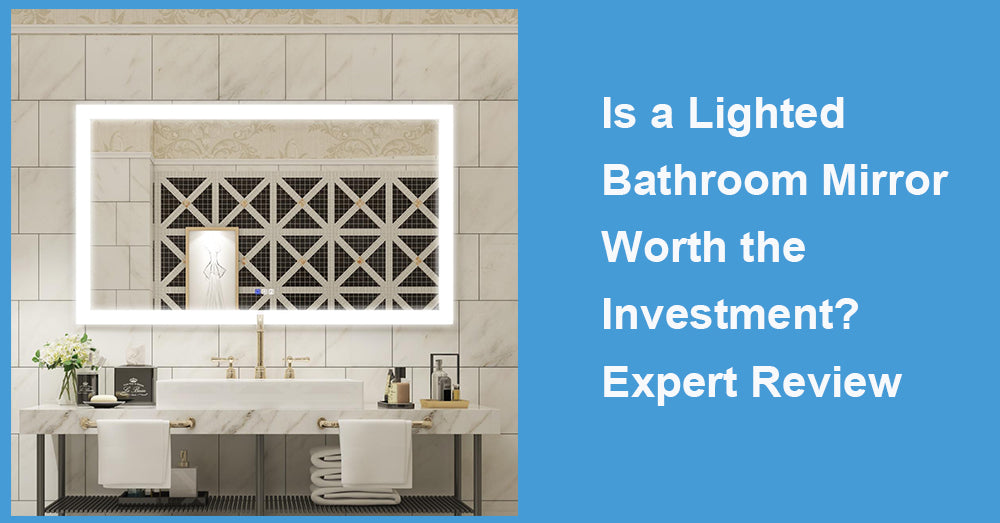
In recent years, the trend of bathroom upgrades has gradually shifted from high-end configurations to mainstream choices for lighted bathroom mirror. Compared to the traditional method of combining mirrors with wall lamps, the mirror system with integrated LED lighting has significantly improved illumination uniformity, spatial integration, and user experience. Is it worth investing in bathroom mirrors with lights? From the perspectives of lighting performance, spatial value, long-term durability, and daily practicality, these types of products are gradually becoming the core configuration in modern bathroom spaces.
1. Lighting effect: Is it really more professional?
Traditional bathrooms typically rely on ceiling or side wall lights for illumination, but this can easily cast shadows on the face. The lighting industry recommends that the grooming area achieve an illumination level of approximately 300-500 lumens per square foot, and that the light source have a color rendering index (CRI) above 90 to ensure natural skin tone restoration.
Data show that in environments with high-color-rendering LED systems and illuminated mirrors, facial shadows are reduced by about 30%, and skin color deviation is significantly reduced. Compared to a single overhead light, an illuminated bathroom mirror can provide more uniform, direct facial illumination, especially advantageous for makeup, shaving, or skincare.
In terms of color temperature, mainstream products support an adjustable range of 3000 K to 6000 K. 4000 K-4500 K is close to natural sunlight and is considered the ideal range of light colors for daily use.
2. Spatial integration: reduce visual clutter
In bathrooms with an area of less than 80 square feet, wall space is particularly precious. The combination of traditional mirrors and wall lamps often takes up more horizontal space. Combining lighting and mirror surfaces with illuminated mirrors can reduce the installation area of lighting fixtures on both sides.
Industry statistics indicate that using integrated luminous mirrors in compact bathrooms can save about 10%-15% of wall space and enhance overall visual simplicity. This integrated structure is particularly suitable for single-basin spaces with 24-inch, 30-inch, or 36-inch widths.
For a 60-inch or 72-inch double-basin layout, the entire illuminated mirror can enhance spatial coherence and make the visual more unified.
3. Installation size and proportion matching
The size selection of the illuminated mirror still follows the principle of proportionality. The mirror width is usually set to 80%-100% of the tabletop width. For example:
30-inch countertop → 24-30-inch mirror surface
36-inch countertop → 28-36-inch mirror surface
48-inch countertop → 40-48-inch mirror surface
The common height of the mirror surface is 30-40 inches, with a recommended distance of 5-10 inches from the bottom of the mirror to the tabletop, and a minimum distance of 6 inches from the top of the mirror to the ceiling.
Reasonable proportions not only enhance aesthetics but also avoid uneven distribution of light.
4. Energy saving and lifespan performance
Modern LED lighting systems have a long service life. Industry data shows that the usage time of high-quality LED light strips can reach 40000-50000 hours. Calculated based on a daily usage of 2 hours, the theoretical lifespan can exceed 20 years.
In terms of energy consumption, LED lighting uses more than 75% less energy than traditional incandescent lamps. Even as the main lighting source, its long-term operating costs are relatively controllable.
Therefore, from an energy-efficiency perspective, illuminated bathroom mirrors are long-term investments with low maintenance and low energy consumption.
5. Anti-fog and additional functional value
In the main bathroom space with a shower, mirror fogging is a common problem. The luminous mirror with heating and defogging function can significantly reduce the condensation time of steam. Data shows that the anti-fog module can shorten the recovery time of mirror clarity by about 80%.
In addition, functions such as touch dimming, brightness memory, and automatic switch are becoming standard on high-end products. These functions, although not necessary, have significant advantages in improving usability.
6. Comparison of Cost and Long-term Value
The initial investment in illuminated mirrors is usually higher than that of ordinary mirrors. But if the following factors are considered:
No additional wall lamp cost required
Energy-saving LED system reduces long-term electricity costs.
Enhance the overall design sense of the space.
Improve daily usage efficiency.
From the perspective of overall system cost, its cost-effectiveness is gradually becoming apparent. Especially in renovation projects, the integrated structure can reduce installation complexity.
7. Which spaces are suitable?
The illuminated bathroom mirror is particularly suitable for the following scenarios:
A bathroom with insufficient natural lighting
Compact space with an area of less than 70 square feet
Grooming areas that require frequent makeup or meticulous care
Design that emphasizes modern style and simple visual effects
In large spaces, luminescent mirrors can also be combined with ceiling lights or wall lights to form a multi-level lighting system.
8. Is there a limitation?
Although the advantages are obvious, it should also be noted that:
If the brightness is insufficient, an auxiliary light source may still be needed.
Installation requires a reserved power interface.
Low-quality products may exhibit light decay.
Therefore, it is particularly important to choose products with high color rendering, adjustable brightness, and stable structure.

9. Conclusion
In terms of comprehensive lighting effects, spatial integration, energy-saving performance, and long-term durability, illuminated bathroom mirrors do indeed have high investment value. It not only optimizes the lighting environment for the face but also enhances the integrity of the overall spatial design.
When making decisions, attention should be paid to core parameters such as color rendering index, color temperature range, size ratio, and anti-fog function. If the space has high requirements for lighting quality and visual cleanliness, then a bathroom mirror with lights is not only an upgrade but also a long-term beneficial configuration choice.









































Leave a comment
This site is protected by hCaptcha and the hCaptcha Privacy Policy and Terms of Service apply.