
















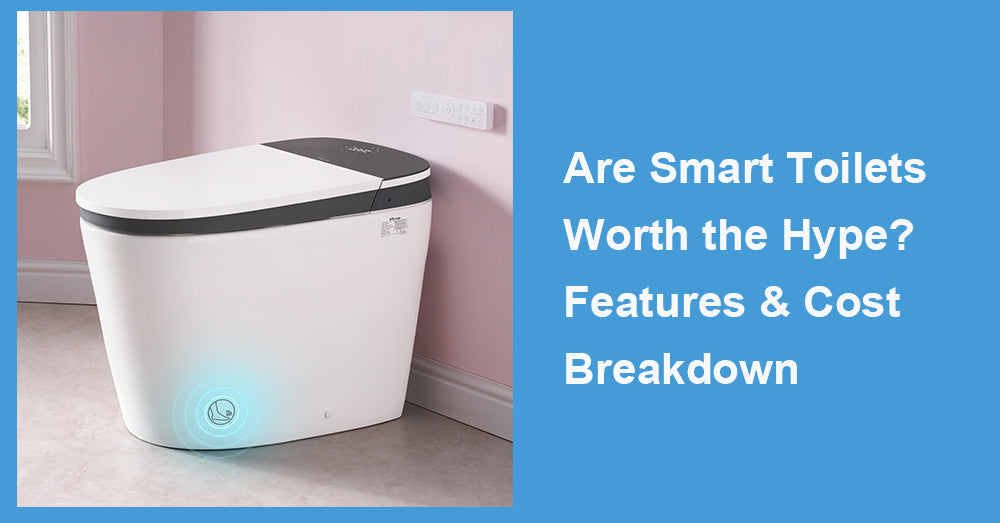
In recent years, smart toilet have gradually shifted from being a "niche technology product" to a frequently mentioned option in discussions about bathroom upgrades.
The controversy surrounding it is equally evident: some believe it is a crucial step toward improving quality of life, while others question whether its price and complexity are worth it.
To answer this question, we cannot just look at the list of features, but need to put the smart toilet back into a real usage scenario and break it down into three aspects: functional value, spatial adaptation, and long-term cost.
1. Why are smart toilets suddenly widely discussed
Industry data shows that in recent years, the penetration rate of toilets or smart toilet seats with electronic functions has continued to rise in bathroom renovation projects.
This change is not solely driven by technological factors, but is closely related to changes in living comfort, hygiene habits, and population structure.
Traditional toilets are highly standardized in functionality, while smart toilets are the first to integrate cleaning, comfort, and personalized settings into a single product.
For many people, it is not about "upgrading the toilet" but about "changing the toilet experience".
2. Core function breakdown: which ones are beneficial and which ones are just bonus points
From a functional perspective, most smart toilets revolve around the following core modules.
Warm water cleaning system
This is the basic function of smart toilets and also the most frequently used one.
Industry research shows that after the first use, over 70% of users will make the cleaning function a daily habit, rather than just "occasionally trying it out".
The adjustable nozzle position, graded water pressure, and independent front- and rear-cleaning solve long-standing but overlooked cleaning problems.
seat heating
In cold seasons, seat heating is highly effective.
Although it appears to be just another parameter, its impact on comfort is often underestimated in practice.
The seat width of most products is 14-15 inches, and the heating area matches the height of the contact surface.
Automatic flushing, sensor opening, and closing
This type of function is more inclined towards "reducing contact".
From a hygiene perspective, reducing manual operation itself is a value.
However, the stability of the sensing system directly determines the quality of the experience, and low-quality solutions may actually increase the cost of accidental touches and maintenance.
Deodorization and Air Purification
The built-in deodorizing module is not a gimmick.
Data shows that in enclosed bathrooms, active deodorization systems can significantly shorten the time odors persist, making them particularly friendly for multiple people sharing bathrooms.
3. Size and installation: Smart toilets are not "plug and play."
Unlike regular toilets, smart toilets require careful evaluation of size and installation conditions before purchase.
Overall dimensions
The length of most integrated smart toilets is between 26 and 29 inches, slightly longer than that of traditional models.
For a compact bathroom, the 2-3 inch difference may directly affect the flow of traffic and door opening.
Pit distance and location
The standard pit spacing is 12 inches, and some models also support 10 or 14 inches.
But unlike ordinary toilets, smart toilets have precise requirements for the space behind the wall and the location of the power supply.
If the power supply is too far away, the cost of later renovation will significantly increase.
Weight factor
Due to their built-in water tank, electronic module, and heating system, smart toilets typically weigh more than traditional toilets.
Although the impact on ground load-bearing is limited, it is still necessary to confirm the installation conditions in advance during the renovation of old houses.
4. Cost breakdown: Price is not just about 'buying once.'
Many people's hesitation towards smart toilets is focused on the price.
According to industry data, the price range for smart toilets is extensive, from basic to high-end models, with price differences of several times.
But if the perspective is extended, comparing only the "purchase price" is not complete.
The changes in water efficiency, toilet paper consumption, and the maintenance cycle of smart toilets will all affect long-term costs.
For example, after long-term use of the warm-water cleaning function, toilet paper use generally decreases.
The automatic flushing system is more stable in water volume control, reducing waste caused by misoperation.
Of course, electronic components also imply potential maintenance costs, which is an essential reason for choosing mature brands and stable technology solutions.

5. Who is most suitable for smart toilets, and who can wait and see for now
From the feedback on usage, the following groups of people have significantly higher satisfaction with smart toilets:
One is the group of people who have higher requirements for cleaning experience.
Secondly, we hope to reduce the number of households that bend over and manually operate;
The third is the bathroom scene, which is frequently used and shared by multiple people.
If bathroom use is infrequent or space and installation conditions are limited, choosing a smart toilet seat as a transitional solution can often provide the core function at a lower cost.
6. Neglected key points: stability and 'not overly intelligent.'
Smart toilets are not necessarily better with more functions.
Industry experience shows that the stability of core functions, rather than the number of functions, truly determines long-term satisfaction.
Whether the water temperature is stable, whether the nozzle is reliable, and whether the system is easy to maintain are far more critical than complex mode switching.
At the same time, whether the operation logic is intuitive or not will directly affect the user experience.
Overly complex control panels may actually become a burden in daily use.
7. So, is the smart toilet really "worth it"
From an industry perspective, smart toilets are not a short-term gimmick, but a gradually accepted shift in usage.
Its value is not reflected in how advanced it looks, but in whether it is genuinely more comfortable, cleaner, and labor-saving when used repeatedly every day.
If space conditions permit, the budget is reasonable, and there is a higher expectation for daily experience.
Smart toilets often rank among the upgrades with the least regret after installation.
On the contrary, if one only pursues concepts while ignoring Size, installation, and actual needs, it may also become an idle, high-priced device.
The key is not whether it is intelligent, but whether it has chosen the one that is genuinely suitable for its own use.

















Leave a comment
This site is protected by hCaptcha and the hCaptcha Privacy Policy and Terms of Service apply.