






















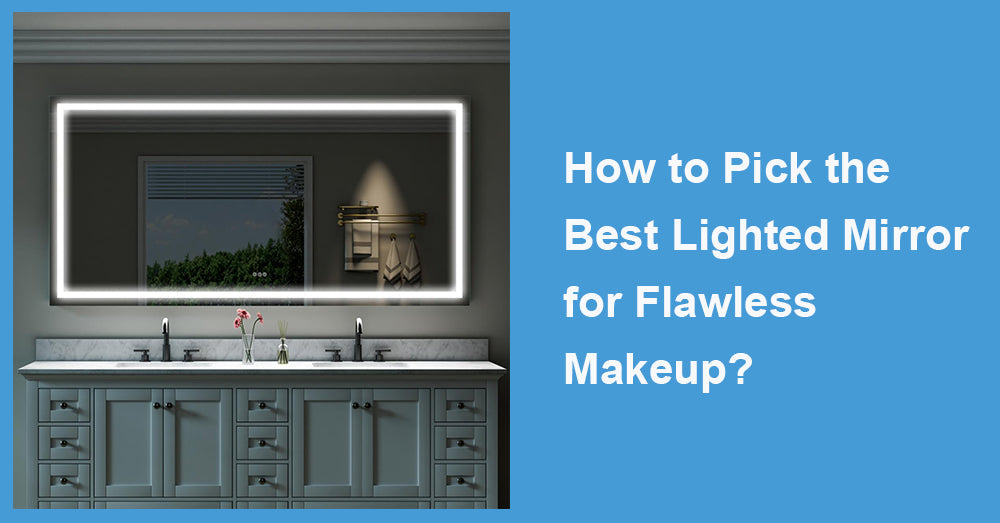
In contemporary bathrooms and dressing spaces, lighted mirror are no longer "mirrors with lights" but key tools that directly determine the precision and authenticity of makeup.
Numerous industry studies and lighting tests have shown that the common reason for makeup failure is not the technique or product, but improper lighting conditions.
Choosing the right lighting mirror is about establishing a stable, repeatable lighting environment for daily makeup application.
1. Why are ordinary mirrors difficult to meet makeup needs
Traditional bathroom lighting often relies on a single ceiling light, which can easily cast shadows under the face or around the eyes.
The data shows that in an environment that relies solely on ceiling lights, the contrast between light and shade on the face will be significantly increased, resulting in uneven base makeup, heavy eye makeup, or an incorrect placement of powder blusher.
The core value of an illuminated mirror is not "brighter", but "more uniform".
When the light source is located around or directly in front of the mirror, the light will cover the face more naturally, significantly reducing shadow interference.
This is why professional makeup rooms commonly use surround fill lighting.
2. Size selection: The larger the mirror, the higher the fault tolerance
When choosing lighting mirrors, the size is often underestimated.
Industry tests have shown that mirror width directly affects the accuracy of makeup judgment.
The width of ordinary illuminated mirrors is concentrated at 24, 30, 36, and 48 inches.
24 inches is suitable for single-person close-range use, but it may be cramped for overall makeup observation.
30-36 inches is the ideal makeup area, covering the face and showing the neck and shoulder lines.
48 inches and above are more suitable for main bath or double-use scenarios, with obvious advantages in overall makeup balance judgment.
In terms of height, most lighting mirrors are concentrated at 28-36 inches.
Too low a height can easily compress the field of view, while too high a height can waste the effective lighting area.
The mirror center is close to the line of sight, which is the most comfortable and accurate configuration method.
3. Color temperature: determines whether the makeup will overturn after going out
Color temperature is one of the most critical parameters in makeup lighting.
Industry data shows that color temperature deviation is the main reason makeup looks appear "completely different" across environments.
Slightly warm light (about 2700K-3000K) can make the skin appear softer, but it can also mask imperfections in the base makeup.
Cold light (above 6000K) can enlarge pores and color differences, and makeup can easily worsen unconsciously.
The neutral light range, close to natural sunlight (approximately 4000K-5000K), is widely considered the most suitable for makeup.
Therefore, temperature-adjustable illuminated mirrors are becoming mainstream configurations.
By repeatedly checking the makeup under different lighting modes, the probability of color deviation getting out of control after going out can be effectively reduced.
4. Brightness is not necessarily better with higher Brightness, but rather whether it is "controllable."
Many people mistakenly believe that the brighter the makeup mirror, the more professional it is.
However, industry lighting tests have shown that excessive Brightness can actually mask the proper skin tone, leading to distorted makeup application.
In an ideal state, lighting should dim smoothly rather than simply switching between bright and dark.
The adjustable Brightness illuminated mirror allows switching to the most suitable brightness level at different stages, such as basic skincare, base makeup, and eye makeup, making it closer to real usage conditions.
5. The position and lighting method of the light affect the judgment of details
Structurally, lighting mirrors are divided into two categories: front-illuminated and side-illuminated.
Frontal illumination is usually supplemented by mirror edges or light strips, providing the most uniform facial lighting and the most makeup-friendly lighting.
Side lighting is visually simpler, but if not appropriately designed, it may create slight shadows on the nose or eye sockets.
Industry feedback shows that the continuity of light distribution is more important than the number of light points.
Continuous light strips can significantly reduce "spot light" and make makeup look more natural.
6. Anti-fog and stability: often overlooked practical details
In the bathroom, anti-fog functionality is not a gimmick.
The data shows that in high-humidity spaces, mirrors without anti-fog function have a significant decrease in average usable time, especially during high-frequency use in the morning.
In addition, lighting stability is crucial.
A light source without flicker or noticeable color deviation can reduce eye fatigue during long-term use, particularly in fine makeup.

7. How to determine if a lighting mirror is genuinely suitable for makeup
Overall, an illuminated mirror that is suitable for flawless makeup typically has the following characteristics:
The size is sufficient to present the ratio of the face to the neck fully.
The color temperature is close to natural light and can be adjusted.
Soft and controllable Brightness.
The light distribution is uniform, with no obvious shadows.
Stable and reliable in humid environments.
8. Conclusion: Good makeup starts with good lighting
The essence of makeup is to make judgments under light.
Compared to constantly changing cosmetics, establishing a stable, reliable lighting environment is a more fundamental, long-term, effective investment.
When the size, color temperature, and Brightness of an illuminated mirror match your usage habits, it is not just a mirror, but a tool that helps you make "correct makeup decisions" every day.
The actual Flawless Makeup often starts with selecting the right light.









































Leave a comment
This site is protected by hCaptcha and the hCaptcha Privacy Policy and Terms of Service apply.