
















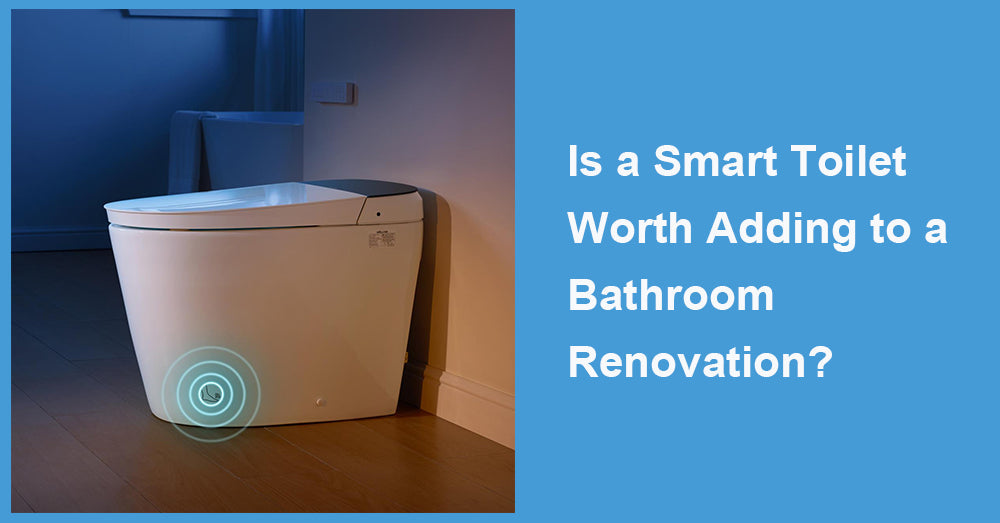
In recent years, amid the trend of high-end bathroom upgrades, smart toilet are gradually shifting from "novel technology" to a functional standard. Compared to traditional toilets, smart toilets integrate multiple functions, such as automatic flushing, warm-water cleaning, a heated seat, warm-air drying, night lighting, and a water-saving flushing system. Is it worth reserving budget and space for a smart toilet in a complete bathroom renovation? The answer is not simply 'yes' or' no ', but requires a comprehensive judgment based on space size, water efficiency, long-term maintenance costs, and user experience. Industry data shows that in the main bathroom renovation project, the proportion of smart toilets has been steadily increasing in recent years, and the installation rate in high-end renovations has approached or exceeded 50%.
1. Do the spatial dimensions match the installation conditions?
Smart toilets are usually integrated structures, measuring 27 to 30 inches long and 15 to 17 inches wide. Compared to traditional two-piece toilets, it has a more compact structure but a more complete shape.
The reserved depth for standard toilets is usually between 28 inches and 30 inches. If the space depth is less than 28 inches, the model should be carefully selected. The reserved space behind usually needs to be maintained at 1 to 2 inches for accommodate the water and power supply connections.
In addition, smart toilets require power support. The socket is usually installed at a distance of 12 to 18 inches from the ground and located within about 12 inches of the toilet's centerline. Data shows that reserving power in advance during the renovation phase can reduce the cost of later renovations by about 20%.
2. Has the comfort experience significantly improved?
The core functions of smart toilets are warm-water cleaning and seat heating. The temperature of the warm water spray can usually be adjusted between 95 ° F and 104 ° F, and the water pressure and angle can be personalized.
Survey data show that in households equipped with a warm-water cleaning function, satisfaction with use is about 25% higher than in households with traditional models. Especially during cold seasons, maintaining the heating seat between 86 °F and 95 °F can significantly enhance comfort.
For renovation projects that aim to improve quality of life, this comfort improvement often becomes a key decision-making factor.
3. Water saving performance and environmental advantages
Modern smart toilets use efficient flush systems, typically 1.28 gallons per flush (GPF), with some models below 1.0 GPF.
Compared to the earlier 3.5 GPF models, the water-saving efficiency can be improved by over 60%. Data show that in households with high daily usage, water-saving toilets can significantly reduce total water use each year.
The dual-level flushing system allows for the selection of flushing volume based on actual needs, improving resource utilization efficiency.
4. Hygiene and health factors
Automatic lid opening and closing, and induction flushing reduce the frequency of hand contact, helping improve the hygiene environment. Some models are equipped with UV nozzle cleaning or a self-cleaning coating design.
Research shows that in environments with automatic flushing and antibacterial design, the average surface bacterial load is reduced by about 15%.
The warm water cleaning function performs better in comfort and cleaning effect than using a simple tissue, which is also one of the reasons why smart toilets are widely recognized.
5. Energy consumption and operating costs
Smart toilets require a continuous power supply to maintain heating and sensing functions. The standby power is usually between 30W and 60W.
Data show that models operating in energy-saving mode have controllable annual power consumption, especially devices with an automatic sleep function, which consume less energy.
Choosing products with energy-saving certification during the renovation phase can balance comfort and long-term operating costs.
6. Maintenance and usage cycle
The internal structure complexity of smart toilets is higher than that of traditional models, so maintenance requirements are slightly higher. The filter element and nozzle need to be cleaned or replaced regularly.
Data shows that under normal maintenance conditions, the lifespan of smart toilets can exceed 10 to 15 years. Choosing reliable brands and high-quality materials can further reduce the failure rate.
In renovation projects, consideration should be given to the convenience of later maintenance, not just the initial price.
7. Is it suitable for all spaces?
Smart toilets are more suitable for main bathrooms or high-traffic areas, especially in layouts with an area exceeding 90 square feet, which are better coordinated with the overall design.
In compact guest bathrooms, if space is limited or budget is prioritized for other projects, the necessity can be evaluated based on usage frequency.
Data show that satisfaction with smart toilets is significantly higher in high-frequency usage areas than in low-frequency usage areas.
8. Investment return and trend judgment
The intelligentization of the bathroom has become a sustainable development direction. Industry data shows that the proportion of smart bathroom equipment in high-end residential renovation has been increasing year by year.
Although the initial cost is usually 20% to 40% higher than that of traditional models, it offers significant advantages in comfort, water conservation, and improved hygiene.
For renovation projects that prioritize long-term value and technological expertise, smart toilets are no longer a luxury option but a part of functional upgrades.

9. Conclusion
Whether to include smart toilets in the renovation depends on space conditions, budget planning, and expectations for comfort. From the 27-inch structure length to the 1.28 GPF water-saving standard, every inch size and flushing efficiency directly affect the user experience. If the power and pipeline layout is reasonably planned during the renovation phase, smart toilets can not only improve hygiene and comfort levels, but also bring more modern functional upgrades to bathroom spaces. Finding a balance between comfort, efficiency, and long-term value is the key to making rational choices.













Leave a comment
This site is protected by hCaptcha and the hCaptcha Privacy Policy and Terms of Service apply.