


















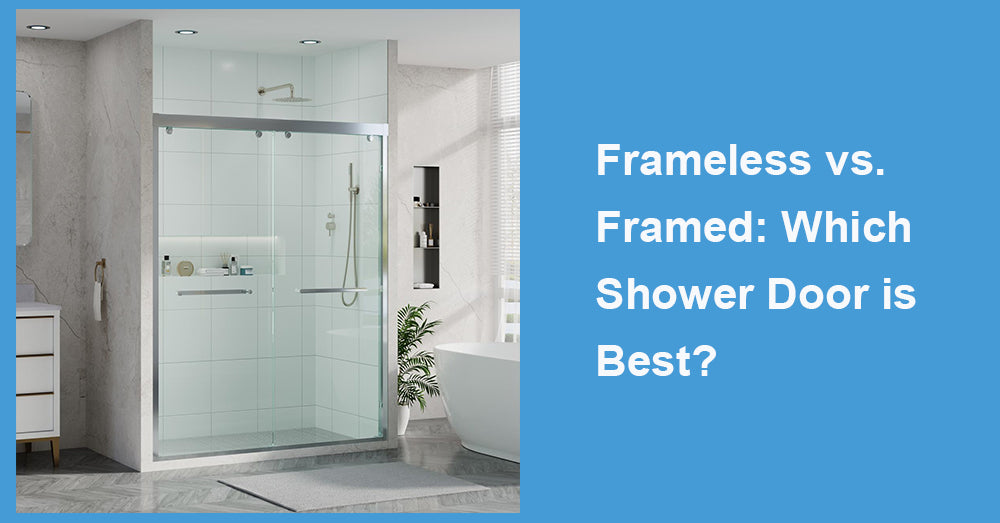
In modern bathroom renovations, the choice of shower door often determines the overall texture and user experience of the space. The structural form of glass doors not only affects visual effects, but also relates to Safety, maintenance costs, and long-term durability, from 60-inch standard shower rooms to 72-inch and above walk-in layouts. At present, the mainstream choices are divided into two types: Frameless and Framed. There are significant differences between the two in terms of glass thickness, sealing method, installation complexity, and price range. To determine which is "best", it is necessary to comprehensively evaluate the spatial conditions and actual usage needs.
1. Structural differences: Glass thickness determines stability
Framed shower doors typically use tempered glass 3/16 to 1/4 inch thick, with aluminum alloy or stainless steel frames for support and attachment. The frame bears the main structural forces, so the glass itself does not need to be too thick.
The Frameless structure relies on a glass body and heavy hardware to achieve stability. The common thickness is 3/8-inch or 1/2-inch. Taking a 30-inch-wide frameless swing door as an example, the weight of a single 1/2-inch-thick glass panel may exceed 70 lbs.
Test data shows that in 10000 simulated opening and closing tests, frameless glass doors with high-quality hinges above 3/8-inch have stability comparable to framed systems, but require higher hardware accuracy and wall load-bearing capacity.
2. Visual Effects: The Difference between Spatial Perception and Boundary Perception
The biggest advantage of a frameless structure is visual transparency. Due to the absence of obvious metal frames, the glass edges are more refined, which can significantly enhance the sense of openness in small shower rooms measuring 36 to 48 inches.
A design survey shows that in bathrooms with an area of less than 90 square feet, satisfaction with the openness of the space is about 20% higher with frameless structures than with framed structures.
A framed structure has clear boundaries and metal lines that complement other hardware accessories, making it more suitable for traditional or transitional style designs. Black or brushed metal frames have also become a popular trend in recent years.
3. Waterproof and sealing performance
Framed structures are typically equipped with a complete track system and rubber sealing strips at the bottom, thereby demonstrating high water-tightness. Especially in the 60-inch sliding door structure, the framed system offers stronger water-blocking performance.
The frameless system relies on transparent sealing strips and precise installation to achieve waterproofing. The data show that when wall flatness deviation is less than 1/4-inch, the Difference in waterproof performance between frameless systems and framed structures is not significant.
But in environments with old walls or uneven floors, framed structures are more fault-tolerant.
4. Difficulty in cleaning and maintenance
The bottom track of the framed structure is prone to water accumulation and scale buildup. Statistics show that in hard-water environments, the cleaning frequency of shower doors with tracks is about 25% higher than that of frameless shower doors.
The frameless structure has fewer metal frames, making cleaning relatively easy. But if thick glass is not coated with a waterproof sealant, water stains may be more noticeable.
In recent years, glass products with nanowaterproof coatings have gradually become popular, reducing the scale adhesion rate by about 40% to 50%.
5. Difference between installation cost and budget
In terms of price, framed structures usually have a cost advantage. The overall budget for standard 60-inch sliding door framed products is usually 20% to 35% lower than that of frameless structures of the same size.
The frameless system is relatively expensive due to increased glass thickness and higher hardware costs. Especially in walk-in shower spaces above 72 inches, using 1/2-inch-thick glass and customized hinges will further increase the budget.
However, from a long-term maintenance perspective, frameless structures have a slightly lower potential maintenance frequency due to their simple structure.
6. Safety and durability
Both structures use tempered safety glass. The impact strength of tempered glass is usually more than 4 times that of ordinary glass. Even if it ruptures, it will shatter into small particles, reducing the risk of injury.
The framed structure provides additional protection for the edges of the glass, making it safer in the event of accidental collisions; The edge of frameless glass is exposed, so higher processing accuracy is required.
Data shows that in long-term use environments, high-quality frameless systems have little Difference in durability compared to framed structures, but maintaining hinges and hardware is particularly important.
7. Suggestions for adapting to different spaces
In compact shower rooms ranging from 36 inches to 48 inches, frameless structures can maximize visual spatial awareness; In the 60-inch standard sliding door layout, the framed structure is more cost-effective and stable.
In open walk-in designs above 72 inches, frameless fixed glass and simple hardware are more in line with modern trends.
If the budget is limited or the wall conditions are complex, a framed structure is a more reliable choice; If pursuing minimalism and high-end texture, a frameless structure is more attractive.

8. Conclusion
The Frameless and Framed shower door structures each have their own advantages. Borderless emphasizes transparency and modernity, while framed emphasizes stability and cost control. From 3/16-inch to 1/2-inch glass thickness, from a 60-inch by 60-inch standard structure to a 72-inch by 72-inch wide layout, each choice should be based on spatial conditions, budget planning, and maintenance capabilities. Only by understanding the structural differences and usage scenarios can we find a truly balanced solution between functionality, Safety, and aesthetics.












Leave a comment
This site is protected by hCaptcha and the hCaptcha Privacy Policy and Terms of Service apply.