






















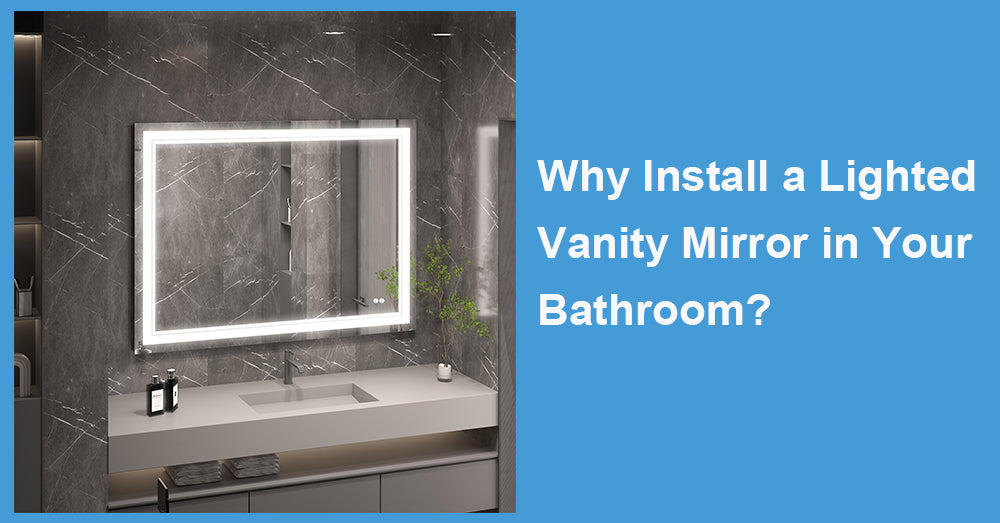
In bathroom renovations or lighting upgrades,lighted vanity mirror are gradually shifting from a "design bonus" to a core functional feature. Compared with traditional lighting methods that rely solely on ceiling or side wall lights, illuminated bathroom mirrors significantly improve visibility during daily grooming, shaving, and tidying details through a lighting layout closer to the user's perspective. From an industry perspective, the significance of installing illuminated bathroom mirrors lies not in visual novelty but in whether it truly enhances the efficiency and long-term comfort of bathroom use.
1. The pain point of bathroom lighting often comes from "incorrect light position."
In many bathrooms, even when overall lighting brightness is not low, users still feel the light in the washing area is insufficient. The root cause of this problem is not the inadequate number or power of lighting fixtures, but rather the unreasonable position of the light source.
Traditional ceiling lights are usually located above or behind the head, and the light is easily blocked by the body when it shines on the face, creating shadows on the face and countertop areas. Especially in scenes that require fine observation, these shadows will be constantly magnified. The illuminated bathroom mirror fundamentally solves this long-standing problem by placing the light source around the mirror surface or at the back of the mirror, allowing it to shine on the user from the front.
2. How can front lighting enhance overall brightness
From a lighting principles perspective, the perception of spatial brightness by the human eye largely depends on the lighting conditions within the line of sight. The illuminated bathroom mirror provides uniform, continuous front lighting rather than single-point highlights.
Industry research shows that under the same environmental brightness conditions, front lighting can significantly improve the clarity of the face and operating area, making the space appear brighter and neater. This is also why, in bathrooms with mature lighting systems, illuminated mirrors often serve as core functional lighting.
3. The relationship between mirror size and lighting effect
Whether illuminated bathroom mirrors can truly improve lighting effects is closely related to the size of the mirror surface.
In practical applications, the standard mirror widths in the washing area are typically 30 to 48 inches, and the heights are generally 26 to 32 inches. This size range can cover the main line of sight area of standing users and provide stable light diffusion in both horizontal and vertical directions.
If the mirror size is too small, even with lighting, its illumination coverage will be limited, making it challenging to brighten the overall space significantly.
4. The actual impact of color temperature control on user experience
A critical advantage of bathroom mirrors with lights is the ability to control color temperature. Different color temperatures will directly affect the spatial atmosphere and visual experience.
Warmer lighting is more suitable for relaxing environments in the morning and evening, while cooler lighting has advantages in detail presentation and clarity. The adjustable color temperature range is typically 3000K to 6000K, covering most daily use scenarios.
This flexible color temperature adjustment allows the bathroom to maintain a suitable brightness at different times and for other needs.
5. Adjustable brightness is more important than "maximum brightness."
In high-reflectivity spaces, such as bathrooms, excessive light can easily cause glare, reducing comfort. Therefore, whether the brightness is adjustable is often more important than the maximum brightness itself.
Bathroom mirrors with lights usually support multiple brightness levels, allowing users to adjust light intensity as needed. When used in the morning or at night, lower brightness is softer; When delicate operation is required, the brightness can be increased.
This controllability is an advantage that traditional fixed lighting fixtures cannot provide.
6. Synergistic effect with the overall lighting system
Installing bathroom mirrors with lights does not mean that other lighting fixtures can be eliminated. A more reasonable solution is to have different light sources perform their respective duties.
In a mature bathroom lighting layout, the ceiling light is responsible for the overall ambient brightness. In contrast, the illuminated bathroom mirror provides functional lighting for the washing area. The synergy between the two can reduce the burden on a single light source and improve the balance of light distribution.
This multi-level lighting structure is more stable and better aligned with practical usage logic in the long term.
7. The implicit influence of mirror structure and border design
The structural design of mirrors can also affect the lighting effect. Borderless or extremely narrow border design is more conducive to the complete diffusion of light and reduces obstruction.
On the contrary, although thick or dark borders are decorative, they may reduce light diffusion efficiency, partially offsetting the lighting advantage of the illuminated mirror. In bathrooms that emphasize practicality, mirror integrity is often more important than complex decoration.

8. Long-term value of energy efficiency and service life
According to industry data, LED light sources offer significant advantages in energy efficiency and lifespan. Under reasonable usage conditions, its stable service life can usually reach 10-15 years, with slow brightness attenuation.
This means that illuminated bathroom mirrors not only improve the lighting experience in the early stages but also maintain relatively stable performance over the long term, reducing maintenance and replacement frequency.
9. Conclusion
Installing a bathroom mirror with lights is not to make the bathroom look more upscale, but to achieve a more reasonable and efficient lighting experience. Through front lighting, adjustable brightness and color temperature, and synergy with the overall lighting system, illuminated vanity mirrors can significantly enhance the brightness, practicality, and comfort of the bathroom without increasing complexity. In rational planning for bathroom renovation, it is often a highly cost-effective choice.








































Leave a comment
This site is protected by hCaptcha and the hCaptcha Privacy Policy and Terms of Service apply.