






















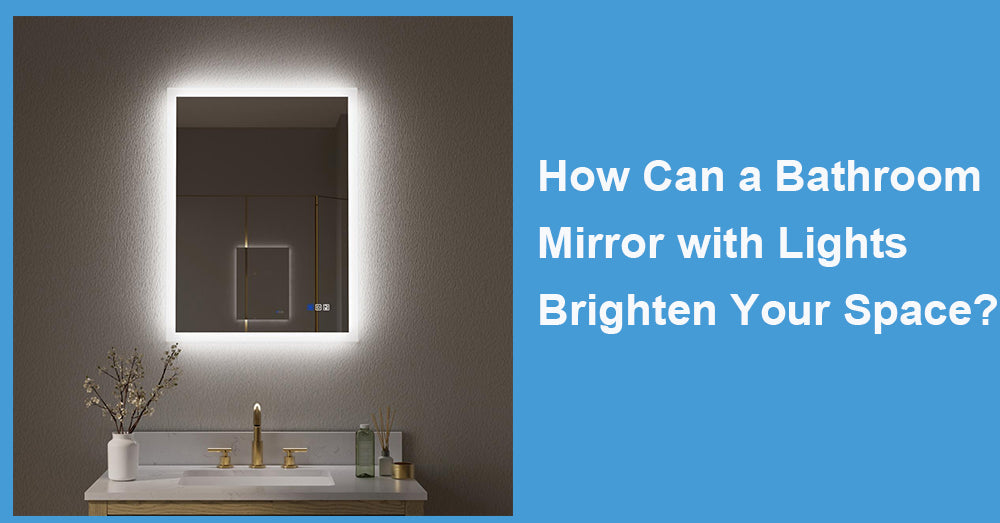
In bathroom renovations or lighting optimization, bathroom mirror with lights are increasingly becoming an essential feature for enhancing space brightness and the user experience. Unlike traditional lighting methods that rely solely on ceiling or wall lights, the use of illuminated mirrors significantly improves the bathroom's overall visual brightness and functionality by redirecting and redistributing light without adding complex structures. From an industry perspective, it is not simply about "brighter", but about making light more effectively serve space and users.
1. The root cause of dim bathrooms is often not insufficient lighting
In many bathrooms, even with brightly lit ceiling lights installed, the space still appears dark or poorly layered. The fundamental reason is not insufficient lighting intensity, but rather an unreasonable position of the light.
Traditional ceiling lights are located above or behind the head, and the light is easily blocked by the body, creating shadows on the face and countertop areas. These shadows will be repeatedly perceived during washing, shaving, or tidying up details, thereby reducing the overall brightness experience. The core function of the illuminated mirror is to fill this long-neglected gap in front lighting.
2. How to amplify the spatial brightness perception with a frontal light source
From an optical perspective, the perception of spatial brightness by the human eye largely depends on the lighting conditions of the face and the line of sight. Mirrors with lights usually emit light uniformly in front of the user by surrounding the mirror surface or the back of the mirror.
Industry research shows that this uniform, positive lighting method can make the space appear brighter, cleaner, and more orderly without significantly increasing overall illuminance. This is also why, with the same number of lighting fixtures, bathrooms equipped with mirrors often have a more transparent feel.
3. The mirror size determines the range of light diffusion
Whether the illuminated mirror can truly "brighten up the space" depends on the size of its surface.
In practical applications, the standard width of the primary washing area mirror is 30-48 inches, and the height is mainly 26-32 inches. This size range not only covers the main line of sight for standing users but also provides sufficient area for the horizontal and vertical diffusion of light.
If the mirror is too small, it will limit light coverage and limit the lighting effect to a specific area; a mirror of a reasonable size can allow light to participate more deeply in the brightness composition of the entire space through reflection and diffusion.
4. The influence of color temperature selection on spatial atmosphere
A critical advantage of having a light mirror is its ability to control color temperature. Different color temperatures not only affect the brightness perception, but also alter the spatial atmosphere.
A warm color temperature is more conducive to creating a relaxed, gentle environment, suitable for use in the morning or at night. The cooler color temperature offers greater clarity and detail presentation and is more ideal for periods that require delicate operation. The adjustable color temperature range is typically 3000K to 6000K, covering most use cases.
Reasonable color temperature adjustment can provide different brightness levels in a space at other times without changing the number of lighting fixtures.
5. Brightness adjustment is more practical than "fixed brightness."
In a high-reflectivity bathroom environment, excessive light can easily cause glare and reduce comfort. Therefore, the adjustability of brightness is more important than the maximum brightness itself.
Mirrors with lights usually support multiple brightness levels, allowing users to adjust light intensity to suit their environment and needs. Under low-brightness conditions, the space appears soft and not glaring; at high brightness, it meets the requirements for delicate operation.
This flexibility ensures that the space maintains appropriate brightness in different usage scenarios.
6. The collaborative relationship between illuminated mirrors and overall lighting
The use of illuminated mirrors does not replace other lighting equipment; rather, it complements overhead lights or auxiliary lighting fixtures.
In mature lighting layouts, overhead lights are responsible for providing overall ambient brightness, while illuminated mirrors are responsible for functional lighting in critical areas. The synergy between the two can reduce the burden of a single light source and make the spatial brightness distribution more balanced.
Industry practice has shown that this multi-level lighting structure is more conducive to long-term use and easier to create a comfortable spatial experience.
7. The implicit role of mirror structure and border design
The structural design of mirrors can also affect brightness performance. Mirrors with no borders or extremely narrow borders are more conducive to the complete diffusion of light and reduce occlusion.
On the contrary, although thick or dark borders are decorative, they may reduce light diffusion efficiency, partially offsetting the lighting advantage of the illuminated mirror. In bathrooms that emphasize spatial brightness, mirror integrity is often more critical than decorative complexity.

8. Energy efficiency and stability in long-term use
According to industry data, LED light sources offer significant advantages in energy efficiency and lifespan. Under normal usage conditions, its stable service life can usually reach 10-15 years, with slow brightness attenuation.
This means that illuminated mirrors can not only significantly improve spatial brightness in the initial stage but also maintain relatively stable lighting performance over the long term, reducing the need for frequent replacement or maintenance.
9. Conclusion
Wearing a mirror with lights is not simply adding lights to the mirror, but rather using more reasonable light direction, distribution, and control methods to maximize the spatial value of limited light sources. Through front lighting, adjustable brightness and color temperature, and coordination with the overall lighting system, bathroom mirrors with lights can make bathroom spaces appear brighter, clearer, and more comfortable without increasing complexity. In rational planning for bathroom renovation, it is often a highly cost-effective choice.









































Leave a comment
This site is protected by hCaptcha and the hCaptcha Privacy Policy and Terms of Service apply.