






















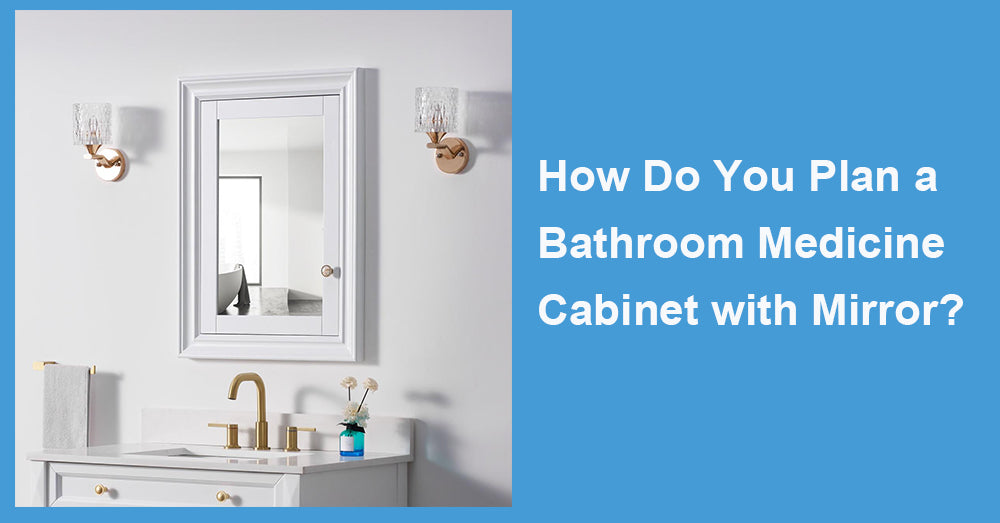
In bathroom renovations or functional reconstructions, the bathroom medicine cabinet with mirror is often considered a standard component that can be installed and used immediately. However, from an industry perspective, the mirror cabinet is actually a system configuration that requires advanced planning. It is not just a simple combination of mirrors and storage space, but a core unit deeply involved in the flow of washing, spatial order, and long-term use efficiency. If there is inadequate planning, even if the product itself has excellent quality, it isn't easy to realize its actual value in practical use.
1. Before planning a mirror cabinet, its role in the bathroom should be clearly defined
In the planning phase, the first question is not whether to install a mirror cabinet, but what role it plays in the entire bathroom.
In most bathrooms, the mirror cabinet serves three core functions simultaneously: a daily mirror, centralized storage for high-frequency items, and visual integration with the washing area. If the mirror cabinet is only regarded as a "storage supplement, it often underestimates its impact on the overall layout and user experience.
Industry experience shows that when mirror cabinets are included in overall planning rather than added later as restocks, satisfaction with use and space utilization is significantly higher.
2. The size of the mirror cabinet should be derived in reverse from the scale of the washing area
The core of mirror cabinet planning is size matching, rather than simply pursuing larger capacity.
The common washbasin width is 30-48 inches, and the mirror cabinet width should usually be close to or slightly smaller than the countertop width to maintain visual stability. If the mirror cabinet is significantly narrower than the countertop, it can appear unbalanced in proportion; if it is too wide, it can create visual and installation pressure.
In terms of height, most mirror cabinets measure 26-32 inches. This height range can cover the main line of sight of standing users and reserve reasonable space for internal storage structures. When planning, one should avoid unthinkingly pursuing higher mirror cabinets, as the top space is often underutilized in actual use.
3. Embedded or wall-mounted, an early decision should be made
The installation method for the mirror cabinet is an important issue that must be clarified during the planning phase.
Embedded mirror cabinets require reserved space inside the wall, and the cabinet depth is usually set at 4-5 inches. This structure is visually smoother, helps to keep the walls clean, and also reduces the sense of spatial pressure. But it has higher requirements for wall structure, pipeline routing, and the construction phase. It is more suitable for inclusion in the overall plan at the early stage of renovation.
Wall-mounted mirror cabinets offer greater construction flexibility and lower requirements for wall modifications, making them suitable for later upgrades or partial renovations. But special attention needs to be paid to depth control and fixing methods during planning, or it may affect traffic and operational comfort in the washing area.
4. The depth planning of the mirror cabinet determines the comfort level of use
The depth of the mirror cabinet is the most easily overlooked factor in planning, but it has a significant impact on the experience.
In most bathroom layouts, controlling the depth of the mirror cabinet at 4-6 inches is more conducive to maintaining spatial balance. If the depth is too large, users may feel a sense of distance pressure when washing, especially in compact bathrooms.
Reasonable planning should strike a balance between "sufficient storage" and "not interfering with the flow, rather than simply pursuing maximum capacity.
5. The internal structure should be planned around high-frequency items
The focus of mirror cabinet planning is not on how much it can hold, but on whether it is easy to use.
Industry practice has shown that a reasonably layered shelf system is more efficient than a single ample space. Commonly used items should be placed within the line of sight height range, while low-frequency or bulky items can be placed in lower or corner positions.
The adjustable shelf structure is fundamental in the planning stage, as it can reserve adjustment space for future changes in usage habits and extend the service life of the mirror cabinet.
6. Planning logic for the structure and opening method of the mirror cabinet doors
The design of the mirror cabinet door directly affects the smoothness of daily operations.
For narrow mirror cabinets, a single-door design is simpler and more conducive to stable installation. The mirror cabinet with a larger width adopts a double- or multi-door structure, which can distribute the door weight and reduce the risk of deformation during long-term use.
When planning, consideration should also be given to whether the direction of door opening will interfere with other functional areas, such as the relationship with faucets, lighting fixtures, or wall edges.
7. Do lighting and anti-fog functions need to be included in the planning in advance
In recent years, mirror cabinets with lighting and anti-fog features have become increasingly popular, but whether they are needed should be determined during planning based on usage habits.
If mirror cabinet lighting is used as the main functional lighting, consider whether the light distribution is uniform and whether it supports brightness or color temperature adjustment. The anti-fog function is handy in high-humidity environments, as it can reduce waiting time due to mirror fogging.
Once such functions are included in the plan, the power supply location and safety requirements must be considered simultaneously, so it is not advisable to make temporary decisions in the later stages of installation.
8. The importance of mirror quality for long-term planning
In the long-term use cycle, mirror quality is often more important than cabinet appearance.
High-quality mirrors are less prone to darkening, edge corrosion, or image distortion in long-term high-humidity environments, which directly affects whether the mirror cabinet can maintain a stable experience within its 8-12-year service life.
In the planning phase, priority should be given to durable, moisture-resistant structures rather than to short-term visual effects.

9. The significance of mirror cabinet planning from the perspective of the overall renovation cycle
From an industry perspective, bathroom renovations are usually large-scale decisions that take 10-15 years to complete, while mirror cabinets, as highly integrated fixed equipment, have higher replacement costs.
This means that mirror cabinet planning is not a one-time installation decision, but a long-term usage arrangement. Planning the size, structure, and functionality often has a cost advantage over later adjustments.
10. Conclusion
Planning a truly functional bathroom mirror cabinet is not simply about choosing a suitable size product, but about making systematic decisions based on spatial conditions, usage habits, and long-term maintenance. From installation methods to deep control, from internal structure to functional configuration, every planning detail will be continuously validated in daily use. Rational planning of the bathroom medicine cabinet with a mirror is often a key step in improving the bathroom's overall efficiency and sense of order.









































Leave a comment
This site is protected by hCaptcha and the hCaptcha Privacy Policy and Terms of Service apply.