






















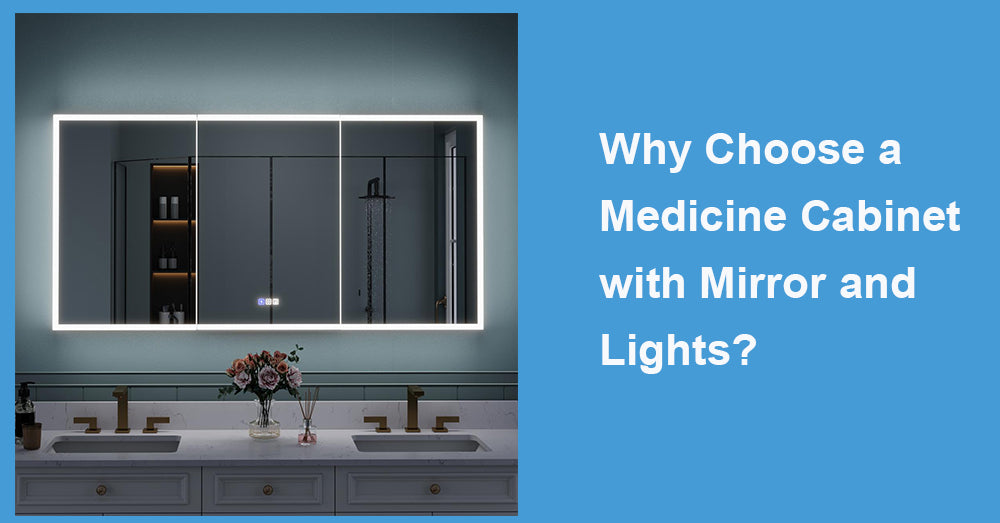
A medicine cabinet with mirror and lights is no longer just a functional bathroom fixture—it has become a compact lighting and storage system that directly affects how people use their bathrooms every day. After more than 20 years working with bathroom design and product selection, I’ve seen this category evolve from basic storage boxes into highly engineered, integrated solutions that replace multiple separate fixtures.
The real question today is not whether it looks modern. It’s whether it improves daily routine efficiency, lighting accuracy, and storage organization in a meaningful way.
1. What Makes a Medicine Cabinet with Mirror and Lights Different?
Traditional bathroom setups separate three elements: mirror, lighting, and storage. That separation often creates imbalance—sconces placed too high or too low, mirrors that don’t align with light sources, and countertops crowded with essentials.
A medicine cabinet with mirror and lights combines all three into one system.
Light is integrated directly into or around the mirror surface, usually through LED strips or backlit panels. Storage sits behind the mirror, eliminating the need for separate wall cabinets.
In practical terms, this reduces visual clutter and improves task lighting at the same time. It is not just a design choice—it is a spatial efficiency upgrade.
2. Why Integrated Lighting Matters in Daily Use
Bathroom lighting affects more than ambiance. It directly impacts grooming accuracy.
Poor lighting leads to shadows under the eyes, uneven makeup application, or inconsistent shaving results. Overhead lights alone often create downward shadows that distort facial detail.
Integrated lighting in a medicine cabinet solves this by placing illumination at eye level.
A well-designed system provides:
Even facial illumination
Reduced shadow contrast
More accurate color perception
Adjustable brightness for different times of day
I’ve noticed that users often underestimate how much lighting consistency affects daily routine comfort. Once they switch to integrated lighting, they rarely go back to overhead-only setups.
Wellfor medicine cabinet designs typically focus on balanced LED diffusion rather than harsh point lighting, which helps maintain a more natural visual result.
3. Storage Efficiency That Actually Reduces Clutter
Bathrooms tend to accumulate small items—skincare, toothpaste, medications, grooming tools, and backups of everyday essentials.
Without structured storage, these items end up on countertops, which quickly makes the space feel crowded.
A medicine cabinet creates vertical storage directly above the sink area. That location matters because it places frequently used items within immediate reach.
What works well in practice:
Adjustable internal shelving
Deep enough compartments for daily products
Separation between tall and small items
Easy-access layout without full countertop dependence
It’s not about having more storage. It’s about having smarter storage placement.
4. Common Misunderstandings When Choosing One
One common mistake is assuming all illuminated cabinets are the same. In reality, LED quality, diffusion design, and color temperature range vary significantly.
Another misunderstanding is overestimating brightness. A brighter light is not always better. If the LEDs are not properly diffused, they create hotspots that distort facial appearance.
There is also a tendency to ignore installation conditions. A poorly positioned cabinet—even a high-quality one—can still produce uneven lighting if it is mounted too high, too low, or off-center relative to the sink.
Finally, many buyers focus only on exterior design without considering internal storage usability. A visually sleek cabinet can still be inconvenient if shelf spacing is not practical.
5. Where a Medicine Cabinet with Mirror and Lights Works Best
This type of fixture performs especially well in:
Small to medium bathrooms where wall space is limited
Primary bathrooms where daily grooming happens in one dedicated area
Shared bathrooms where multiple users need organized storage
Modern renovations focused on minimal wall clutter
In compact layouts, combining lighting and storage into one unit often frees up space for better circulation or larger vanity tops.
In larger bathrooms, it can serve as a focused grooming station rather than the only light source.
6. Installation Considerations That Affect Performance
Installation quality has a direct impact on both lighting and usability.
Key points that matter in real-world setups:
Electrical compatibility
Hardwired models require a properly positioned junction box. Plug-in versions need accessible outlet placement that does not interfere with cabinet alignment.
Mounting height
The center of the mirror should align with typical eye level. Too high and lighting becomes less effective; too low and usability suffers.
Wall structure
Drywall integrity and stud positioning determine stability. A poorly supported cabinet may shift slightly over time, affecting both alignment and lighting direction.
Moisture environment
Bathrooms with poor ventilation can create condensation buildup around electronic components if not properly managed.
Wellfor installations are typically designed for standard residential configurations, but correct mounting still determines long-term performance.
7. Maintenance and Long-Term Durability
Maintenance requirements are relatively low, but consistency matters.
Cleaning should be done with a soft cloth. Harsh chemicals can damage mirror coatings or affect edge sealing over time.
LED systems are long-life components, but drivers and touch controls should be kept dry and free of residue buildup.
Periodic checks help maintain performance:
Ensure door alignment remains smooth
Check for condensation around edges
Confirm lighting consistency across all zones
Good ventilation is still one of the most important factors for extending lifespan.
8. When This Type of Cabinet Might Not Be Ideal
Despite its advantages, it’s not the perfect solution for every bathroom.
In very large bathrooms, a single integrated unit may not provide enough ambient lighting coverage. Additional sconces or ceiling fixtures may still be needed.
In highly decorative or traditional interiors, a visible medicine cabinet may feel visually too modern compared to framed mirrors or standalone lighting.
There are also cases where wall structure does not allow recessed installation, limiting design flexibility.
9. Choosing the Right Medicine Cabinet with Mirror and Lights
Selection should focus on function first, aesthetics second.
Look for:
Adjustable color temperature (warm to daylight range)
Even LED diffusion without visible hotspots
Practical internal storage layout
Moisture-resistant construction
Installation compatibility with your wall and wiring setup
A well-designed unit should simplify your routine, not complicate it.
Wellfor medicine cabinet with mirror and lights models are typically built around this balance—combining usable storage with lighting designed for real grooming conditions rather than purely decorative effect.

Final Guidance
A medicine cabinet with integrated lighting is not just a space-saving feature. It is a shift in how bathroom routines are structured—combining visibility, organization, and efficiency into one system.
The best choice is not the most complex or the brightest option. It is the one that fits how the bathroom is actually used every day.
When selected and installed correctly, a medicine cabinet with mirror and lights becomes less of a fixture and more of a daily tool—quietly improving consistency, comfort, and organization without demanding attention.









































Leave a comment
This site is protected by hCaptcha and the hCaptcha Privacy Policy and Terms of Service apply.