






















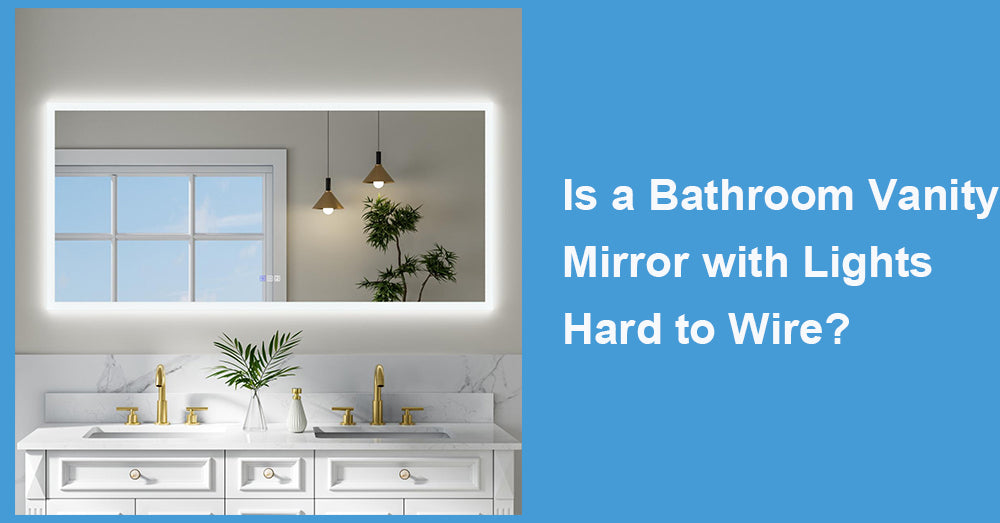
A bathroom vanity mirror with lights has become a common upgrade in modern bathroom renovations, especially for users who want integrated lighting without adding wall sconces. But when it comes to installation, one question comes up repeatedly: is it actually hard to wire, or just perceived as complicated?
The honest answer is that wiring difficulty depends less on the mirror itself and more on your existing electrical setup, wall conditions, and whether the unit is plug-in or hardwired. In most cases, the wiring is not technically complex—but it does require attention to safety, compatibility, and code compliance.
From an industry standpoint, LED mirrors are shifting from “decorative accessories” to “electrical fixtures,” which means installation expectations are also rising.
1. Plug-in vs hardwired makes the biggest difference
The first thing to understand is that not all LED mirrors are wired the same way.
A plug-in bathroom vanity mirror with lights is essentially an appliance. You mount it and connect it to a standard outlet (typically 110–120V in most residential setups). In this case, wiring is minimal—there is no need to open walls or connect to junction boxes.
A hardwired mirror, however, connects directly to household electrical wiring through a junction box behind the wall. This requires matching line, neutral, and ground connections, and must comply with local electrical code requirements.
Industry observation: more than half of installation complications come from users choosing a hardwired mirror without confirming whether a junction box is already available behind the vanity wall.
2. Wall junction box availability is the real challenge
In new construction, electricians typically install a junction box above the vanity at a standard height of around 60 in to 66 in from the floor, depending on design layout.
In older bathrooms, that box may not exist at all—or may be positioned off-center relative to the mirror.
According to general residential electrical guidelines referenced in the National Electrical Code (NEC), all permanently installed bathroom lighting fixtures must be connected to an accessible junction box (Source: NFPA/NEC).
If no junction box is available, installation becomes significantly more complex because it requires opening drywall and running new wiring.
This is where most “hard wiring” difficulty actually comes from—not the mirror itself, but the wall infrastructure behind it.
3. LED drivers add a second layer of wiring logic
Unlike traditional lighting, LED mirrors include a driver that converts household AC voltage into low-voltage DC power.
This means the installation is not just “black wire to black wire.” It is a system involving:
· incoming line voltage (110–120V)
· LED driver conversion
· low-voltage output to the light strip
DOE lighting guidance notes that LED performance and stability depend heavily on driver quality and electrical load compatibility (Source: U.S. Department of Energy).
If the driver is built into the mirror housing, installation is simpler. If it is external, installers need to ensure it is properly concealed and ventilated.

4. Moisture environment requires extra safety awareness
Bathrooms are classified as high-moisture environments, which changes wiring expectations compared to standard rooms.
The U.S. Consumer Product Safety Commission (CPSC) emphasizes the use of ground-fault circuit interrupter (GFCI) protection in bathroom electrical circuits to reduce shock risk near water sources (Source: CPSC).
In practical terms, this means your mirror should either be:
· connected to a GFCI-protected circuit, or
· plugged into a GFCI outlet
This is not about difficulty—it is about compliance and safety.
5. Dimmer compatibility often gets overlooked
Another common issue is connecting LED mirrors to incompatible wall dimmers.
Older dimmers designed for incandescent bulbs can cause LED flickering, unstable brightness, or delayed startup. LED mirrors typically require compatible electronic dimmers or must be used with built-in touch controls instead.
Industry judgment: many “wiring problems” reported by users are actually control compatibility issues, not wiring errors.
6. Installation difficulty in real-world terms
From a contractor perspective, wiring difficulty can be broken down into three levels:
A plug-in mirror with an existing outlet nearby:
· Low difficulty
· 10–30 minutes installation time
A hardwired mirror with an existing junction box:
· Moderate difficulty
· 30–90 minutes depending on alignment
A hardwired mirror without a junction box:
· High difficulty
· Requires electrical modification and drywall repair
So the mirror itself does not determine difficulty—the wall condition does.
7. When professional installation is recommended
Even though many LED mirrors appear simple, there are cases where professional installation is strongly recommended:
· No existing junction box
· Unclear wiring behind the wall
· Need to install a new circuit or GFCI protection.
· Large mirrors over 48 in wide with heavy mounting systems
· Integrated features like defoggers, speakers, or smart controls
Industry practice shows that multi-function LED mirrors have more connection points, which increases the chance of incorrect wiring if installed without experience.
Final takeaway
A bathroom vanity mirror with lights is not inherently hard to wire—but it becomes more technical depending on your setup.
If you are working with a plug-in model and a nearby outlet, installation is straightforward. If you are dealing with a hardwired system, the complexity depends almost entirely on whether your wall already supports it.
The key insight from industry practice is simple: wiring difficulty is rarely about the mirror design itself. It is about infrastructure readiness—junction boxes, circuit protection, and compatibility with existing electrical systems.
In modern bathroom design, LED mirrors are easy to install when planned correctly, but less forgiving when treated as a last-minute upgrade.










































Leave a comment
This site is protected by hCaptcha and the hCaptcha Privacy Policy and Terms of Service apply.