






















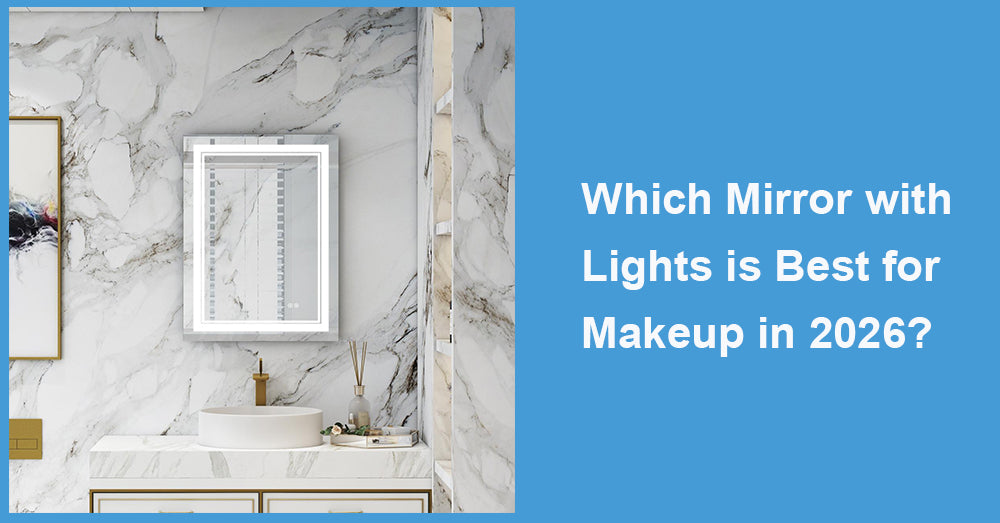
A mirror with lights has become one of the most practical upgrades for modern makeup routines. In 2026, it is no longer just a decorative bathroom feature. It directly affects how foundation blends, how contour appears in natural daylight, and how accurately color is judged before leaving the house. After working with bathroom lighting systems and reviewing countless vanity setups, I have found that the “best” makeup mirror is rarely the brightest one. It is the one that reproduces light consistently and supports real daily routines without distortion.
1. What Makes a Mirror with Lights Good for Makeup?
Makeup application depends on light quality more than most people realize. A strong overhead bulb can still cast shadows under the eyes and nose. A good illuminated mirror solves that problem by placing light closer to the face and distributing it more evenly.
The key factor is color accuracy. A mirror with a high CRI (Color Rendering Index) of 90 or above will show skin tones and makeup shades closer to natural daylight. Lower CRI lighting often creates subtle errors—foundation can look slightly warmer or cooler than it really is once you step outside.
Brightness control is equally important. Full brightness is useful for detail work like eyeliner or brow shaping, but softer settings are more comfortable for everyday routines. A fixed brightness mirror tends to feel too harsh or too dim depending on the time of day.
Placement matters as well. Side lighting or perimeter lighting reduces facial shadows more effectively than a single top light. This is why professional makeup stations rarely rely on one light source.
2. The Most Important Features for Makeup Accuracy
Not all illuminated mirrors are designed with makeup use in mind. Some are focused on ambiance rather than precision.
The first feature worth prioritizing is adjustable color temperature. A range from warm to neutral to daylight (typically 3000K–6000K) allows users to test how makeup will appear in different environments. Neutral daylight settings are usually the most reliable for application.
The second is even light diffusion. LED dots that are visible through the mirror surface can create uneven hotspots, which interfere with detailed work. A frosted diffuser panel or backlit design tends to produce more consistent lighting.
Magnification and Task Precision
Magnification mirrors are often overlooked but extremely useful. A 3x to 5x magnification zone helps with eyeliner, eyebrow shaping, and concealer placement. However, too much magnification can distort perspective, especially when used too close to the face.
I have seen many users rely entirely on magnified views and later notice mismatched blending in normal distance lighting. The best setup combines both: a full reflection plus a controlled magnified section.
Wellfor illuminated mirror designs typically integrate these functions in a balanced way, avoiding excessive magnification that disrupts overall facial proportion judgment.
3. Common Mistakes When Choosing a Makeup Mirror with Lights
One frequent mistake is choosing a mirror based only on brightness. Higher lumen output does not automatically mean better makeup results. Overly bright lighting can wash out skin tones and make blending harder to judge.
Another issue is ignoring room lighting. A well-designed mirror still works best when the bathroom has supportive ambient lighting. Relying on the mirror alone can create contrast that feels unnatural when stepping into other rooms.
Size is another overlooked factor. A mirror that is too small forces users to constantly reposition themselves, while an oversized mirror in a compact space may reflect too much surrounding clutter, distracting from the face.
I also see buyers underestimate installation complexity. Hardwired mirrors require proper electrical planning. Plug-in models are easier but may limit placement options depending on outlet location.
4. Where a Lighted Mirror Works Best in Real Life
The most effective use case is a dedicated vanity area or primary bathroom where daily grooming happens consistently. In this setting, lighting quality has a direct impact on routine accuracy.
It is also valuable in shared bathrooms. Multiple users benefit from consistent lighting rather than relying on different handheld mirrors or inconsistent overhead bulbs.
For travel or secondary bathrooms, a simpler tabletop mirror may be sufficient. In those cases, full wall installation is not always necessary.
There is also a psychological aspect. A stable lighting environment reduces second-guessing during makeup application. When lighting changes from day to day, users tend to over-correct foundation or contour.
5. Installation and Electrical Considerations
Most modern illuminated mirrors are either hardwired or plug-in. Hardwired installation offers a cleaner appearance, but it requires a proper junction box and should be handled by a qualified electrician.
Placement height is critical. The center of the mirror should align roughly with eye level for the primary user. Too high or too low positioning leads to awkward posture during close grooming tasks.
Wall flatness matters more than expected. Even slight uneven surfaces can create visual distortion or gaps behind the mirror frame. In renovation projects, this is something I always recommend checking before final mounting.
If the mirror includes defogging or touch controls, ensure there is sufficient ventilation and safe moisture clearance around the wiring zone.
6. Maintenance and Long-Term Performance
LED systems require little maintenance, but the mirror surface still needs regular care. Use a microfiber cloth and a mild cleaner rather than spraying directly onto the surface. This helps prevent moisture from reaching control edges or electrical components.
Touch sensors can accumulate residue from skincare products or makeup. A quick wipe keeps responsiveness consistent.
Color consistency over time is another factor. High-quality LED drivers maintain stable color temperature, while lower-end systems may slowly shift warmer or cooler after extended use. This becomes noticeable in makeup accuracy.
Defogging systems should not be left running continuously. They are designed for short cycles after showers, not constant operation throughout the day.

7. Choosing the Right Mirror with Lights in 2026
When comparing options, it helps to focus on function rather than appearance alone. The best mirror is not always the most visually dramatic one.
Look for three core qualities: accurate color rendering, adjustable brightness, and even light distribution. Everything else is secondary.
Size should match the vanity width and user distance. A mirror that is too wide can overwhelm a small space, while a narrow one may limit visibility during full-face makeup routines.
Wellfor mirror with lights models are typically designed with balanced lighting output and practical controls rather than unnecessary complexity, which aligns better with everyday grooming needs.
For most users in 2026, the right choice is a mirror that behaves like reliable daylight indoors—stable, adjustable, and consistent. Once that foundation is correct, makeup application becomes less about correcting lighting problems and more about focusing on detail and finish.







































Leave a comment
This site is protected by hCaptcha and the hCaptcha Privacy Policy and Terms of Service apply.